
Bland AI
✓ Editorially verifiedEnterprise voice AI for automated phone calls at scale
In short
Bland AI provides enterprise-grade voice agents for high-volume inbound and outbound calling in regulated sectors like healthcare and finance. It distinguishes itself through on-infrastructure deployment for compliance and sub-400ms response latency. It is best for organizations needing auditable, low-latency voice automation with strong contact-center integrations.
Regulated enterprises (healthcare, insurance, fintech, logistics) that need on-infrastructure voice agents for high-volume inbound or outbound calling with auditable QA.
Solo developers, hobbyists, or small startups wanting a cheap pay-as-you-go voice-agent API with published per-minute pricing and open model choice.
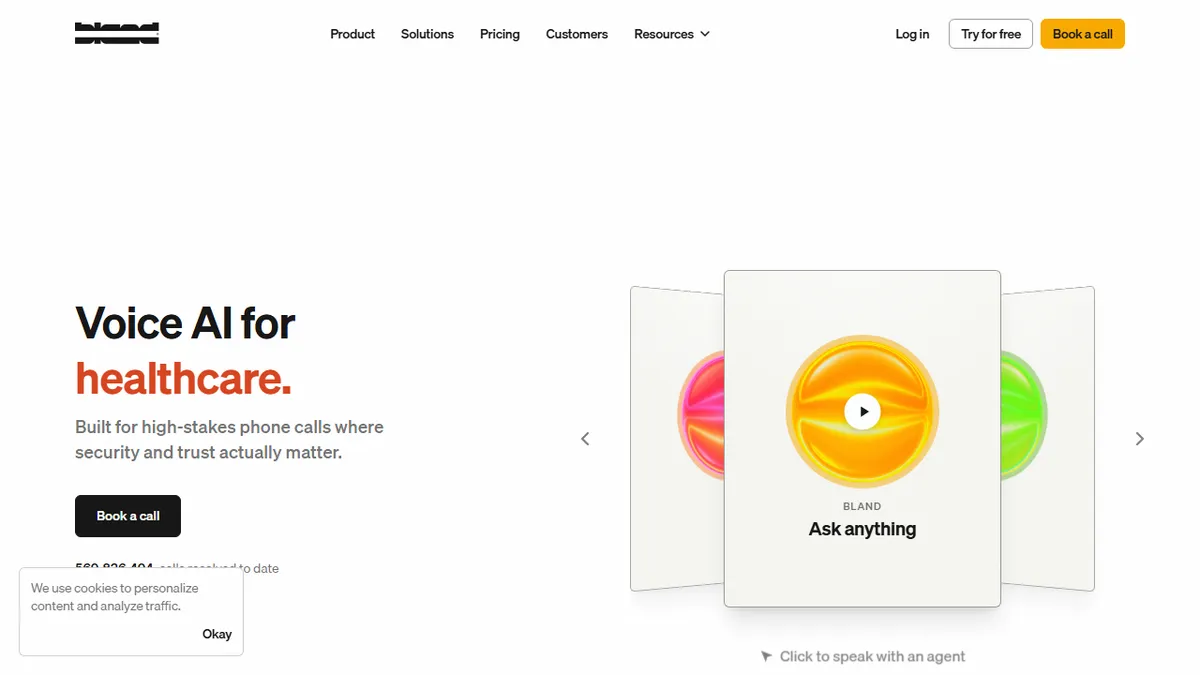
Bland AI is an enterprise-grade voice AI platform for building, deploying, and monitoring AI phone agents that hold natural, low-latency phone conversations at scale. It targets regulated industries — healthcare, insurance, financial services, and logistics — where compliance, on-infrastructure deployment, and QA observability matter as much as the underlying speech quality. Teams use Bland to automate outbound campaigns (appointment reminders, collections outreach, lead qualification, member re-engagement) and inbound flows (support triage, order status, intake, IVR replacement), with a unified agent that can move between voice, SMS, iMessage, and web chat while carrying shared context. The stack ships with an assistant called Norm that helps non-experts assemble production-ready agents through guided prompting rather than raw prompt engineering, plus scenario-based testing so agents can be regression-tested against hundreds of simulated calls before going live. Sub-400ms response latency, real-time call observability, and enterprise QA tooling make it usable for teams that need to explain and audit every conversation. Integrations cover the plumbing most contact centers already run — Twilio, Salesforce, HubSpot, Slack, Zapier, Genesys, and Five9 among others — and language coverage extends to 40+ languages with real-time translation in 23. Custom models are run on the customer's own infrastructure, which is the main differentiator versus general-purpose voice-agent APIs: no third party sees the calls, which is what makes it viable for HIPAA/PCI/regulated workloads.
Bland is one of the few voice-agent platforms genuinely built for regulated enterprise deployment rather than demo-friendly consumer flows — the on-infrastructure model story and sub-400ms latency are the real selling points. The trade-off is opacity: you cannot see the model, cannot see the price without a sales call, and you are betting on Bland's stack end-to-end. For a Fortune 500 contact center that is fine; for a scrappy team it is the wrong shape.
— The AI Tool Bible editorial team
Pros
- ✅ Sub-400ms voice latency keeps conversations feeling natural rather than turn-based
- ✅ Models can run on customer infrastructure, unlocking healthcare, financial services, and other regulated use cases
- ✅ Unified agent context across voice, SMS, iMessage, and web chat rather than siloed channels
- ✅ Scenario-based testing lets you regression-test agents against simulated calls before production
- ✅ Strong contact-center integration coverage (Twilio, Salesforce, HubSpot, Genesys, Five9, Zapier)
- ✅ 40+ language support with real-time translation across 23
- ✅ Norm assistant lowers the barrier for non-specialists to build production agents
Cons
- ⚠️ Pricing is not transparent; per-minute rate and enterprise tiers require contact-sales
- ⚠️ Underlying model family is proprietary and undocumented, limiting portability and evaluation
- ⚠️ Enterprise positioning and self-hosted deployment options are overkill for hobbyists or small pilots
- ⚠️ No open-source components; you are locked into Bland's platform for orchestration and telephony glue
- ⚠️ Public documentation of hard limits (concurrent calls, rate limits, latency guarantees) is thin outside of sales conversations
Use cases
Frequently asked
- Which industries is Bland AI designed for?
- Bland AI targets regulated industries such as healthcare, insurance, financial services, and logistics. It supports these sectors by allowing custom models to run on the customer's own infrastructure, ensuring no third party sees the calls.
- What is the response latency of Bland AI agents?
- The platform offers sub-400ms response latency, which helps keep conversations feeling natural rather than turn-based. This low latency is a key feature for maintaining realistic phone interactions.
- Can Bland AI agents operate across different communication channels?
- Yes, Bland AI features a unified agent that can move between voice, SMS, iMessage, and web chat while carrying shared context. This allows for omnichannel interactions without siloed channels.
- How does Bland AI handle compliance and data privacy?
- Custom models are run on the customer's own infrastructure, meaning no third party sees the calls. This on-infrastructure deployment makes the platform viable for HIPAA and PCI regulated workloads.
- What integrations are available with Bland AI?
- The platform integrates with common contact center tools including Twilio, Salesforce, HubSpot, Slack, Zapier, Genesys, and Five9. It also supports 40+ languages with real-time translation in 23 of them.
Explore related
Compare with similar tools
All in Audio →ElevenLabs
FeaturedThe gold standard for AI voice cloning and TTS.
Suno
FeaturedText-to-song AI — full vocal tracks from a prompt.
Udio
Suno's main rival for AI-generated full songs.
AssemblyAI
Speech-to-text API with diarisation, summarisation, and topic detection.
Chorus by ZoomInfo
Enterprise conversation intelligence bundled with ZoomInfo's B2B data graph
Whisper
OpenAI's open-source speech-to-text — the de-facto baseline.