Augment Code
Not yet source-checkedEnterprise agent-orchestration platform for the software development lifecycle.
Machine-drafted from the vendor's site · not yet source-checkedProfile updated Link checked Pricing captured How we rate
In short
Augment Code orchestrates multiple AI agents for SDLC tasks like code review and incident triage. It uses a Prism router to optimize model costs and supports self-hosting for enterprise teams.
Platform, DevEx and security engineering teams at mid-to-large orgs that want a governed way to deploy multiple coding and SDLC agents across many repos, with SSO, audit and self-hosting options.
Solo developers, students or small teams who just want an in-IDE autocomplete or single chat assistant; those users are better served by Cursor, Copilot or Claude Code.
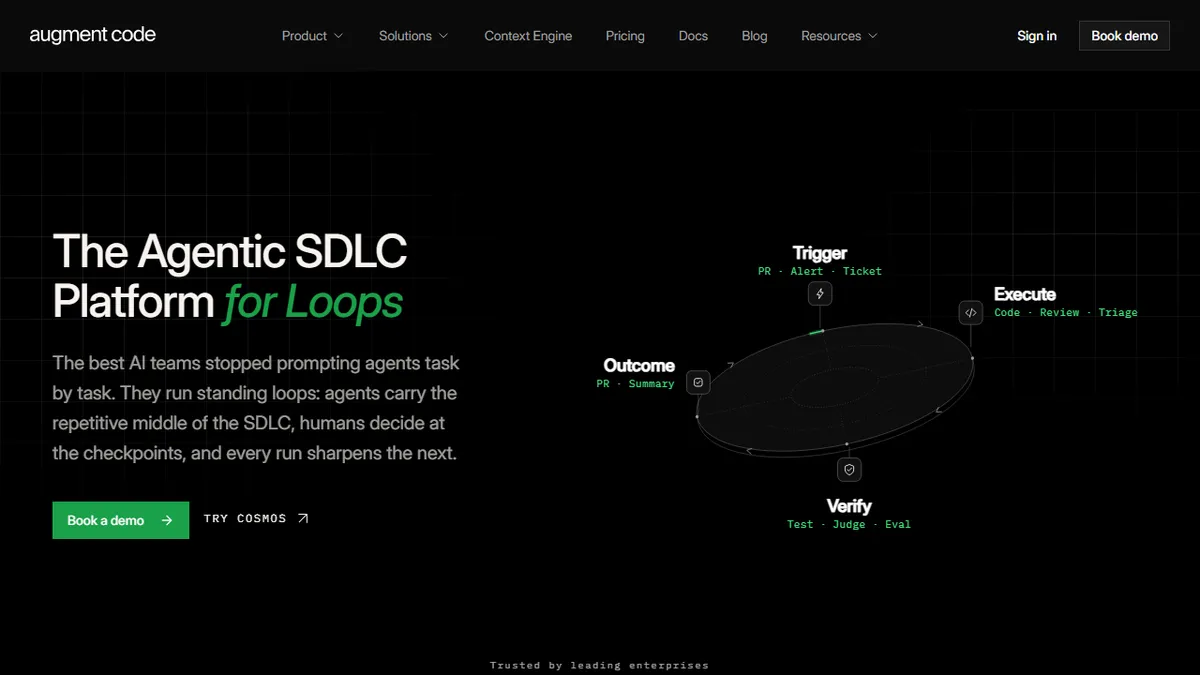
Augment Code has pivoted from a single AI pair-programmer into Cosmos, an enterprise agent-orchestration platform that coordinates multiple specialised AI agents across the software development lifecycle. Instead of one chat window, teams get a registry of pre-built 'experts' for code review, test-coverage expansion, PR authoring, incident response, security remediation, and work triage, plus the ability to fork or build custom experts. A router called Prism dispatches each turn to the model best suited to it (Claude Opus, Claude Sonnet, Gemini, or open-source models via BYOK), which the company claims trims 20-30% off inference cost, while a proprietary Context Engine indexes the codebase structurally to reduce token consumption by roughly a third at equivalent quality. Cosmos runs wherever engineers already work: local laptops, Codespaces/Devcontainer VMs, Augment's own cloud, or self-hosted AWS/GCP. It integrates with Slack, GitHub, Jira, and CI/CD, and supports human-in-the-loop escalation, daemon-mode agents, and up to 50 concurrent sessions on Business. Enterprise adds SSO/SCIM, CMEK, ISO 42001, SIEM export, data residency, and full SLA. The typical buyer is a platform or DevEx team at a mid-to-large engineering org (Adobe, MongoDB, Snyk and Webflow are cited customers) who wants to standardise how agents are deployed across many repos and workflows rather than let each dev wire up their own Cursor or Copilot setup. Common workflows include running an always-on review agent on incoming PRs, having an incident-triage agent watch alert channels, backfilling test coverage on legacy modules, and using the CLI or MCP tooling to script agents into existing pipelines.
Augment made a smart bet by moving upmarket: the individual-IDE-assistant space is a bloodbath, and Cosmos is one of the few products treating agents as a fleet that needs routing, governance and observability. The Prism router and Context Engine claims are plausible and the enterprise posture is real, but the $100/mo floor and the lack of an open API mean this only makes sense once you have a platform team asking the question.
— The AI Tool Bible editorial team
Pros
- ✅ Orchestrates multiple specialised agents rather than a single chat assistant, which scales better across large orgs
- ✅ Prism router picks a model per turn and reports 20-30% cost reduction versus single-model setups
- ✅ Proprietary Context Engine indexes large codebases structurally, cutting token spend without quality loss
- ✅ Deep enterprise posture: SOC 2 Type II on Business, plus CMEK, ISO 42001, SSO/SCIM and SIEM on Enterprise
- ✅ Deployment flexibility across laptop, cloud VM, Augment cloud, or self-hosted AWS/GCP
- ✅ BYOK support for Claude, Gemini and open-source models avoids vendor lock-in on inference
- ✅ Pre-built experts for code review, PR authoring, incident response and security remediation ship day one
Cons
- ⚠️ No public free tier; the $100/mo Business floor prices out solo devs and hobbyists
- ⚠️ Pitched at platform/DevEx teams, so individual engineers get less value than from Cursor or Copilot
- ⚠️ Cosmos is a young platform and the expert registry is still shallow versus mature CI/CD ecosystems
- ⚠️ Usage top-ups expire 12 months after purchase, which penalises bursty adoption
- ⚠️ No open-source release and no publicly documented REST API for third-party integrators
Pricing (captured )
| Tier | Monthly | Key features |
|---|---|---|
| STANDARD | $20/month |
|
| BUSINESS | $100/month |
|
| ENTERPRISE | Custom |
|
Prices change; we show the grid as captured on Oct 13, 2026. Check current pricing on the vendor's site →
Facts
- Free trial
- Yes
- Model used
- Claude Opus, Claude Sonnet, Gemini, and open-source models via BYOK; routed by proprietary Prism model router
- Hacker News
- 62 stories · top 183 points · last Oct 11, 2026 · checked Nov 8, 2026
- Earliest Wayback capture
- 2024-04-15 (earliest archived capture of the site, not a launch date)
- Headquarters
- United States (Wikidata)
Where this tool sits
Use cases
Frequently asked
- How much does Augment Code cost?
- Business plans cost $100 per month. Enterprise pricing is custom and includes additional features like SSO, CMEK, and full SLA. The platform supports up to 50 concurrent sessions on the Business tier.
- Which AI models does Augment Code use?
- It routes requests via Prism to Claude Opus, Claude Sonnet, Gemini, or open-source models via BYOK. This routing aims to reduce inference costs by 20-30% while maintaining quality through a proprietary Context Engine.
- Is Augment Code suitable for solo developers?
- No. It is designed for mid-to-large organizations needing governed deployment across many repos. Solo developers or small teams seeking simple in-IDE autocomplete are better served by tools like Cursor, Copilot, or Claude Code.
- What integrations and deployment options are available?
- It integrates with Slack, GitHub, Jira, and CI/CD. Deployment options include local laptops, Codespaces, Augment’s cloud, or self-hosted AWS/GCP. Enterprise adds SSO/SCIM, SIEM export, and data residency controls.
- What specific workflows can it automate?
- Common workflows include automated pull-request review, test-coverage expansion, incident triage from Slack alerts, security vulnerability remediation, and work-item triage in Jira. Teams can also build custom expert agents for specific needs.