Approving
Visual orchestration for coding agents with human approval gates and sandboxed execution
In short
Approving is a self-hosted tool that visualizes coding agent workflows as a finite state machine. It allows teams to mix agents like Cursor and Claude Code while enforcing human approval gates and sandboxed execution for safe code delivery.
Engineering teams that already use coding agents like Cursor or Claude Code and want reviewable, sandboxed, multi-agent delivery pipelines with explicit human approval checkpoints and Git-based MR/PR output.
Solo hobbyists who just want a chat-style coding copilot, or teams that need a hosted SaaS without running Docker infrastructure and wiring up per-agent backends themselves.
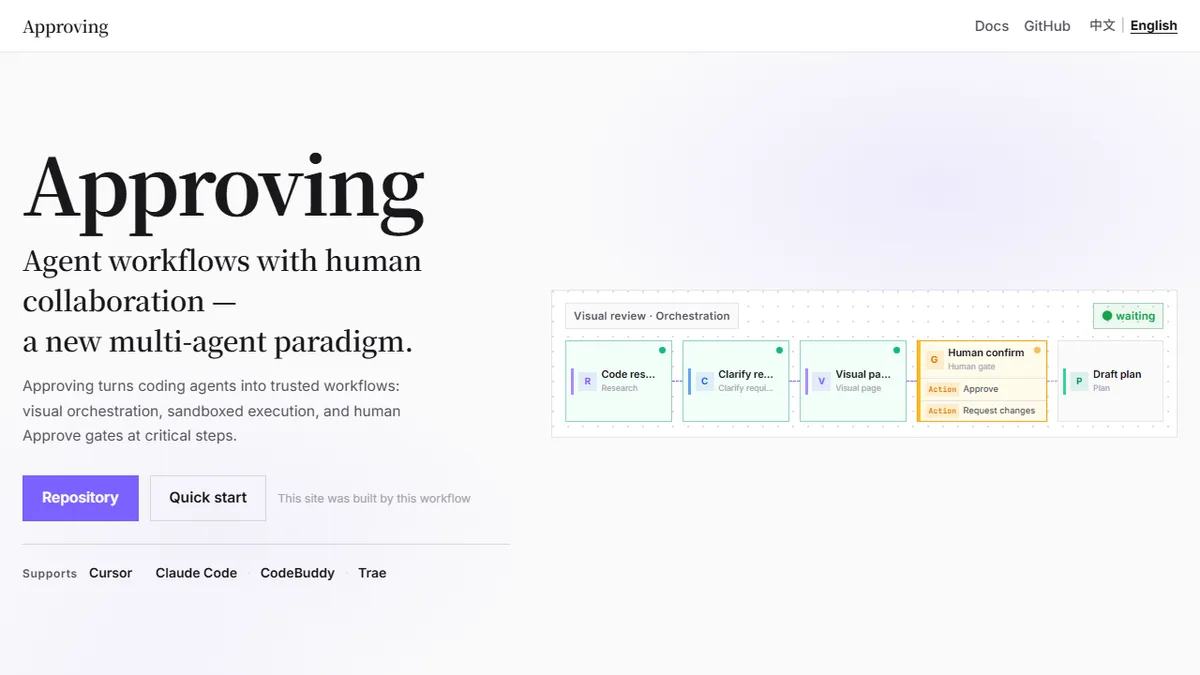
Approving is an open-source, self-hosted platform for orchestrating coding agents into structured, reviewable workflows. Instead of letting a single autonomous agent churn through a repo behind the scenes, Approving models the delivery process as a finite state machine on a Vue Flow canvas: agent nodes plan, implement, and test; react nodes route on outputs; and gate nodes pause the run so a human can approve, edit, or reject before work continues. Every agent runs inside a real Docker sandbox provided by the vendored sandbox-gateway, with scoped Git credentials for GitHub, GitLab, or SSH so the agent can open real MRs/PRs without holding the keys to your whole account. It supports multiple ACP backends out of the box, including Cursor, Claude Code, CodeBuddy, and Trae, and lets each node pick its own backend, so you can, for example, use one model for planning and another for implementation. A PM-style scheduler runs multiple requirements in parallel, and run-scoped artifact contracts (built on MCP) give downstream nodes typed access to earlier outputs rather than passing giant free-text blobs around. The web UI ships execution visibility across timelines, logs, artifacts, and token usage, so a reviewer can see exactly which prompts, files, and tool calls led to a given commit. Typical workflows: a research node gathers context; a design node proposes several approaches; a human approval gate picks one; implementation and test nodes execute in the sandbox; a review gate signs off the resulting MR. A Go backend exposes REST APIs at /api alongside the web UI, so teams can drive runs from CI or internal tooling. It is aimed at engineering teams that want the leverage of coding agents but need explicit approval checkpoints, audit trails, and isolation, rather than a fully autonomous SaaS.
I like that Approving inverts the usual autonomous-agent framing: the diagram is the source of truth, and humans are wired into the graph rather than nagged by pop-ups. The Docker-sandbox-plus-scoped-Git-credentials model is the right default for anything touching real repos. It is early software with rough edges and no SaaS, but if you already run Cursor or Claude Code and want a visible, auditable delivery pipeline, it is worth cloning.
— The AI Tool Bible editorial team
Pros
- ✅ Human-in-the-loop gates are first-class nodes, not an afterthought bolted onto an autonomous loop
- ✅ Real Docker sandbox per run with scoped Git credentials, safer than giving an agent your full token
- ✅ Multi-agent: mix Cursor, Claude Code, CodeBuddy, and Trae in the same workflow
- ✅ Visual FSM canvas makes complex agent pipelines legible and reviewable
- ✅ MCP-based artifact contracts give downstream nodes typed inputs instead of blob prompts
- ✅ MIT-licensed and self-hostable, with a REST API for CI/internal tool integration
- ✅ Execution visibility (timeline, logs, artifacts, token usage) helps postmortem agent runs
Cons
- ⚠️ Self-hosted only; no managed SaaS, so you own the Docker host, upgrades, and secrets
- ⚠️ Setup requires Linux plus Docker Compose and separate ACP backends configured per agent
- ⚠️ Young project with limited public case studies and thin end-user documentation
- ⚠️ Backend catalogue is coding-agent focused; not a general LLM orchestration tool
- ⚠️ Human approval gates add latency, so it fits deliberate delivery flows more than rapid prototyping
Use cases
Frequently asked
- How does Approving handle agent security?
- Every agent runs inside a real Docker sandbox provided by a vendored gateway. It uses scoped Git credentials for GitHub, GitLab, or SSH, allowing agents to open MRs or PRs without holding full account keys.
- Which coding agents are supported by Approving?
- The platform supports multiple ACP backends out of the box, including Cursor, Claude Code, CodeBuddy, and Trae. Users can assign different backends to specific nodes within the same workflow.
- Is Approving a hosted SaaS service?
- No, Approving is a self-hosted, MIT-licensed open-source platform. Users are responsible for infrastructure costs, including the Docker host and agent API tokens, and must manage their own upgrades and secrets.
- What is the primary use case for this tool?
- It is designed for engineering teams that want to use coding agents for multi-agent code delivery pipelines. It provides explicit human approval checkpoints, audit trails, and isolation for generating reviewable MRs and PRs.
- Can teams integrate Approving with their CI systems?
- Yes, the Go backend exposes REST APIs at /api alongside the web UI. This allows teams to drive runs from CI or internal tooling.
Explore related
Compare with similar tools
All in Agents →LangGraph
FeaturedStateful, graph-based agent orchestration from LangChain.
CrewAI
FeaturedPython framework for multi-agent orchestration.
Ernie Bot
Baidu's Mandarin-first ChatGPT rival, powered by the ERNIE model family
Moveworks
The enterprise AI assistant that searches, answers, and takes action across your business systems
AWS Bedrock
Build and scale generative AI applications with foundation models
Claude Agent SDK
Anthropic's official SDK for building autonomous Claude agents.