Apache Mahout
Open-source ML framework pivoting toward scalable quantum computing primitives.
In short
Apache Mahout is a research-grade toolkit for building quantum-classical hybrid ML pipelines. It provides a unified API to run quantum circuits across Qiskit, Cirq, and Amazon Braket without vendor-specific rewrites. It is best for researchers prototyping quantum experiments rather than production ML.
Pick Apache Mahout if you are a researcher prototyping quantum-classical ML pipelines and want one API that runs across Qiskit, Cirq, and Braket.
Skip it if you need a mature classical ML library or a hosted product with support, SLAs, and active enterprise tooling.
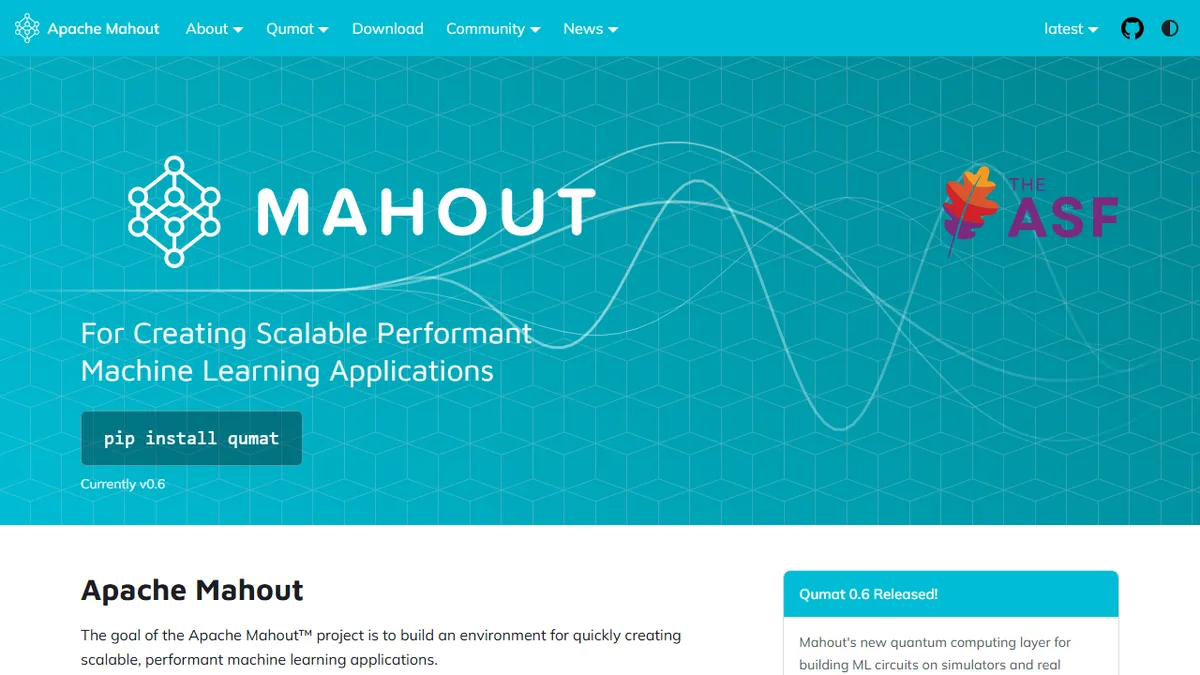
Apache Mahout is an Apache Software Foundation project that began as a distributed machine learning library and has shifted focus to quantum computing tooling for ML workloads. Its current centerpiece is Qumat, a framework that lets you author quantum circuits with standard gates once and run them across Qiskit, Cirq, and Amazon Braket through a unified API, plus a Quantum Data Plane (QDP) that encodes classical tensors into quantum states using GPU-accelerated kernels with zero-copy transfer.
It is squarely aimed at ML researchers and engineers who want to experiment with quantum-classical hybrid pipelines without re-writing code for every vendor SDK. Like everything under the Apache umbrella, it is free and Apache-2.0 licensed, with source on GitHub and no commercial tier to speak of. The trade-off is maturity: the project is at version 0.6, the original Samsara/Spark-era ML algorithms have been deprioritized, and you will be living close to the metal.
Integrations lean on the dominant quantum SDKs (Qiskit, Cirq, Braket) and standard Python/JVM tooling. Documentation exists but is sparse compared to mainstream ML frameworks, and the community is smaller than it was during Mahout's MapReduce heyday. Treat this as a research-grade toolkit, not a production platform.
Mahout is no longer the distributed-ML workhorse it was a decade ago; it has rebranded around Qumat and quantum computing. That makes it a niche but interesting pick for hybrid-quantum experimentation, provided you accept the small community and 0.x maturity. Most teams should look elsewhere for production ML.
— The AI Tool Bible editorial team
Pros
- ✅ Single API targets Qiskit, Cirq, and Amazon Braket
- ✅ Apache-2.0 licensed with no vendor lock-in
- ✅ GPU-accelerated classical-to-quantum data encoding
- ✅ Backed by the Apache Software Foundation
Cons
- ⚠️ Project has pivoted; legacy ML algorithms deprioritized
- ⚠️ Small community and sparse documentation
- ⚠️ Pre-1.0 (v0.6) and rough around the edges
- ⚠️ Useful mainly for quantum research, not mainstream ML
Use cases
Frequently asked
- What is the primary function of Apache Mahout today?
- It serves as a framework for quantum computing tooling in ML workloads. Its centerpiece, Qumat, allows users to author quantum circuits once and run them across Qiskit, Cirq, and Amazon Braket via a unified API.
- Is Apache Mahout suitable for production machine learning?
- No, it is treated as a research-grade toolkit, not a production platform. The project is at version 0.6, has a small community, and its original distributed ML algorithms have been deprioritized.
- How does Apache Mahout handle data encoding for quantum states?
- It includes a Quantum Data Plane (QDP) that encodes classical tensors into quantum states. This process uses GPU-accelerated kernels with zero-copy transfer.
- What are the licensing and cost terms for Apache Mahout?
- The tool is free and licensed under Apache-2.0. It is backed by the Apache Software Foundation and has no commercial tier or vendor lock-in.
Explore related
Compare with similar tools
All in Coding →Cursor
FeaturedAI-first VS Code fork — chat, edit, and agentic coding in one IDE.
GitHub Copilot
FeaturedThe original AI pair programmer, now with chat and agents.
Replit Agent
FeaturedBuild & deploy a full app from a single prompt.
Warp
The agentic development environment, from the terminal up
Cline
Open-source agentic coding assistant that plans, edits, and runs code inside your IDE
Aider
Terminal-based AI pair programmer that writes commits.