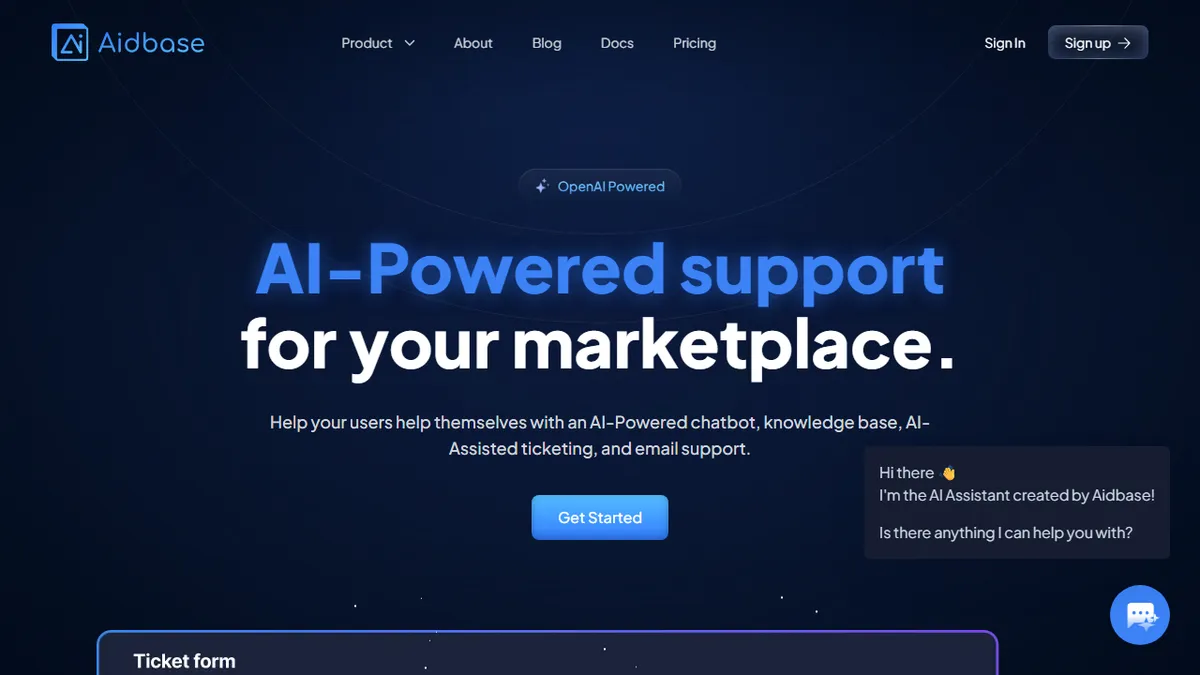

Aidbase
AI-powered customer support stack purpose-built for SaaS startups, bundling a trained chatbot, ticketing, and knowledge base.
In short
Aidbase provides an all-in-one customer support solution for SaaS startups, combining an AI chatbot, ticketing, and knowledge base. It is best for small teams wanting to deflect tickets without integrating multiple vendors.
Pick Aidbase if you are a SaaS startup that wants one tool to handle AI chat, tickets and a knowledge base without integrating three vendors.
Skip it if you need an open-source, self-hosted support stack or want full control over the underlying LLM and retrieval pipeline.
Aidbase is an end-to-end customer support platform aimed at SaaS startups, built around an OpenAI-powered chatbot that gets trained on your own documentation, website content, Notion pages, PDFs and YouTube videos. Around the bot it wraps the usual support furniture: a unified ticket inbox, custom ticket forms, an email support workflow, a public knowledge base, and analytics that flag gaps in what the AI actually knows so you can fill them.
The pitch is that a small team can deflect a meaningful chunk of tickets without stitching together Intercom plus a separate RAG vendor. Deployment is flexible for engineering teams who want it: drop-in CDN embed, an @aidbase/chat npm package, a React/Next.js library, plus webhooks and an API for deeper integration. Connectors cover Discord, WhatsApp, Slack, Shopify, WordPress and Zapier, which makes it a reasonable fit for indie SaaS and e-commerce shops that already live in those tools. Pricing is subscription-based with a 7-day free trial and no credit card required up front.
It is not open source and the model layer is essentially OpenAI under the hood, so you are betting on a hosted black box rather than running your own retrieval stack. For teams that just want a working AI support agent yesterday, that trade-off is the entire point.
Aidbase is a sensible packaging of the now-standard 'RAG bot plus helpdesk' pattern, aimed at founders who do not want to assemble it themselves. The OpenAI dependency and SaaS-startup framing are honest about who it is for; bigger support orgs will likely outgrow it, but for a 2-10 person team it is a defensible starting point.
— The AI Tool Bible editorial team
Pros
- ✅ All-in-one support stack: chatbot, tickets, email, and KB in one product
- ✅ Trains on Notion, PDFs, YouTube and site content out of the box
- ✅ Multiple integration paths from no-code embed to React/Next.js SDK
- ✅ Native connectors for Discord, WhatsApp, Slack, Shopify and Zapier
Cons
- ⚠️ Closed-source and locked to OpenAI as the underlying model
- ⚠️ Aimed squarely at SaaS startups, less suited to large enterprise support orgs
- ⚠️ Free tier is only a 7-day trial rather than a permanent free plan
Use cases
Frequently asked
- What data sources can the Aidbase chatbot be trained on?
- The chatbot can be trained on your own documentation, website content, Notion pages, PDFs, and YouTube videos.
- How can Aidbase be integrated into a product?
- Integration options include a drop-in CDN embed, an npm package, a React/Next.js library, webhooks, and an API.
- Which third-party tools does Aidbase connect with?
- Aidbase offers native connectors for Discord, WhatsApp, Slack, Shopify, WordPress, and Zapier.
- Is Aidbase open source or self-hosted?
- No, Aidbase is not open source and relies on OpenAI as the underlying model, making it a hosted black box rather than a self-hosted stack.
- What is the pricing structure for Aidbase?
- Pricing is subscription-based with plans for Standard at €29, Pro at €39, and Expert at €199, including a 7-day free trial.
Explore related
Compare with similar tools
All in Agents →LangGraph
FeaturedStateful, graph-based agent orchestration from LangChain.
CrewAI
FeaturedPython framework for multi-agent orchestration.
Ernie Bot
Baidu's Mandarin-first ChatGPT rival, powered by the ERNIE model family
Moveworks
The enterprise AI assistant that searches, answers, and takes action across your business systems
AWS Bedrock
Build and scale generative AI applications with foundation models
Claude Agent SDK
Anthropic's official SDK for building autonomous Claude agents.