
AI SDK
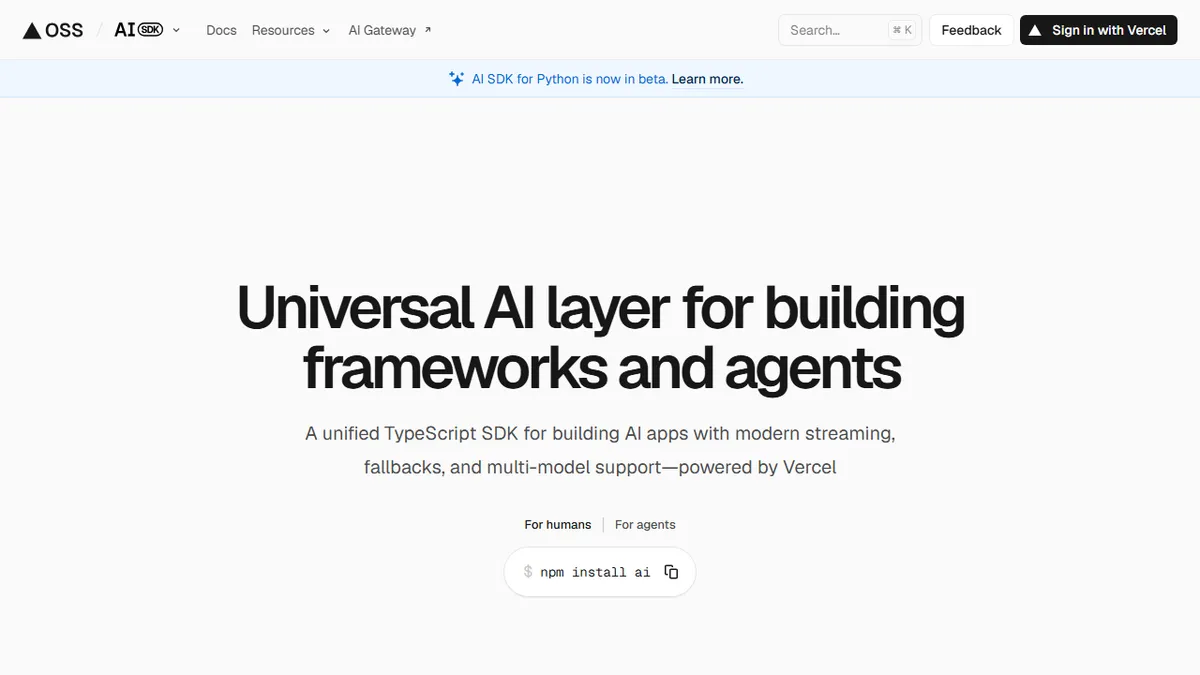
Vercel's open-source TypeScript framework for building AI apps across 16+ providers with unified streaming, tools, and UI hooks.
In short
AI SDK is a TypeScript toolkit that abstracts LLM provider differences behind a single API. It is best for developers building chat or agent features who need provider portability and built-in streaming without custom plumbing.
Pick AI SDK if you're a TypeScript developer building chat, agent, or generative features and want provider portability without writing the streaming plumbing yourself.
Skip it if you're working in Python, need deep model-specific features (e.g. raw OpenAI Realtime), or want a hosted product rather than a library.
AI SDK is a TypeScript-first toolkit from Vercel that abstracts the differences between LLM providers behind a single, consistent API. It ships as the `ai` npm package (around 15.8M weekly downloads) and breaks into two main parts: AI SDK Core for text/image/speech/transcription/video generation, tool calling, and agent loops; and AI SDK UI, a set of framework-agnostic hooks (React, Next.js, Vue, Svelte) that make chat, completion, and streaming UIs trivial to wire up.
It's aimed squarely at full-stack TypeScript developers who want to ship AI features without re-implementing streaming, retries, structured output, and tool-calling glue for every provider. Switching from OpenAI to Anthropic to Google is essentially a one-line change in the `model:` argument, which makes it ideal for teams that want optionality or are running A/B tests across providers. The SDK itself is free and open-source (Apache 2.0, 25k+ GitHub stars); you pay only for the underlying model APIs you call.
It integrates cleanly with the rest of Vercel's stack (AI Gateway for unified billing/rate limiting, Sandbox for code execution, Workflows for orchestration), but nothing forces you to deploy on Vercel. Caveats: it's TypeScript/JavaScript only, the API surface has evolved quickly across major versions, and 'multi-provider' still means writing against the lowest common denominator of features.
The de facto standard for AI in the TypeScript world. If you're shipping a Next.js app with any LLM feature, the cost of not using AI SDK is reinventing streaming and tool-calling glue for every provider. The churn between major versions is real, but the abstraction has earned its place.
— The AI Tool Bible editorial team
Pros
- ✅ One API across OpenAI, Anthropic, Google, Mistral, xAI, Meta and 10+ more providers
- ✅ First-class streaming, tool calling, and structured output baked in
- ✅ Framework-agnostic UI hooks for React, Next.js, Vue, and Svelte
- ✅ Open source, Apache 2.0, maintained by Vercel with active community
- ✅ Battle-tested at scale (15M+ weekly npm downloads)
Cons
- ⚠️ TypeScript/JavaScript only - no Python or Go bindings
- ⚠️ Frequent breaking changes across major versions
- ⚠️ Provider parity is lowest-common-denominator; some model-specific features are awkward
Use cases
Frequently asked
- Which programming languages does AI SDK support?
- AI SDK is TypeScript/JavaScript only and does not provide Python or Go bindings.
- How much does AI SDK cost to use?
- The SDK is free and open-source under the Apache 2.0 license, though you must pay for the underlying model APIs you call.
- Does AI SDK work with different frontend frameworks?
- Yes, it includes framework-agnostic UI hooks that support React, Next.js, Vue, and Svelte.
- Can I switch between different LLM providers easily?
- Switching providers is essentially a one-line change in the model argument, allowing for easy optionality across 16+ providers.
- Is AI SDK limited to deployment on Vercel?
- No, while it integrates with Vercel's stack, nothing forces you to deploy on Vercel.
Explore related
Compare with similar tools
All in Coding →Cursor
FeaturedAI-first VS Code fork — chat, edit, and agentic coding in one IDE.
GitHub Copilot
FeaturedThe original AI pair programmer, now with chat and agents.
Replit Agent
FeaturedBuild & deploy a full app from a single prompt.
Warp
The agentic development environment, from the terminal up
Cline
Open-source agentic coding assistant that plans, edits, and runs code inside your IDE
Aider
Terminal-based AI pair programmer that writes commits.