AI Meter
Local usage meter that turns AI coding-agent tokens into estimated electricity and water consumption.
In short
AI Meter monitors local log files from AI coding agents to estimate energy and water consumption. It is best for macOS developers seeking a private, on-device view of their AI session impact without cloud dependencies.
macOS developers and small engineering teams who use local AI coding agents daily and want a private, transparent sense of the energy and water cost of their sessions.
Windows or Linux users, enterprises needing audited sustainability numbers, or teams that rely mostly on web-based ChatGPT/Claude rather than local CLI agents.
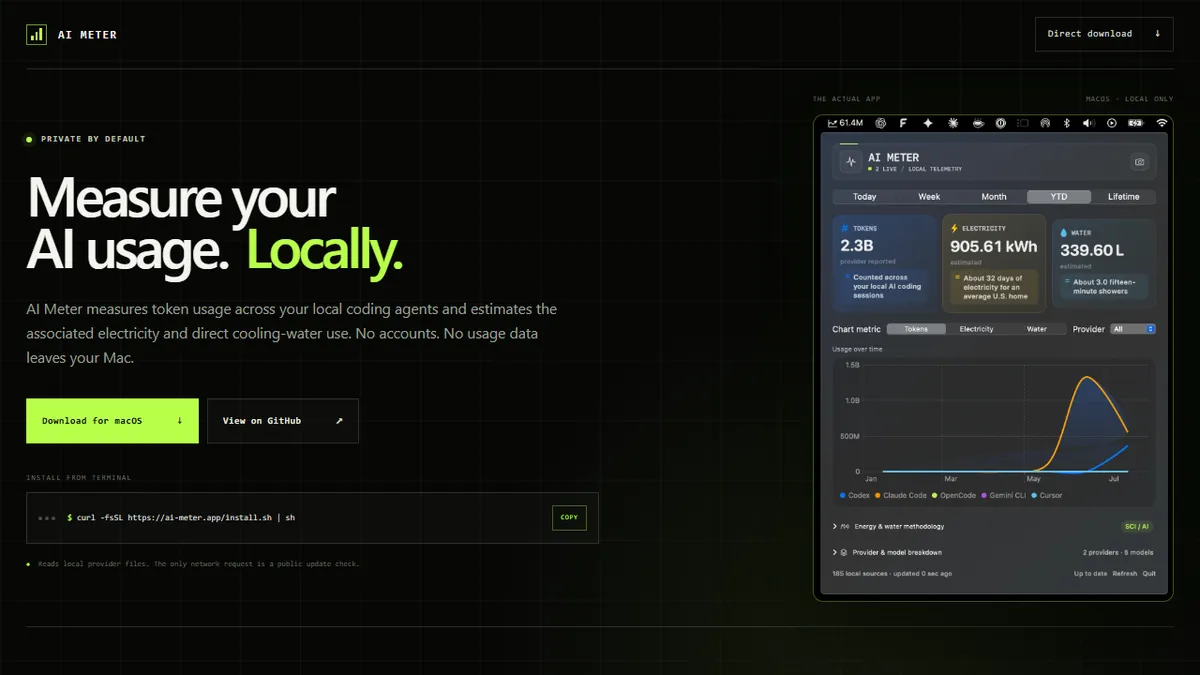
AI Meter is a macOS menu-bar app that watches the local log files written by AI coding agents (Claude Code, Codex, Cursor, OpenCode, Gemini CLI) and converts the tokens they consume into estimated electricity draw (kWh) and cooling water (liters). Everything runs on-device — the only outbound network call is a public update check — so no API keys, accounts, or telemetry leave the machine. Under the hood it reads each provider's local usage files, deduplicates overlapping events, aggregates by day and provider, and applies a research-backed conversion (default 0.39 kWh per million tokens, adjustable in a 0.20-0.75 range, plus a configurable PUE of 1.20 and site WUE of 0.45 L per IT-kWh) to translate raw counts into environmental impact. The UI presents interactive charts, per-provider breakdowns, and a live widget so developers can see, at a glance, how heavy today's agentic coding session was. It is aimed at engineers, tech leads, and sustainability-minded teams who want an honest, self-hosted view of the invisible externalities of AI-assisted development — not a marketing dashboard from the model vendor. Typical workflows: leaving the widget open during a Claude Code / Cursor session to watch the meter tick, comparing weekly consumption across agents to pick the most efficient tool for a task, or exporting rough per-project impact figures for an internal ESG or FinOps report. Because the calculations exclude training energy, embodied hardware, off-site grid mix, networking, and user-device power, the numbers are best treated as directional lower-bound estimates rather than audited measurements.
A refreshingly honest little utility: it tells you exactly which numbers it made up, which it measured, and which it deliberately ignored. That candor plus the local-only design makes it more useful than most 'AI sustainability' dashboards I've seen, even if the absolute figures are directional. The macOS-only, single-machine ceiling is the main thing keeping it from being a team tool.
— The AI Tool Bible editorial team
Pros
- ✅ 100% local processing — no accounts, no cloud, no API keys; reads existing provider files directly
- ✅ Covers the five most-used local coding agents in one place (Claude Code, Codex, Cursor, OpenCode, Gemini CLI)
- ✅ Transparent, user-adjustable math for kWh/token, PUE, and WUE rather than a black-box estimate
- ✅ Open source on GitHub, so the deduplication and parsing logic can be audited
- ✅ Free for individuals and companies with no gated tier
- ✅ Native macOS widget makes ambient monitoring effortless during long coding sessions
- ✅ Explicitly documents what it does NOT count (training, embodied hardware, grid carbon), which is rare for impact tools
Cons
- ⚠️ macOS only — no Windows or Linux build, which excludes a large slice of the developer audience
- ⚠️ Estimates are based on published research, not real telemetry from OpenAI/Anthropic/Google data centers
- ⚠️ Ignores training energy, embodied hardware, networking, and grid-mix carbon, so figures understate true impact
- ⚠️ Only tracks agents that write local usage files; hosted web chat sessions (chatgpt.com, claude.ai) are invisible
- ⚠️ No API or export hooks documented, which limits integration with FinOps or ESG dashboards
- ⚠️ Single-machine scope — no team roll-up view for a whole engineering org
Use cases
Frequently asked
- Which AI coding agents does AI Meter support?
- It tracks local usage files from Claude Code, Codex, Cursor, OpenCode, and Gemini CLI.
- Does AI Meter require an internet connection or API keys?
- No, it runs entirely on-device. The only outbound network call is a public update check, and it does not require API keys or accounts.
- Is AI Meter available for Windows or Linux?
- No, AI Meter is currently a macOS-only application with no builds for Windows or Linux.
- How accurate are the energy and water estimates?
- The figures are directional lower-bound estimates based on research-backed conversion factors. They exclude training energy, embodied hardware, and off-site grid mix.
- Is AI Meter free to use?
- Yes, it is free for individuals and companies and is open source under a public GitHub repository.
Explore related
Compare with similar tools
All in Evaluation →Braintrust
FeaturedEval, monitor, and improve AI products end-to-end.
LangSmith
LangChain's eval + observability platform.
Weights & Biases
The ML experiment tracker, now with LLM eval features.
Helicone
Open-source LLM observability — one-line proxy install.
Arize AI
Enterprise observability and evaluation platform for LLM agents and generative AI applications.
Giskard
Continuous AI red teaming platform that stress-tests LLM agents for vulnerabilities before they hit production.