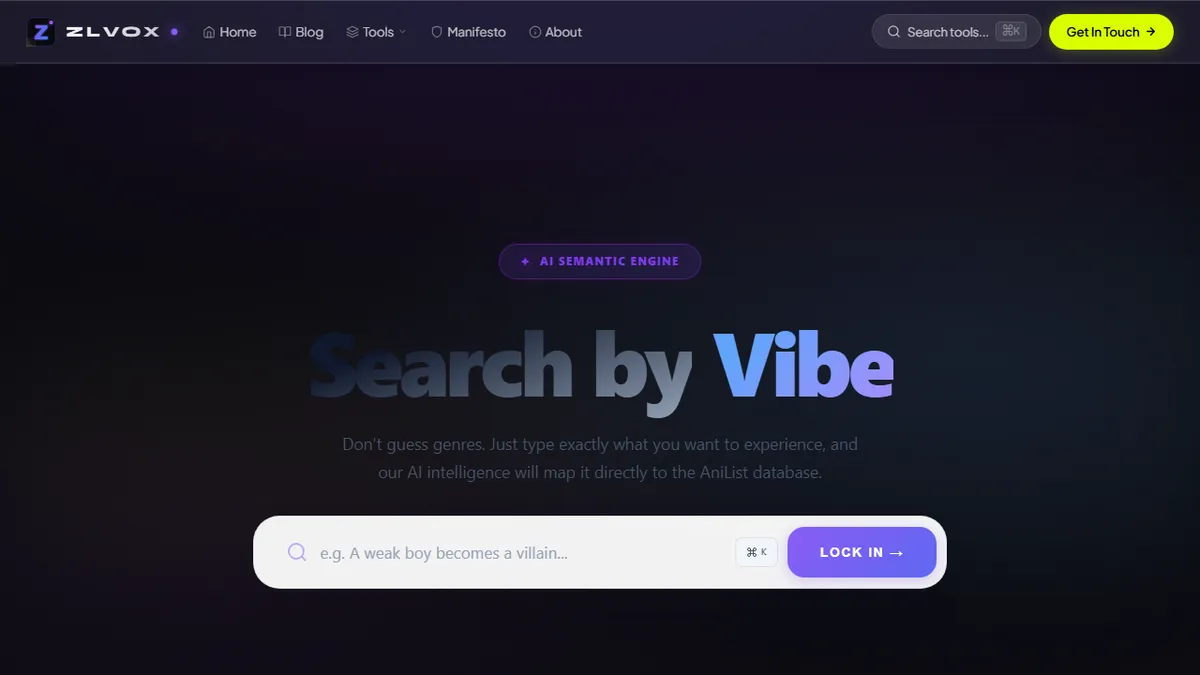
AI Anime Finder
Vibe-based semantic search over the AniList catalogue with watch-time and shareable taste cards.
In short
This tool allows users to find anime by describing their mood or vibe in plain English rather than using genre tags. It pulls live data from AniList to provide current recommendations and includes utilities for calculating watch time and generating shareable taste cards.
Anime viewers who want mood- or theme-driven recommendations without logging into a tracker, and bingers planning a watch based on realistic (filler-adjusted) runtime.
Users who want a persistent watchlist, MyAnimeList/AniList sync of their own history, or developers who need an API — this is a self-contained web tool with no account layer.
AI Anime Finder is a free semantic discovery tool published on Zlvox that lets you describe what you feel like watching in plain English and returns matching anime pulled live from the AniList GraphQL catalogue. Instead of drilling into a genre tree, you type prompts such as 'enemies to lovers romance in a cyberpunk city', 'slow, melancholic sci-fi like Ergo Proxy', or pick one of the pre-baked mood chips ('just went through a breakup', 'can't sleep at 3 AM', 'need something short and dumb'). The tool interprets the intent, translates it into a structured AniList query, and renders a grid of results with high-resolution cover art, scores, episode counts, format (TV / OVA / movie) and synopsis.
Beyond raw search, it wraps two small utilities that shōnen and completionist viewers actually use. A watch-time calculator estimates how long a series will take to finish given a daily viewing budget and can optionally skip filler episodes rather than counting the aired total. A 'taste card' generator exports your top three picks as a shareable PNG trading card sized for Instagram, X and Discord embeds, which is the sort of low-friction social hook that keeps the tool floating around anime Twitter and r/anime rec threads.
Typical workflows: finding a next series after finishing something specific, breaking a decision-paralysis rut with a mood prompt, budgeting a binge before a long weekend, or generating a quick 'my top 3 of the season' card to post. Because the backing catalogue is AniList rather than a scraped snapshot, currently-airing and seasonal titles show up with fresh metadata, and less-mainstream shows (art-house films, older OVAs, shorts) surface far more readily than they do on Netflix-style recommender rows. The whole experience runs in-browser with no login, no watch-history tracking, and no upsell.
A pleasant, single-serving discovery tool that punches above its weight because AniList is a good source of truth and mood prompts genuinely beat genre tag-chasing. I'd reach for it when I've finished something specific and want the next thing, not as a replacement for AniList or MAL. The taste-card export is the small delight that makes it memorable; the missing model disclosure is the small friction that keeps it from feeling authoritative.
— The AI Tool Bible editorial team
Pros
- ✅ Natural-language / vibe prompts work meaningfully better than tag filters for mood-driven discovery.
- ✅ Live AniList GraphQL backend means seasonal and currently-airing titles are current, and long-tail OVAs surface.
- ✅ Watch-time calculator with optional filler-skip is a genuinely useful planning aid before starting a long series.
- ✅ Shareable taste-card PNG export is a nice, frictionless social output.
- ✅ Zero sign-up, zero paywall, no visible query limits — you can iterate on prompts freely.
- ✅ Client-side / privacy-respecting posture — no watch history to log in to and leak.
Cons
- ⚠️ Backing model architecture is undocumented — you cannot tell whether it is an LLM, an embedding index, or a heuristic query builder, which matters if results feel off.
- ⚠️ Recommendations are only as good as AniList's coverage; live-action adaptations, unlicensed doujin, and non-Japanese animation are effectively out of scope.
- ⚠️ No personal watch history, ratings sync, or 'more like the shows I've finished' — every session starts cold.
- ⚠️ No public API, no self-host option, no way to embed the semantic engine in your own app.
- ⚠️ Sits inside the broader Zlvox utility grab-bag rather than being a dedicated anime product, so roadmap and longevity are uncertain.
Use cases
Frequently asked
- How does AI Anime Finder search for anime?
- It uses semantic search to interpret natural language prompts or mood chips. The tool translates these inputs into structured queries against the live AniList GraphQL catalogue to return matching titles.
- Is there a cost or sign-up requirement?
- The tool is completely free with no account, sign-up, or advertised per-query limits. It runs in the browser without requiring a login or tracking watch history.
- What additional features are included beyond search?
- It includes a watch-time calculator that can estimate completion time based on a daily budget and optionally skip filler episodes. It also generates a shareable PNG 'taste card' of your top three picks for social media.
- Can I sync my watch history or use an API?
- No, the tool does not offer persistent watchlists, history sync with services like MyAnimeList, or a public API. It is a self-contained web tool where every session starts without prior user data.
Explore related
Compare with similar tools
All in RAG →Pinecone
FeaturedManaged vector database for production-scale similarity search.
LlamaIndex
FeaturedData framework for connecting LLMs to your data.
Elasticsearch Vector Search
Hybrid vector + keyword search in the enterprise-grade Elasticsearch engine
Snowflake Cortex
Generative AI and RAG built into the Snowflake data cloud
DataStax Astra DB
Serverless vector and document database for production RAG and AI agents
MongoDB Atlas Vector Search
Vector search built into the operational database you're already using.