AgentGPT
Not yet source-checkedBrowser-based autonomous AI agent builder that chains GPT calls toward a goal you define.
Machine-drafted from the vendor's site · not yet source-checkedProfile updated Link checked How we rate
In short
AgentGPT is a no-code, browser-native platform for building autonomous AI agents that recursively plan and execute sub-tasks. It is best suited for non-developers wanting to experiment with goal-decomposition and agent behavior without writing code or installing frameworks.
Pick AgentGPT if you want to experiment with autonomous AI agents in a browser without writing code or wiring up a framework.
Skip it if you need a production-grade agent framework with rich tool integrations, observability, or modern frontier models.
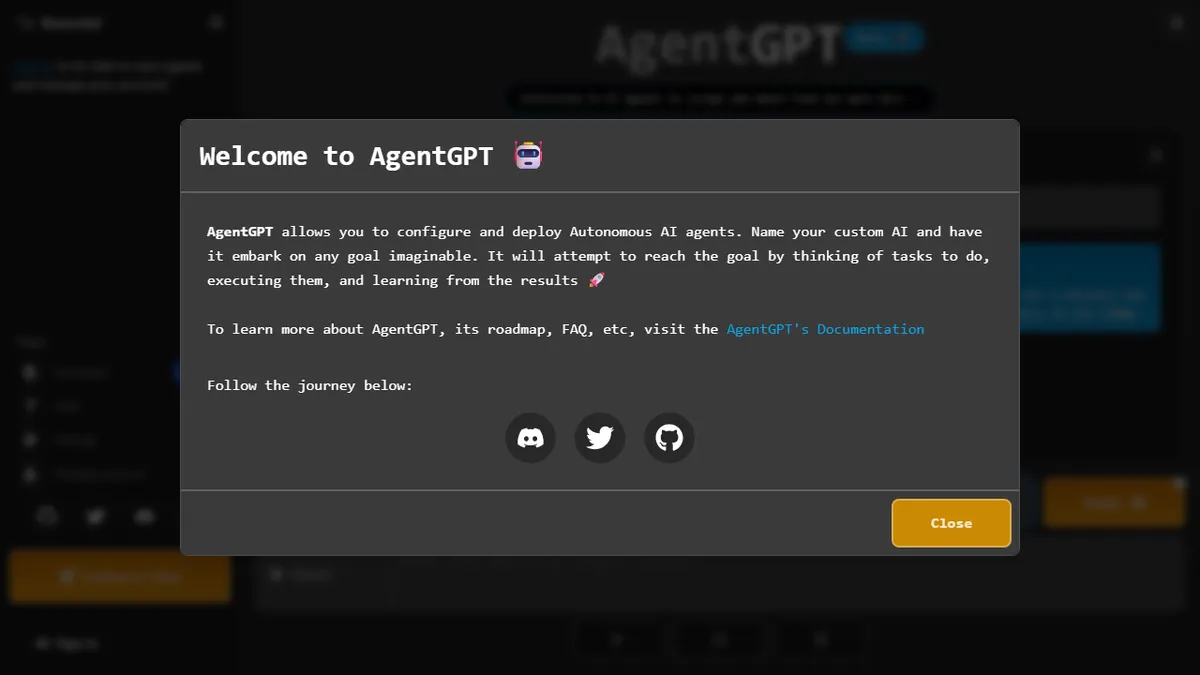
AgentGPT, built by Reworkd, is a browser-native autonomous agent platform: you give it a name and a goal, hit deploy, and the agent recursively plans sub-tasks, executes them via LLM calls, and iterates until the goal is reached (or it runs out of steam). It popularized the Auto-GPT pattern in a no-install web UI, with template starters like ResearchGPT, TravelGPT, and StudyGPT, plus light web-scraping for grounding answers in fresh data.
The hosted product runs on GPT-3.5 by default with a small free monthly run quota; heavier usage and longer agent loops require a paid plan or bringing your own OpenAI key. The codebase is open-source on GitHub (Next.js + TypeScript), so technical users can self-host with their own model keys and skip the quota entirely. It is best understood as an accessible on-ramp to the autonomous-agent concept rather than a production agent framework.
For serious agent engineering you would reach for LangGraph, CrewAI, or OpenAI's Agents SDK, but AgentGPT remains a useful sandbox for non-developers who want to see goal-decomposition and tool-use behaviour without writing code.
AgentGPT was the gateway drug to autonomous agents for a lot of people in 2023 and it still works as a quick sandbox. The hosted UX shows its age though, and anyone shipping real agent workflows has long since graduated to LangGraph, CrewAI, or the OpenAI Agents SDK.
— The AI Tool Bible editorial team
Pros
- ✅ No-code browser UI for autonomous agent loops
- ✅ Open-source codebase, self-hostable with your own keys
- ✅ Ready-made templates (research, travel, study) lower the learning curve
- ✅ Good demo of goal-decomposition and recursive task planning
Cons
- ⚠️ Default GPT-3.5 backend feels dated next to modern agent frameworks
- ⚠️ Free tier is tightly capped on monthly runs
- ⚠️ Agents can loop, hallucinate sub-tasks, or stall without finishing
- ⚠️ Limited tool/integration surface compared to LangGraph or CrewAI
Facts
- Platforms
- web
- Free trial
- Yes
- Open source
- Yes
- Model used
- GPT-3.5 (BYO key for others)
- Hacker News
- 4 stories · top 98 points · last May 26, 2023 · checked Nov 7, 2026
- Earliest Wayback capture
- 2023-04-10 (earliest archived capture of the site, not a launch date)
Where this tool sits
Use cases
Frequently asked
- How does AgentGPT work?
- You provide the agent with a name and a goal, and it recursively plans sub-tasks, executes them via LLM calls, and iterates until the goal is reached or resources run out. It uses GPT-3.5 by default and includes light web-scraping for grounding answers.
- Is AgentGPT free to use?
- AgentGPT offers a freemium model with a free tier that includes limited monthly runs. Heavier usage or longer agent loops require a paid plan, or you can bring your own OpenAI key to skip the quota.
- Can I self-host AgentGPT?
- Yes, the codebase is open-source on GitHub using Next.js and TypeScript. Technical users can self-host the application with their own model keys to avoid usage quotas.
- Who is AgentGPT designed for?
- It is designed for non-developers who want to experiment with autonomous AI agents in a browser without writing code. It serves as an accessible on-ramp to the autonomous-agent concept rather than a production framework.
- What are the limitations of AgentGPT?
- The default GPT-3.5 backend is considered dated, and the free tier has tight usage caps. Agents may loop, hallucinate sub-tasks, or stall, and the tool has a limited integration surface compared to frameworks like LangGraph or CrewAI.