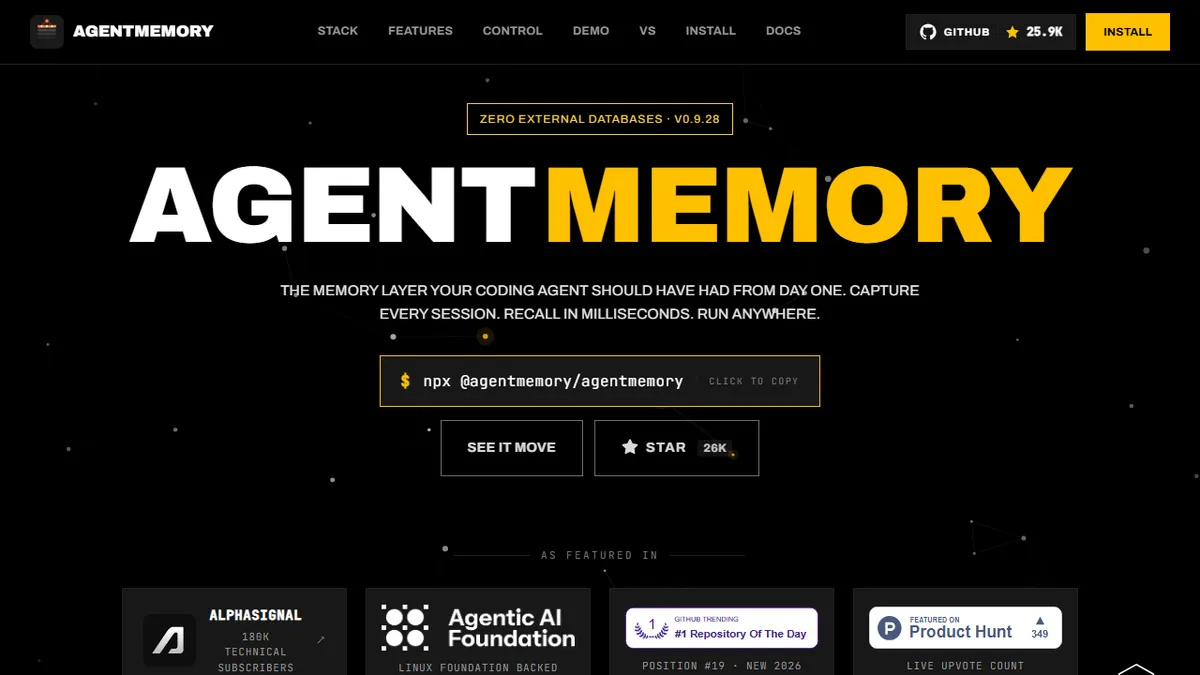
AgentMemory
Open-source persistent memory runtime for AI coding agents, with hybrid retrieval and zero external dependencies.
In short
AgentMemory provides a self-contained, self-hosted memory layer for AI coding assistants like Claude Code and Cursor. It uses a single Node.js process with JSON storage to offer durable, searchable context across sessions without requiring external databases. It is best for builders who need persistent agent context without standing up complex infrastructure.
Pick AgentMemory if you want a drop-in, self-hosted memory layer for your coding agent stack without running a vector DB or graph store.
Skip it if you need a hosted, multi-tenant memory service with SLAs or a production-grade datastore behind it.
AgentMemory is a self-contained memory layer that plugs into AI coding assistants like Claude Code, Cursor, Cline, Windsurf, Copilot CLI, Codex CLI, and Gemini CLI to give them durable, searchable context across sessions. It runs as a single Node.js process backed by JSON file storage on disk, with no Redis, Postgres, Qdrant, or Neo4j to operate. Twelve auto-capture hooks record every tool call, prompt, and session event, then an hourly consolidation pass compresses raw observations into semantic memories with duplicate merging and decay scoring.
The headline differentiator is its triple-stream retrieval: BM25 lexical search, vector embeddings, and a knowledge graph all queried in parallel, with claimed sub-20ms recall and 95.2% R@5 on LongMemEval-S. It is Apache 2.0 licensed, free to use via NPX, and rides on whatever LLM credentials you already have (Anthropic, Gemini, MiniMax, OpenRouter). For builders of coding agents who need persistent context without standing up infrastructure, the value proposition is straightforward.
The surface area is large for an early project: 53 MCP tools, 128 REST endpoints, peer-to-peer sync between instances, Obsidian markdown export, and OpenTelemetry observability with a real-time viewer on port 3113. At v0.9.27 it is still pre-1.0, so expect API churn and rough edges, but the integration breadth is unusual for a memory layer.
A refreshingly opinionated memory runtime that bets on filesystem simplicity over the usual Postgres-plus-Qdrant-plus-Neo4j sprawl. The integration list and MCP/REST surface are unusually broad for an early project, and the LongMemEval numbers are credible. Treat it as pre-1.0 and watch the changelog.
— The AI Tool Bible editorial team
Pros
- ✅ Zero external infrastructure: single Node process, JSON on disk
- ✅ Triple-stream retrieval (BM25 + vectors + graph) with sub-20ms recall
- ✅ Native plugins for Claude Code, Cursor, Cline, Windsurf, and 15+ agents
- ✅ Apache 2.0, runs on your existing LLM subscription
- ✅ Strong benchmark numbers (95.2% R@5 on LongMemEval-S)
Cons
- ⚠️ Pre-1.0 (v0.9.27), expect breaking changes
- ⚠️ Single-process JSON storage may not scale to team-wide deployments
- ⚠️ Self-hosted only; you operate the runtime
- ⚠️ Effectiveness depends on the LLM provider you wire in
Use cases
Frequently asked
- What infrastructure is required to run AgentMemory?
- AgentMemory runs as a single Node.js process backed by JSON file storage on disk. It requires no external dependencies such as Redis, Postgres, Qdrant, or Neo4j.
- Which AI coding agents does AgentMemory support?
- It plugs into AI coding assistants including Claude Code, Cursor, Cline, Windsurf, Copilot CLI, Codex CLI, and Gemini CLI. It supports over 15 agents via native plugins.
- How does AgentMemory handle data retrieval?
- It uses a triple-stream retrieval system that queries BM25 lexical search, vector embeddings, and a knowledge graph in parallel. The tool claims sub-20ms recall and 95.2% R@5 on LongMemEval-S.
- Is AgentMemory free to use?
- Yes, AgentMemory is free and open-source under the Apache 2.0 license. You bring your own LLM API key, supporting providers like Anthropic, Gemini, MiniMax, and OpenRouter.
- What are the limitations of AgentMemory?
- The tool is currently pre-1.0 (v0.9.27), so users should expect API churn and breaking changes. It is self-hosted only and uses single-process JSON storage, which may not scale to team-wide deployments.
Explore related
Compare with similar tools
All in Agents →LangGraph
FeaturedStateful, graph-based agent orchestration from LangChain.
CrewAI
FeaturedPython framework for multi-agent orchestration.
Ernie Bot
Baidu's Mandarin-first ChatGPT rival, powered by the ERNIE model family
Moveworks
The enterprise AI assistant that searches, answers, and takes action across your business systems
AWS Bedrock
Build and scale generative AI applications with foundation models
Claude Agent SDK
Anthropic's official SDK for building autonomous Claude agents.