Agent Lightning
Microsoft's open-source trainer that fine-tunes AI agents with RL and prompt optimization, framework-agnostic.
In short
Agent Lightning is a free, open-source Microsoft tool that uses RL and prompt optimization to fine-tune existing AI agents without requiring code rewrites.
Pick Agent Lightning if you're an ML engineer or researcher who wants to systematically train and optimize agents already running in LangChain, AutoGen, or CrewAI.
Skip it if you want a hosted no-code agent builder or you haven't yet shipped a baseline agent worth optimizing.
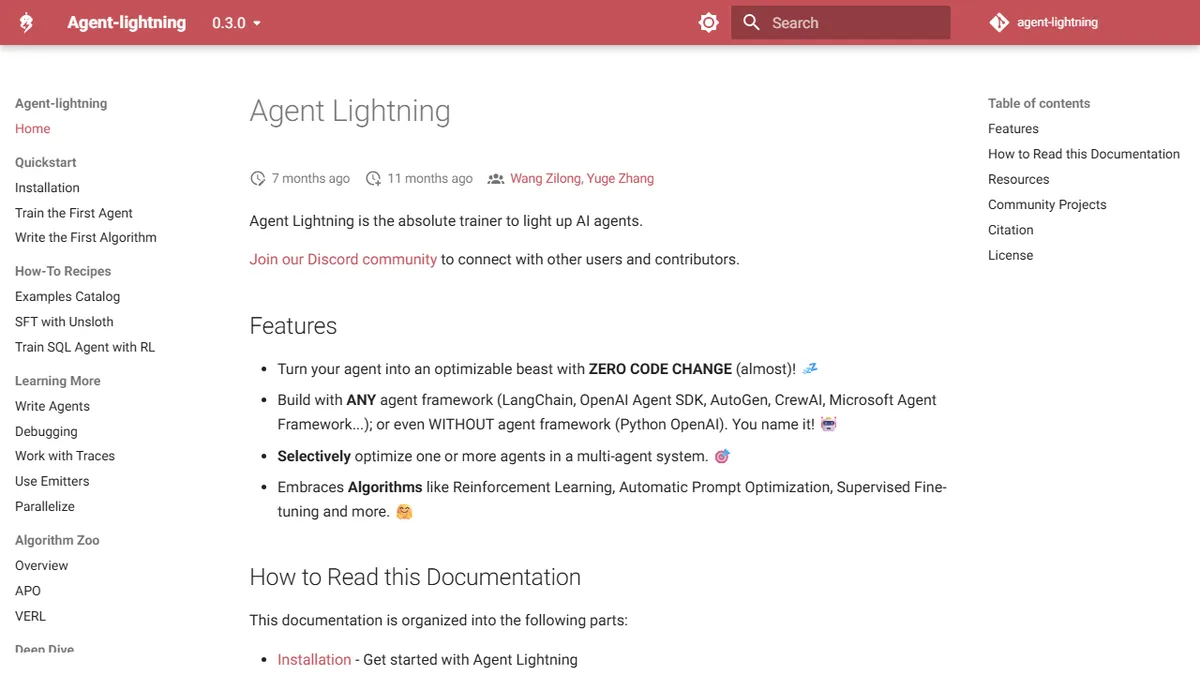
Agent Lightning is an open-source training framework from Microsoft Research that applies reinforcement learning, automatic prompt optimization, and supervised fine-tuning to existing AI agent systems. Its headline claim is "zero code change (almost)" — you point it at agents built in LangChain, OpenAI Agents SDK, AutoGen, CrewAI, the Microsoft Agent Framework, or even raw Python, and it learns to improve them without forcing you to rewrite the orchestration layer.
The framework is aimed squarely at developers and researchers building serious multi-agent systems who have hit the ceiling of prompt engineering and want a principled way to optimize specific agents inside a pipeline. Because it's framework-agnostic and supports selective optimization, you can target one weak agent in a chain without retraining the others. It's MIT-licensed, free to use, and lives on GitHub at microsoft/agent-lightning, with a Python API surface covering agents, algorithms, runners, and trainers.
Documentation includes recipes, algorithm deep-dives, and an active Discord community. There's no managed service or hosted offering — you bring your own compute and your own base models. That makes it a researcher-and-engineer tool rather than a no-code product, but it's one of the more credible attempts to make agent training a first-class workflow rather than a one-off project.
This is one of the few credible attempts to treat agent training as a real ML discipline rather than yet-another prompt-tuning UI. The framework-agnostic angle is the killer feature — most teams don't want to rewrite their stack just to try RL. Useful if you're past the demo phase and have real failure modes to fix.
— The AI Tool Bible editorial team
Pros
- ✅ Framework-agnostic — works with LangChain, AutoGen, CrewAI, OpenAI Agents SDK and more
- ✅ Combines RL, prompt optimization, and SFT in one trainer
- ✅ Minimal code changes to integrate with existing agent stacks
- ✅ Backed by Microsoft Research with active development and Discord support
- ✅ MIT-licensed and fully open source
Cons
- ⚠️ Requires ML engineering chops — not a no-code product
- ⚠️ No managed/hosted service; bring your own compute
- ⚠️ Docs assume familiarity with RL and agent internals
- ⚠️ Young project; APIs and recipes still evolving
Use cases
Frequently asked
- How much does Agent Lightning cost?
- Agent Lightning is completely free to use. It is an open-source project released under the MIT license. There are no subscription fees or managed service costs, though you must provide your own compute resources and base models.
- Which agent frameworks does Agent Lightning support?
- It is framework-agnostic and supports agents built in LangChain, OpenAI Agents SDK, AutoGen, CrewAI, the Microsoft Agent Framework, or raw Python. It allows you to optimize specific agents within a pipeline without rewriting the orchestration layer.
- Is Agent Lightning suitable for beginners or no-code users?
- No, it is not suitable for no-code users. It is designed for ML engineers and researchers who have already shipped a baseline agent. It requires you to bring your own compute and base models, making it a developer-focused tool rather than a hosted builder.
- What specific optimization techniques does Agent Lightning use?
- The framework applies reinforcement learning, automatic prompt optimization, and supervised fine-tuning to existing AI agent systems. It is designed for developers who have hit the ceiling of prompt engineering and need a principled way to improve specific agents in a multi-agent system.
- Does Agent Lightning require changing my existing agent code?
- Its headline claim is "zero code change (almost)." You can point it at existing agents and it learns to improve them without forcing you to rewrite the orchestration layer. It supports selective optimization, allowing you to target one weak agent without retraining others.
Explore related
Compare with similar tools
All in Agents →LangGraph
FeaturedStateful, graph-based agent orchestration from LangChain.
CrewAI
FeaturedPython framework for multi-agent orchestration.
Ernie Bot
Baidu's Mandarin-first ChatGPT rival, powered by the ERNIE model family
Moveworks
The enterprise AI assistant that searches, answers, and takes action across your business systems
AWS Bedrock
Build and scale generative AI applications with foundation models
Claude Agent SDK
Anthropic's official SDK for building autonomous Claude agents.