Rember vs Transept
A side-by-side look at pricing, capabilities, pros, cons, and our editorial scores.
 Rember Writing | Transept Writing | |
|---|---|---|
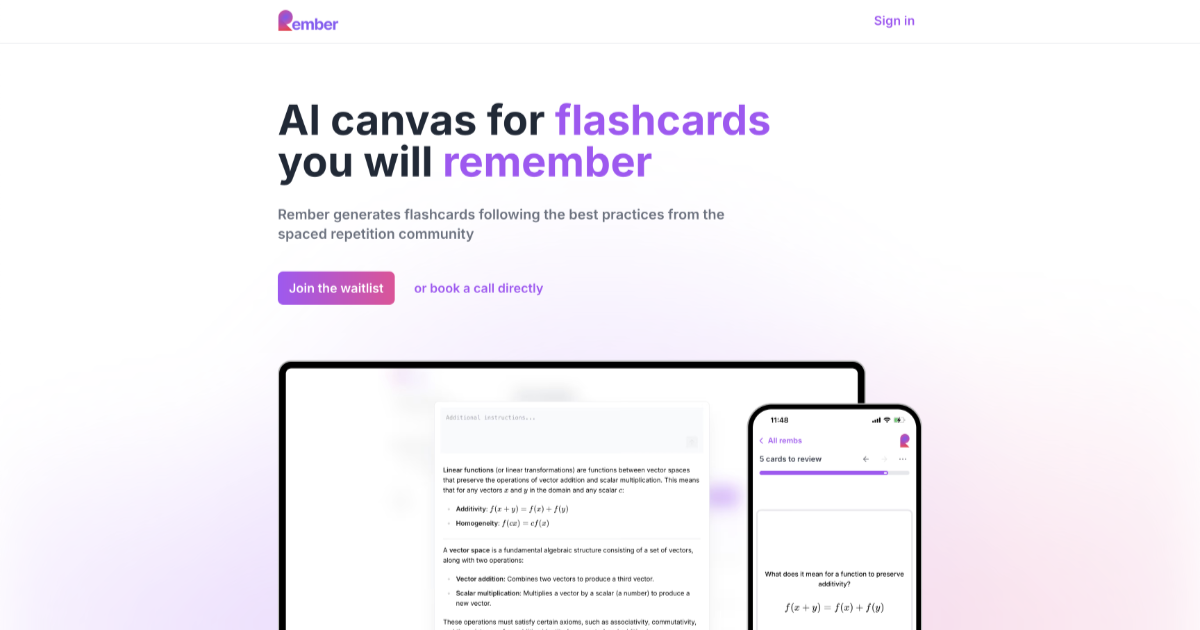
| Tagline | AI flashcard generator that turns PDFs, videos, and chats into spaced-repetition decks. | AI translation workspace with shared glossaries, styleguides, and decision-context memory |
| Category | Writing | Writing |
| Pricing | Freemium· Free up to 30 AI notes/mo; Pro $8/mo for 1,000 notes | Freemium· Free (1,500 words/mo) / Starter EUR 29/mo (100k words) / Pro EUR 79/mo (300k words). Additional word packs from EUR 19 (50k) to EUR 149 (500k). Extra seats EUR 29/user/mo, unlimited free viewer users. |
| Model | Multi-model | Multi-model (benchmarks Claude, GPT, Gemini, and open models; final routing not disclosed) |
| Editorial score | 7.0 / 10 | — |
| Use cases | flashcard generationspaced repetitionstudy aidpdf-to-notesvideo-to-notes | literary translationbook localizationmarketing copy translationbrand voice consistency across languagescollaborative translation reviewterminology glossary managementstyleguide enforcementNotion document localizationGoogle Drive document translationTMX/XLIFF export for CAT tools |
| Pros |
|
|
| Cons |
|
|
| Website | rember.com | transept.ai |
Pick Rember if
- ✅ Eliminates the worst part of SRS: hand-authoring cards
- ✅ Native MCP hooks into Claude and ChatGPT for inline capture
- ✅ Modern FSRS scheduling, not legacy SM-2
- ✅ Offline PWA with cross-device sync
Pick Transept if
- ✅ Decision-context memory records why a phrasing was chosen, not just the final word, which is unusual for MT tools
- ✅ Shared glossaries and styleguides apply across every document in a project, not per-file
- ✅ Side-by-side editor with sentence-level regeneration and custom rewrite prompts
- ✅ Handles real localization file formats (DOCX, PDF, Markdown, TMX/XLIFF) plus Notion and Google Drive