LynxKite vs Relevance AI
A side-by-side look at pricing, capabilities, pros, cons, and our editorial scores.
 LynxKite Agents | 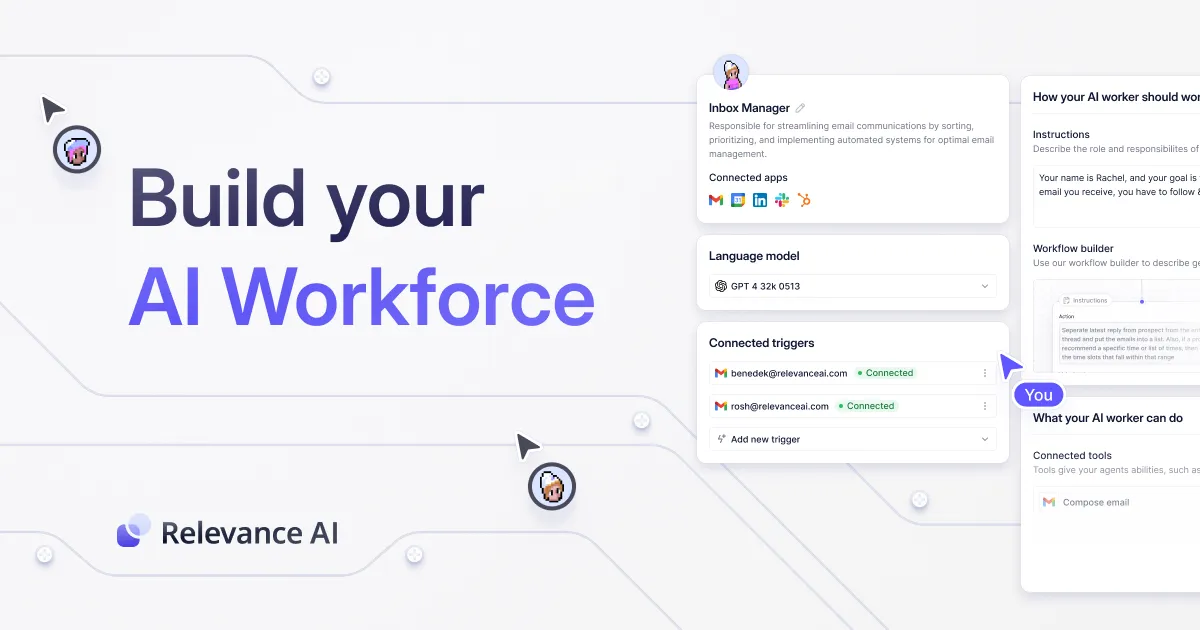 Relevance AI Agents | |
|---|---|---|
| Tagline | No-code AI orchestration platform built for graph-native pipelines in drug discovery and enterprise analytics. | Build and deploy an AI workforce of specialized agents across your business tools |
| Category | Agents | Agents |
| Pricing | Enterprise· Contact sales; no public pricing | Enterprise· Free trial available via the app. Paid tiers are quote-based (Enterprise): custom actions, unlimited agents/tools/users, dedicated account manager. Reported customer benchmarks cite an average cost of ~$0.09 per task at scale; no fixed public tier pricing. |
| Model | Multi-model (LLM agents + GNNs + NVIDIA BioNeMo) | Multi-model: Claude (Opus/Sonnet/Haiku), OpenAI GPT, Google Gemini, plus open-weight options (Kimi K2, GLM) |
| Editorial score | 6.9 / 10 | — |
| Use cases | drug-discoverygraph-neural-networksknowledge-graphsai-workflow-orchestrationenterprise-ml-pipelines | Outbound prospect research and personalisationMeeting prep and CRM hygieneSales call summarisation and follow-upDeal-review and pipeline QA copilotsCustomer support ticket triageInternal knowledge-base RAG assistantsApplicant screening and recruiter workflowsCompetitive intelligence briefingsMarketing content and campaign operationsCross-SaaS data reconciliation |
| Pros |
|
|
| Cons |
|
|
| Website | lynxkite.com | relevanceai.com |
Pick LynxKite if
- ✅ Graph-native: first-class GNNs and knowledge graphs, not bolted on
- ✅ GPU-accelerated via NVIDIA cuGraph and BioNeMo integrations
- ✅ No-code workflow builder usable by non-engineer domain experts
- ✅ Pre-built pharma pipelines shorten time to first model
Pick Relevance AI if
- ✅ No-code visual builder gets non-engineers shipping usable agents quickly
- ✅ Model-agnostic routing across Claude, GPT, Gemini and open-weight models lets you optimise cost vs. quality per step
- ✅ Very large integration catalogue (1,000+ apps) including Salesforce, HubSpot, Slack, Gmail
- ✅ Built-in evaluation and cost-monitoring framework — rare in this category and important for production use