
LynxKite
No-code AI orchestration platform built for graph-native pipelines in drug discovery and enterprise analytics.
In short
LynxKite is a composable AI orchestration platform featuring a drag-and-drop builder for assembling LLM agents, graph neural networks, and ML steps into reproducible pipelines. It is best suited for preclinical pharmaceutical R&D and enterprise teams needing graph reasoning over complex data without writing glue code.
Pick LynxKite if you are a pharma or enterprise R&D team that needs graph-native AI pipelines built collaboratively by scientists, not just ML engineers.
Skip it if you want a self-serve, public-priced LLM tool or a generic agent builder without the graph and life-sciences focus.
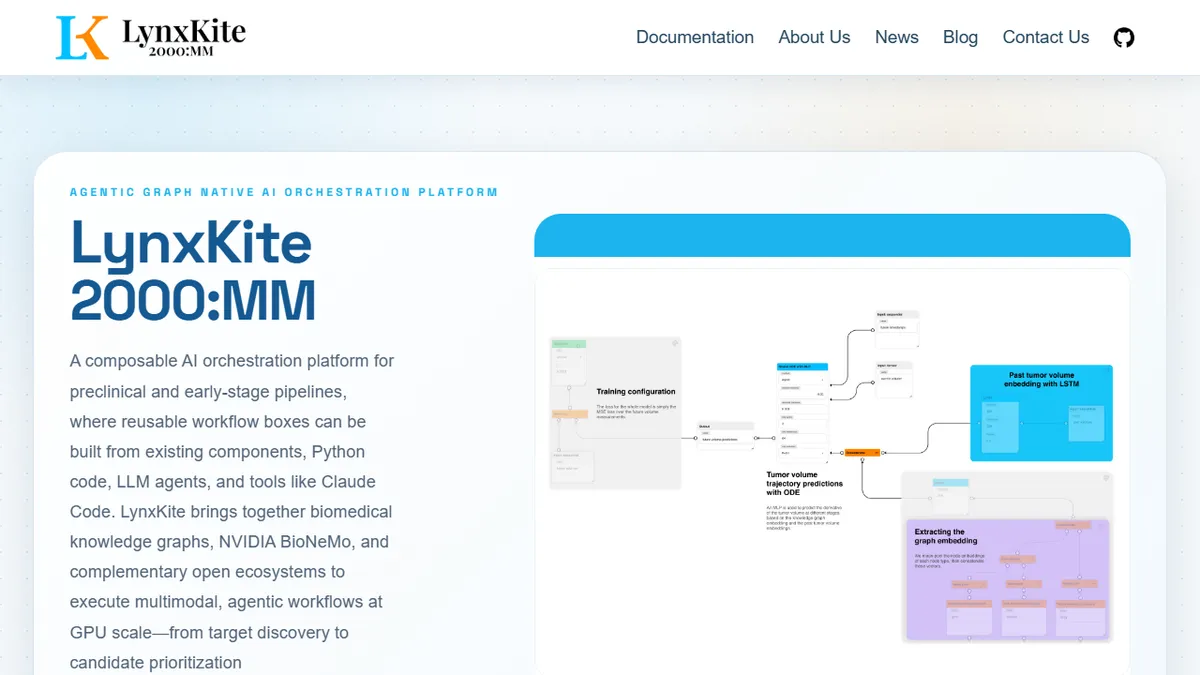
LynxKite (now branded LynxKite 2000:MM) is a composable AI orchestration platform with a drag-and-drop workflow builder for assembling LLM agents, graph neural networks, and conventional ML steps into reproducible pipelines. It is graph-native at heart: knowledge graphs, GNNs, and NVIDIA cuGraph acceleration sit alongside multi-modal connectors that pull in structured, unstructured, and relational data, so teams can model real-world relationships without writing glue code.
The sharpest fit is preclinical and early-stage pharmaceutical R&D, where LynxKite ships pre-built workflows for indication selection, compound screening, pharmacokinetic modeling, and clinical trial optimisation, with NVIDIA BioNeMo models wired in for biomedical work. Outside life sciences, the same building blocks are pitched at financial services and retail teams that need graph reasoning over messy enterprise data. Pricing is not published on the site, which is a strong tell that this is an enterprise sales motion rather than a self-serve SaaS.
There is some lineage to be aware of: an older Apache Spark-era LynxKite (5.x) is open source on GitHub, but the current 2000:MM commercial product is a distinct, closed-by-default platform with custom plugins and API integrations. Treat the legacy repo as a different product when scoping a project.
LynxKite is one of the few orchestration platforms that takes graphs seriously instead of treating them as a side feature, and the BioNeMo and cuGraph wiring make it a credible pick for drug-discovery teams. The catch is opacity: closed source, no pricing, and a clear enterprise-only posture mean smaller teams should look elsewhere.
— The AI Tool Bible editorial team
Pros
- ✅ Graph-native: first-class GNNs and knowledge graphs, not bolted on
- ✅ GPU-accelerated via NVIDIA cuGraph and BioNeMo integrations
- ✅ No-code workflow builder usable by non-engineer domain experts
- ✅ Pre-built pharma pipelines shorten time to first model
Cons
- ⚠️ No public pricing; enterprise sales cycle required
- ⚠️ Current 2000:MM version is not open source (older 5.x is)
- ⚠️ Narrow sweet spot outside pharma, finance, and retail verticals
Use cases
Frequently asked
- Who is LynxKite best for?
- LynxKite is best for pharma or enterprise R&D teams that need graph-native AI pipelines built collaboratively by scientists rather than just ML engineers. It also serves financial services and retail teams requiring graph reasoning over messy enterprise data.
- Does LynxKite support open source?
- The current commercial product, LynxKite 2000:MM, is closed-by-default. While an older Apache Spark-era version (5.x) was open source on GitHub, it is considered a distinct product from the current platform.
- What are the key technical features?
- Key features include a no-code drag-and-drop workflow builder, first-class GNNs and knowledge graphs, NVIDIA cuGraph acceleration, and integrations with NVIDIA BioNeMo models for biomedical work.
- Is there public pricing or a free trial?
- There is no public pricing available as it requires contacting sales for an enterprise motion. Additionally, LynxKite does not offer a free trial.
Explore related
Compare with similar tools
All in Agents →LangGraph
FeaturedStateful, graph-based agent orchestration from LangChain.
CrewAI
FeaturedPython framework for multi-agent orchestration.
Ernie Bot
Baidu's Mandarin-first ChatGPT rival, powered by the ERNIE model family
Moveworks
The enterprise AI assistant that searches, answers, and takes action across your business systems
AWS Bedrock
Build and scale generative AI applications with foundation models
Claude Agent SDK
Anthropic's official SDK for building autonomous Claude agents.