Granola vs Rember
A side-by-side look at pricing, capabilities, pros, cons, and our editorial scores.
 Granola Writing | 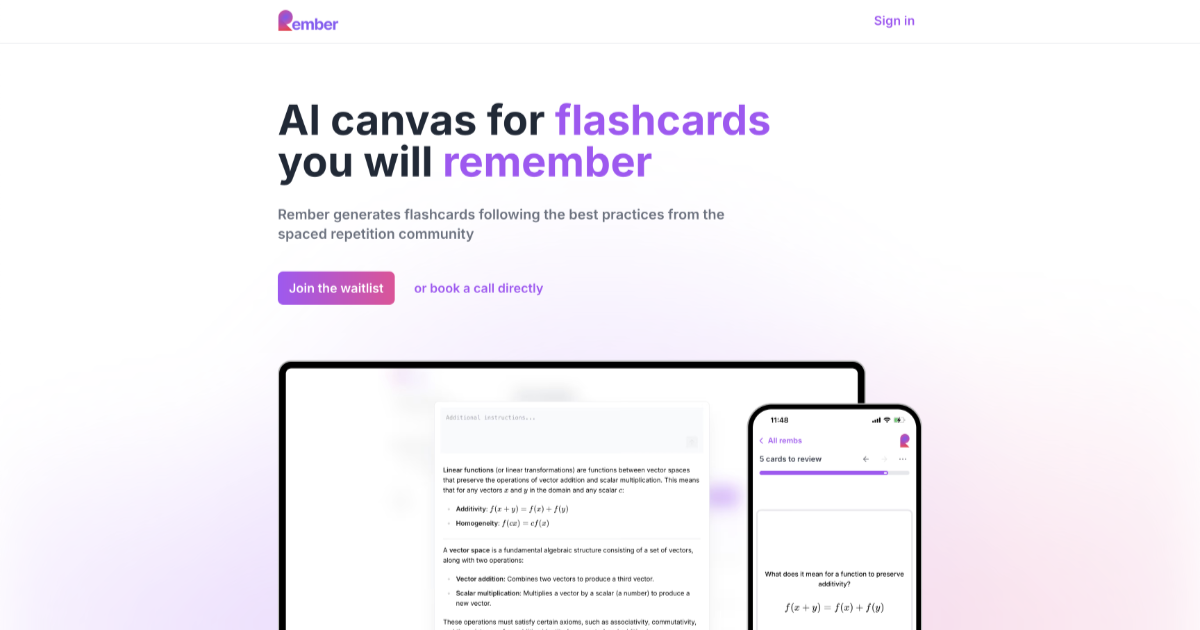 Rember Writing | |
|---|---|---|
| Tagline | AI notepad for back-to-back meetings — captures audio locally, drafts structured notes | AI flashcard generator that turns PDFs, videos, and chats into spaced-repetition decks. |
| Category | Writing | Writing |
| Pricing | Freemium· Basic Free / Business $14 per user/mo / Enterprise $35 per user/mo | Freemium· Free up to 30 AI notes/mo; Pro $8/mo for 1,000 notes |
| Model | — | Multi-model |
| Editorial score | — | 7.0 / 10 |
| Use cases | Sales discovery call notesCustomer interview summaries1:1 and standup writeupsInvestor meeting recapsFollow-up email draftingAction item extractionCross-meeting knowledge searchFeeding meeting context to Claude or ChatGPT via MCPConsulting client call documentationProduct user research synthesis | flashcard generationspaced repetitionstudy aidpdf-to-notesvideo-to-notes |
| Pros |
|
|
| Cons |
|
|
| Website | www.granola.ai | rember.com |
Pick Granola if
- ✅ No bot joins the call — captures system audio locally, so it works in impromptu huddles and doesn't announce itself to guests
- ✅ The 'expand my shorthand' flow is genuinely different from pure transcription tools — you stay engaged in the meeting instead of drifting because a bot is 'handling it'
- ✅ Cross-meeting chat turns months of notes into a searchable knowledge base you can query in natural language
- ✅ Templates are customizable per meeting type and the outputs stay consistent across a team
Pick Rember if
- ✅ Eliminates the worst part of SRS: hand-authoring cards
- ✅ Native MCP hooks into Claude and ChatGPT for inline capture
- ✅ Modern FSRS scheduling, not legacy SM-2
- ✅ Offline PWA with cross-device sync