Forefront vs PyTorch Lightning
A side-by-side look at pricing, capabilities, pros, cons, and our editorial scores.
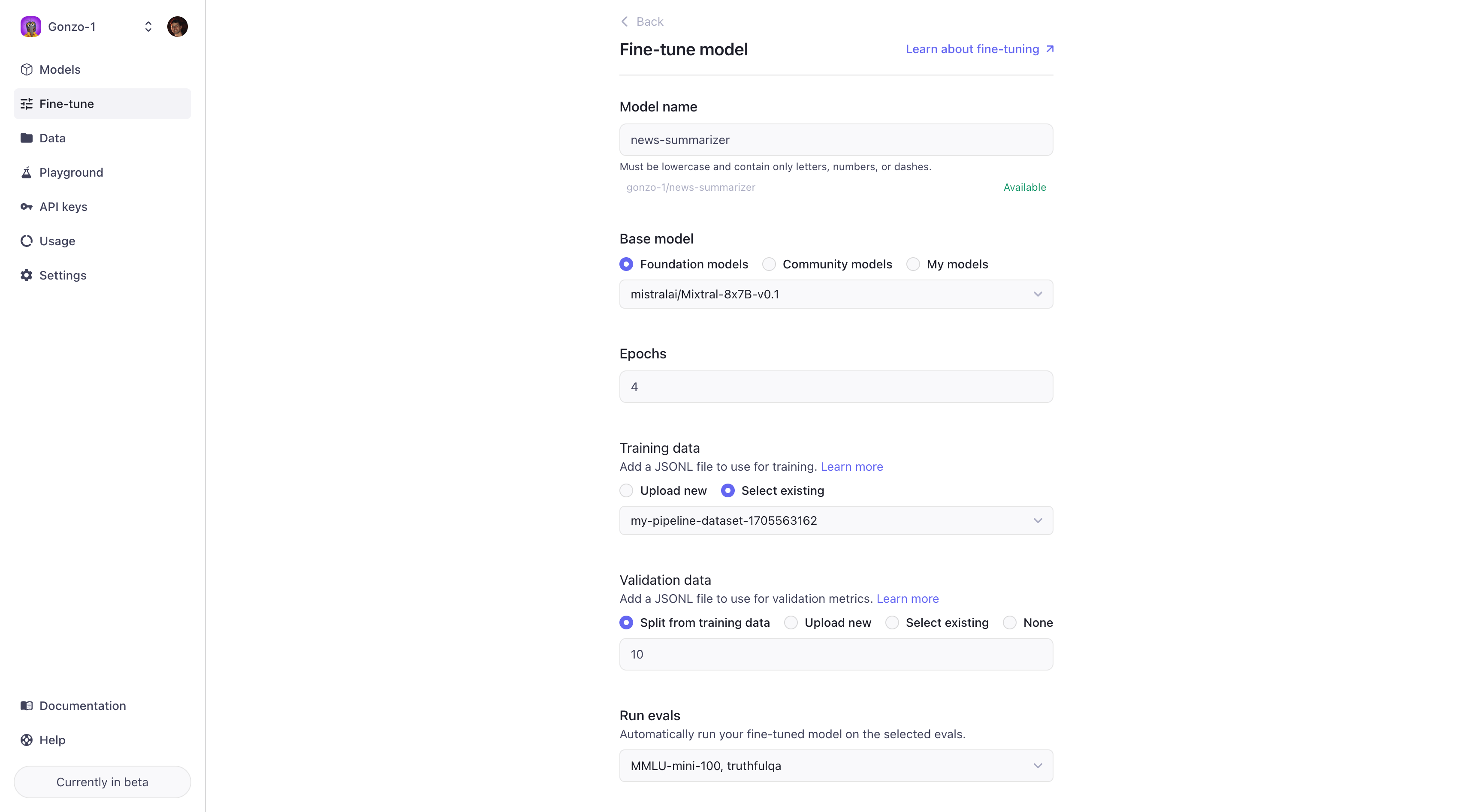 Forefront Fine-tuning | PyTorch Lightning Fine-tuning | |
|---|---|---|
| Tagline | Fine-tune and serve open-source LLMs on your own data without managing GPUs. | The deep learning framework for professional AI researchers and ML engineers |
| Category | Fine-tuning | Fine-tuning |
| Pricing | Paid· Basic: $20 · Pro: $50 · Enterprise: Contact sales | Free· Free and open source (Apache 2.0). Optional paid compute available via the Lightning AI Studio platform. |
| Model | Multi-model (Mistral-7B, Mixtral, Phi-2) | Framework-agnostic — trains any PyTorch model (transformers, CNNs, diffusion, RL nets, etc.) |
| Editorial score | 7.0 / 10 | — |
| Use cases | fine-tuningopen-source-llmsmodel-hostinginference-apimodel-evaluation | Multi-GPU LLM fine-tuningComputer vision model trainingSelf-supervised pretrainingReinforcement learning experimentsDistributed training on TPU/GPU clustersHyperparameter sweepsReproducible research pipelinesProduction model training jobs |
| Pros |
|
|
| Cons |
|
|
| Website | forefront.ai | lightning.ai |
Pick Forefront if
- ✅ End-to-end workflow: data, training, eval, and inference in one platform
- ✅ No GPU provisioning — serverless scaling with per-token pricing
- ✅ Built-in benchmarks (MMLU, TruthfulQA, HumanEval) for fine-tune evaluation
- ✅ Model export lets you take fine-tuned weights to self-hosted infra
Pick PyTorch Lightning if
- ✅ Removes boilerplate training-loop code while keeping full PyTorch flexibility and access to every low-level hook
- ✅ Same LightningModule scales from laptop to multi-node clusters via DDP, FSDP, DeepSpeed and TPU strategies with a config flag
- ✅ Built-in mixed precision, gradient accumulation, checkpointing, early stopping and profiling out of the box
- ✅ First-class integrations with TorchMetrics, W&B, MLflow, TensorBoard and Hugging Face models/datasets