AI Toolbox vs Rember
A side-by-side look at pricing, capabilities, pros, cons, and our editorial scores.
AI Toolbox Writing | 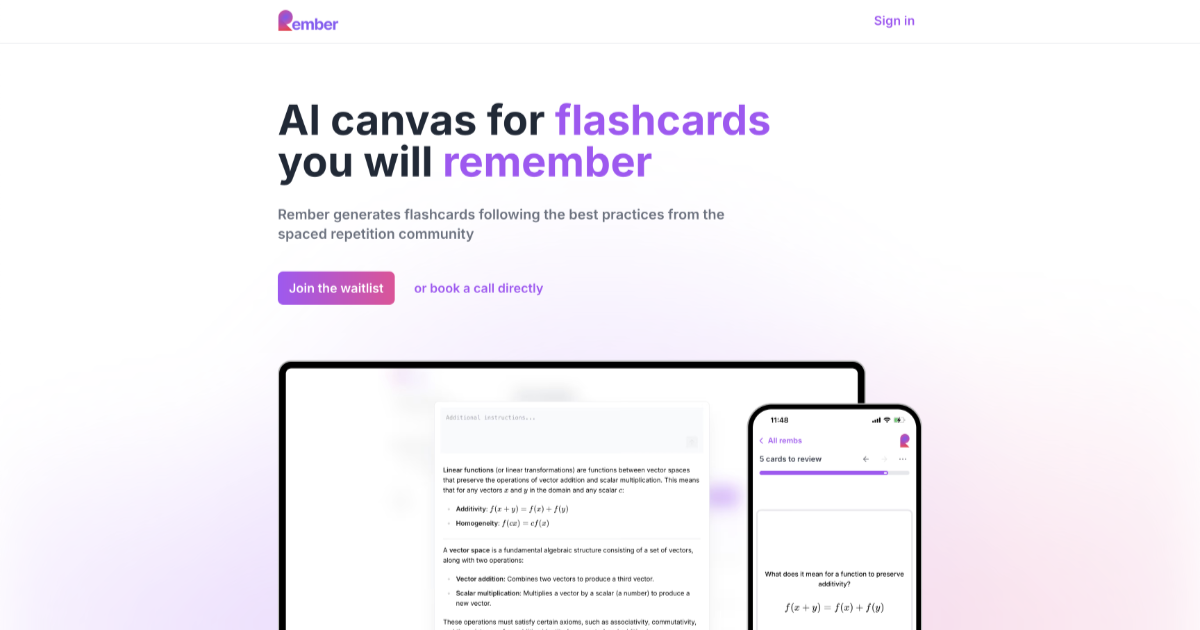 Rember Writing | |
|---|---|---|
| Tagline | One Chrome extension for ChatGPT, Gemini, Claude, and Grok | AI flashcard generator that turns PDFs, videos, and chats into spaced-repetition decks. |
| Category | Writing | Writing |
| Pricing | Freemium· Free (2 folders, 5 search results, 2 bookmarks) / Premium Monthly $9.99 per platform / Premium Lifetime $99 per platform / All Access Lifetime $199 for all four platforms | Freemium· Free up to 30 AI notes/mo; Pro $8/mo for 1,000 notes |
| Model | — | Multi-model |
| Editorial score | — | 7.0 / 10 |
| Use cases | Organizing ChatGPT and Claude chat history into foldersFull-text search across past LLM conversationsExporting AI chats to Markdown or PDF as deliverablesReusable prompt template libraryPrompt chaining across multi-step workflowsBookmarking specific messages inside long threadsCollecting Claude artifacts in one vaultSharing a prompt playbook across ChatGPT, Claude, Gemini, and Grok | flashcard generationspaced repetitionstudy aidpdf-to-notesvideo-to-notes |
| Pros |
|
|
| Cons |
|
|
| Website | www.ai-toolbox.co | rember.com |
Pick AI Toolbox if
- ✅ One extension covers ChatGPT, Claude, Gemini, and Grok, so you keep the same folder tree and prompt library across models
- ✅ Full-text search across message bodies fixes the single biggest gap in every native LLM chat UI
- ✅ Multi-format export (TXT, MD, JSON, PDF) makes chats usable as deliverables or version-control inputs
- ✅ Prompt templates with variables and chained prompts remove the copy-paste tax on repeated workflows
Pick Rember if
- ✅ Eliminates the worst part of SRS: hand-authoring cards
- ✅ Native MCP hooks into Claude and ChatGPT for inline capture
- ✅ Modern FSRS scheduling, not legacy SM-2
- ✅ Offline PWA with cross-device sync