YAFL
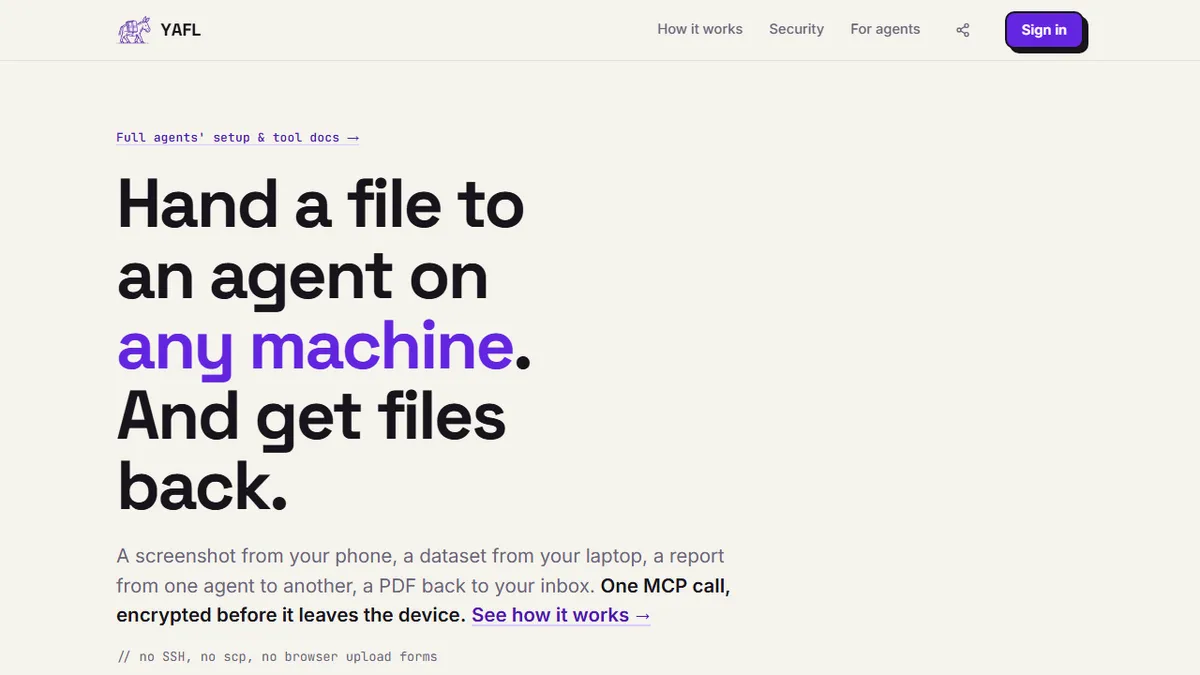
Agent-first, end-to-end-encrypted file transfer over one MCP call or CLI command.
In short
YAFL facilitates secure, asynchronous file handoffs between AI agents using a single MCP call or CLI command. It is best for developers moving files between different machines without managing SSH keys or shared cloud storage.
Developers wiring MCP-based agents across a laptop, phone, and VPS who need a one-call way to hand encrypted files between environments without scp key juggling or cloud-drive setup.
Teams needing large-file transfer (>100 MB), long-lived shared storage, self-hosted or open-source deployment, or contractual SLAs and audit logs for regulated workloads.
YAFL (Yet Another File Layer) is a purpose-built file-transfer layer for AI agents and the developers driving them. Its central idea is that agents living on different machines - a laptop, a VPS, a Docker container, a phone via SSH - shouldn't need scp keys, shared cloud drives, or human copy-paste to hand each other a screenshot, a PDF, a build artifact, or a zipped project directory. Instead, an agent invokes a single MCP tool call (upload_file / download_file) or the yafl CLI, and gets back a share link the receiving agent can dereference with one call of its own.
Everything is encrypted client-side with a fresh AES-256-GCM key before it leaves the machine. The decryption key travels only in the URL fragment (never transmitted to any server, and the site's Matomo config is explicitly patched to strip fragments to avoid leaking it). The app server and R2 object storage only ever see ciphertext, links auto-expire after 24 hours, and there is a 100 MB per-transfer cap. Optional password protection and one-time (burn-after-read) links are supported.
YAFL ships an MCP server (npx @yafldev/mcp), a global CLI (@yafldev/cli with put/get/status/list/delete/whoami), a Claude Desktop .mcpb bundle for one-click install, a REST API (POST /api/v1/transfers, complete, GET, DELETE), and a Claude-Code-style skill file. Login uses RFC 8628 device flow tied to a verified-email account. Common workflows: piping a screenshot from your phone into Claude Code running on a VPS, moving a build artifact between two servers that can't SSH to each other, or letting agent A drop a file for agent B to pick up asynchronously within the 24h window.
A refreshingly narrow tool that fills a real gap: agent-to-agent file handoff without the scp dance. The threat model is spelled out, the fragment-key discipline is respected end-to-end (even in the analytics config), and the MCP surface is small enough that agents actually use it correctly. The 100 MB cap and closed-source, hosted-only model keep it firmly in the utility bucket rather than the infrastructure bucket - but for its job, it's the tidiest option I've seen.
— The AI Tool Bible editorial team
Pros
- ✅ MCP-first: drops straight into Claude Desktop, Claude Code, Cursor and other MCP clients with one npx config block.
- ✅ True end-to-end encryption - AES-256-GCM client-side, key in the URL fragment, server only ever holds ciphertext.
- ✅ Async by design: 24-hour link acts as a buffer, so sender and receiver agents never need to be online at the same time.
- ✅ Same primitives available as CLI, MCP tools, and REST API, so scripts and agents share one mental model.
- ✅ Sensible security defaults: expiring links, one-time-download option, password protection, no fragments logged to analytics.
- ✅ Zero-setup retrieval - anyone with the link can download without an account or API key.
- ✅ Practical developer touches: .mcpb bundle for Claude Desktop, a shipped SKILL.md, machine-readable JSON output, honest exit codes.
Cons
- ⚠️ 100 MB per-transfer cap and hard 24-hour expiry rule out large datasets, model weights, or long-lived shares.
- ⚠️ Not open source - the server is hosted by YAFL, so security-conscious teams must trust operator claims about ciphertext-only storage.
- ⚠️ Free service with no stated SLA or paid tier; production reliance is at your own risk if traffic or the project changes.
- ⚠️ Requires Node 20+ and account creation with a verified email for uploads, which is friction for locked-down enterprise laptops.
- ⚠️ Losing the URL fragment means losing the file forever - there is no server-side recovery path by design.
Use cases
Frequently asked
- How does YAFL ensure file security during transfer?
- Files are encrypted client-side with AES-256-GCM before leaving the machine. The decryption key travels only in the URL fragment, which is never transmitted to the server or logged in analytics.
- What are the file size and expiration limits for YAFL transfers?
- There is a 100 MB per-transfer cap. All share links automatically expire after 24 hours, and optional one-time download links are supported.
- How can AI agents interact with YAFL?
- Agents can use the MCP server via npx or the yafl CLI. The tool provides upload_file and download_file MCP tools, as well as a REST API for programmatic access.
- Is YAFL open source or self-hostable?
- No, YAFL is not open source and the server is hosted by the provider. It does not support self-hosted deployment or open-source installation.
- What are the requirements to use YAFL for uploads?
- Users must have Node 20+ installed and create an account with a verified email address. The service is free to use with no paid tiers currently advertised.
Explore related
Compare with similar tools
All in Agents →LangGraph
FeaturedStateful, graph-based agent orchestration from LangChain.
CrewAI
FeaturedPython framework for multi-agent orchestration.
Ernie Bot
Baidu's Mandarin-first ChatGPT rival, powered by the ERNIE model family
Moveworks
The enterprise AI assistant that searches, answers, and takes action across your business systems
AWS Bedrock
Build and scale generative AI applications with foundation models
Claude Agent SDK
Anthropic's official SDK for building autonomous Claude agents.