
Valohai
MLOps platform for versioned pipelines, distributed training, and LLM evaluation across any cloud.
In short
Valohai provides a mature MLOps platform for versioned pipelines, distributed training, and LLM evaluation across any cloud or on-prem. It is best for regulated industries requiring cloud-agnostic infrastructure and strong data lineage without hyperscaler lock-in.
Pick Valohai if you're an ML platform team that needs reproducible pipelines and training across multiple clouds or on-prem without committing to one hyperscaler's stack.
Skip it if you're a solo developer, a hobbyist, or a team whose workloads fit comfortably inside SageMaker, Vertex AI, or a single notebook.
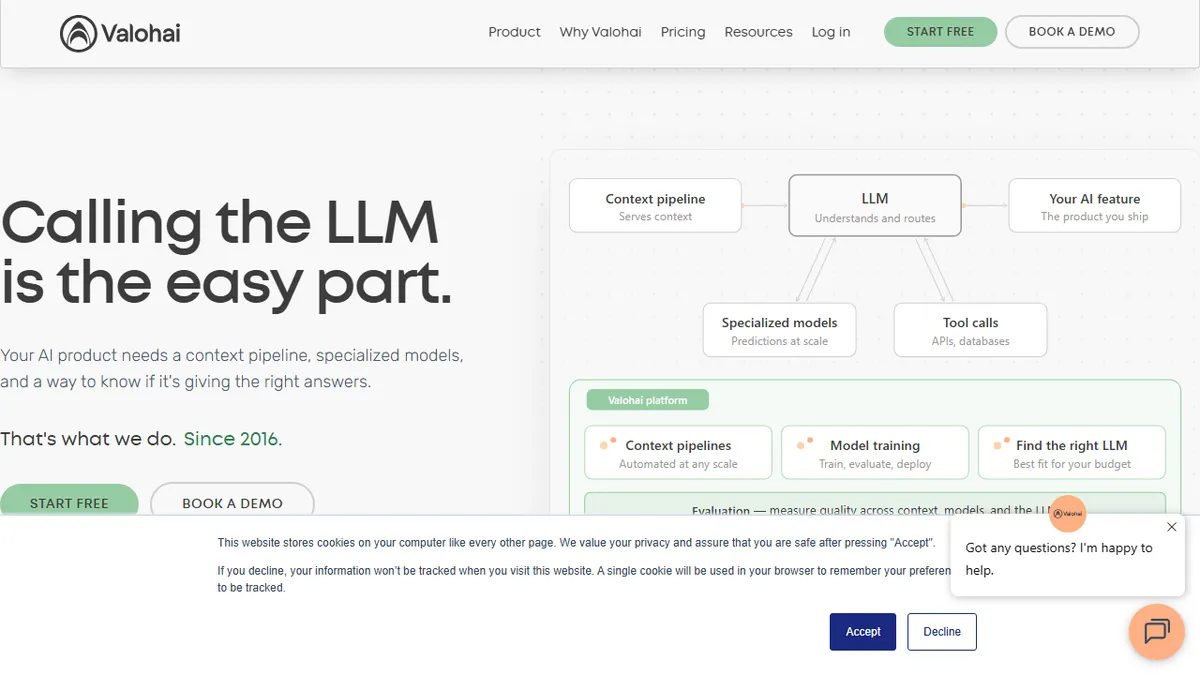
Valohai is a Finnish MLOps platform that has been around since 2016, built for teams that need to run reproducible machine learning pipelines across multiple clouds or on their own hardware. It handles the unglamorous infrastructure work around AI products: dataset versioning, experiment tracking, distributed training on multi-GPU/multi-node clusters, model deployment, and lineage from raw data through to production endpoints. More recently it has added LLM-specific tooling, including systematic evaluation of models across cost, latency, and quality, plus pipelines with conditional logic and human-in-the-loop approval steps.
Where Valohai differentiates itself from Databricks, SageMaker, or Vertex AI is its cloud-agnostic stance. It runs on AWS, Azure, GCP, Oracle Cloud, OVHcloud, and on-prem, and is pitched at regulated or sovereignty-conscious teams (aerospace, medical imaging, finance) that don't want to be locked into one hyperscaler. Datasets up to 18TB can be cached and versioned without duplication. Pricing isn't published; it's a sales-led enterprise product with a no-credit-card free trial at app.valohai.com.
Integrations cover the standard Python ML stack (PyTorch, transformers, scikit-learn), and there's a `valohai-llm` Python package plus a documented API for wiring it into existing CI/CD. It's not open source, and it's overkill for solo practitioners or anyone happy in a notebook.
Valohai is the quiet, competent choice in MLOps: less buzz than Databricks but a much cleaner story if multi-cloud or on-prem matters to you. The recent LLM evaluation tooling is a sensible bolt-on rather than a pivot, and the platform's lineage discipline pays off the first time a regulator asks how a model was trained.
— The AI Tool Bible editorial team
Pros
- ✅ Genuinely cloud-agnostic: AWS, Azure, GCP, Oracle, OVH, on-prem
- ✅ Strong lineage and reproducibility across data, code, and models
- ✅ Handles distributed multi-GPU training without bespoke infra work
- ✅ Free trial requires no credit card
- ✅ Mature platform (since 2016) with regulated-industry customers
Cons
- ⚠️ No public pricing; enterprise sales motion
- ⚠️ Not open source
- ⚠️ Overkill for small teams or notebook-only workflows
- ⚠️ Learning curve to model pipelines in Valohai's YAML conventions
Use cases
Frequently asked
- Which cloud providers does Valohai support?
- Valohai is cloud-agnostic and runs on AWS, Azure, GCP, Oracle Cloud, OVHcloud, and on-premises hardware. This allows teams to avoid locking into a single hyperscaler.
- What specific LLM features does Valohai offer?
- The platform includes LLM-specific tooling for systematic evaluation of models across cost, latency, and quality. It also supports pipelines with conditional logic and human-in-the-loop approval steps.
- Is Valohai suitable for solo developers or small teams?
- No, Valohai is considered overkill for solo practitioners, hobbyists, or teams whose workloads fit comfortably inside a single notebook or existing platform like SageMaker.
- How is Valohai priced?
- Valohai is an enterprise product with a sales-led pricing model. There is no public pricing, but a free trial is available without requiring a credit card.
- Does Valohai support distributed training?
- Yes, it handles distributed training on multi-GPU and multi-node clusters without requiring bespoke infrastructure work. It also manages dataset versioning and experiment tracking.
Explore related
Compare with similar tools
All in Agents →LangGraph
FeaturedStateful, graph-based agent orchestration from LangChain.
CrewAI
FeaturedPython framework for multi-agent orchestration.
Ernie Bot
Baidu's Mandarin-first ChatGPT rival, powered by the ERNIE model family
Moveworks
The enterprise AI assistant that searches, answers, and takes action across your business systems
AWS Bedrock
Build and scale generative AI applications with foundation models
Claude Agent SDK
Anthropic's official SDK for building autonomous Claude agents.