
Taskade
AI-powered workspace that turns natural-language prompts into apps, agents, and automated workflows.
In short
Taskade is a productivity platform that generates working apps, multi-agent teams, and automations from plain English prompts. It consolidates docs, tasks, and chat into a single workspace, ideal for operators who want to avoid stitching together separate tools.
Pick Taskade if you're a small team or solo operator who wants docs, tasks, and AI agents in one workspace instead of stitching three tools together.
Skip it if you're an engineer who'd rather call models directly or need a deep specialist agent framework with code-level control.
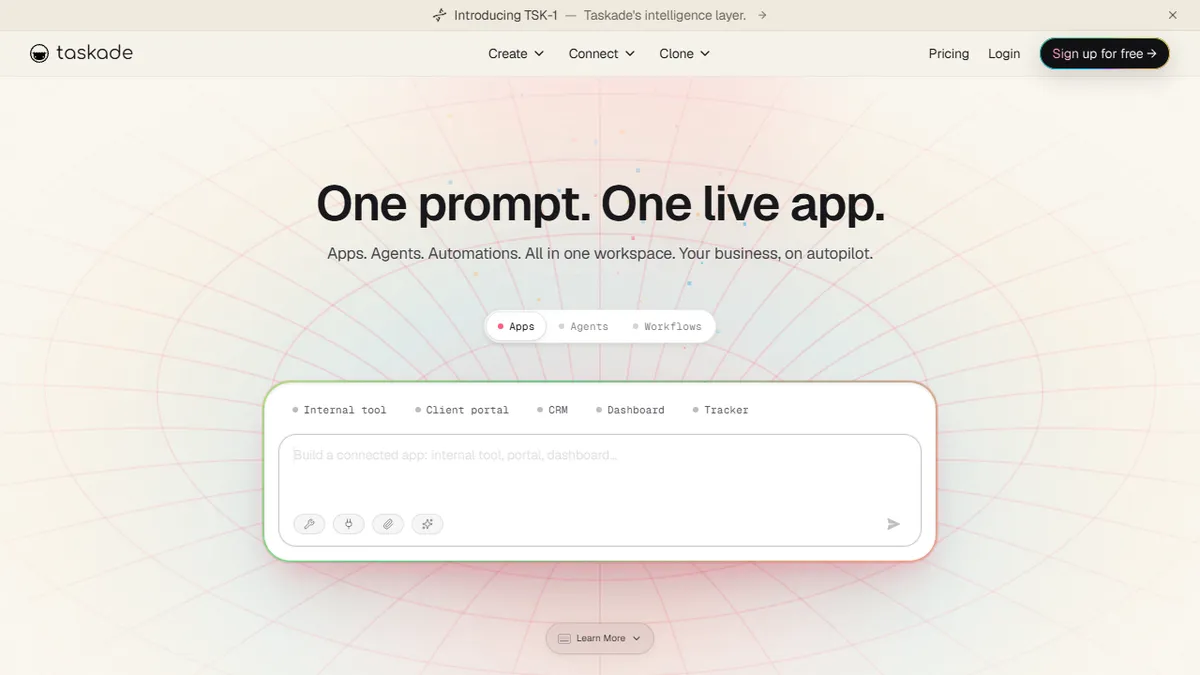
Taskade is a productivity platform that has pivoted hard into AI agents and app-building. Its current incarnation (branded 'Genesis') lets you describe a business workflow in plain English and have the platform generate a working app, multi-agent team, or automation around it — think sales CRMs, client portals, dashboards, or booking systems spun up from a prompt rather than wired together by hand. Underneath the agent layer, it can route work to multiple frontier models (Claude, GPT, Gemini) and persist workspace memory across runs.
It sits in an awkward middle ground between project-management tools (Notion, ClickUp) and agent builders (Relevance AI, Lindy), and that's the pitch: one workspace for docs, tasks, chat, and the agents that act on them. Pricing is freemium with a generous free tier for solo users; paid plans unlock custom domains for published apps, more integrations, and team features. Best for operators and small teams who want to consolidate tools rather than glue together a separate PM app and a separate agent stack.
There's a Developer API (docs.taskade.com) for custom integrations and 100+ prebuilt connectors. It's proprietary SaaS — not open source — and the heavy focus on no-code app generation means it's less suited to engineers who'd rather call models directly. Y Combinator-backed, actively developed, and one of the more credible 'AI workspace' contenders.
Taskade has done a smart job pivoting from yet-another-PM-app into a credible AI-agent workspace. The Genesis app-builder demos are impressive, and the multi-model routing is a nice touch. Just go in knowing it's a generalist — power users of dedicated agent frameworks will hit ceilings.
— The AI Tool Bible editorial team
Pros
- ✅ One workspace for docs, tasks, agents, and automations
- ✅ Generate working apps and multi-agent teams from a prompt
- ✅ Routes to multiple frontier models (Claude, GPT, Gemini)
- ✅ 100+ integrations and a public developer API
- ✅ Genuinely usable free tier
Cons
- ⚠️ Jack-of-all-trades positioning can feel unfocused vs. specialists
- ⚠️ Generated apps less flexible than hand-built code
- ⚠️ Proprietary SaaS, no self-hosting option
Use cases
Frequently asked
- What kind of applications can Taskade generate?
- Taskade can generate working apps such as sales CRMs, client portals, dashboards, and booking systems from natural language prompts. It also creates multi-agent teams and automations around business workflows.
- Which AI models does Taskade support?
- Taskade routes work to multiple frontier models, including Claude, GPT, and Gemini. It persists workspace memory across runs and offers a public developer API for custom integrations.
- Is Taskade suitable for software engineers?
- It is less suited to engineers who prefer calling models directly or need code-level control, as it focuses on no-code app generation. It is best for small teams and solo operators wanting to consolidate tools.
- What are the pricing options for Taskade?
- Taskade offers a freemium model with a generous free tier for solo users. Paid plans unlock custom domains, more integrations, and team features.
Explore related
Compare with similar tools
All in Agents →LangGraph
FeaturedStateful, graph-based agent orchestration from LangChain.
CrewAI
FeaturedPython framework for multi-agent orchestration.
Ernie Bot
Baidu's Mandarin-first ChatGPT rival, powered by the ERNIE model family
Moveworks
The enterprise AI assistant that searches, answers, and takes action across your business systems
AWS Bedrock
Build and scale generative AI applications with foundation models
Claude Agent SDK
Anthropic's official SDK for building autonomous Claude agents.