
SWE-agent
Open-source autonomous agent framework that lets LLMs fix GitHub issues and find security vulnerabilities by using a custom agent-computer interface.
In short
SWE-agent is a free, open-source framework that lets LLMs fix GitHub issues and find vulnerabilities. It is a hackable research baseline, not a hosted product.
Pick SWE-agent if you're a researcher or engineer who wants a hackable, reproducible coding-agent baseline you can wire to any LLM.
Skip it if you want a plug-and-play hosted coding assistant - reach for Cursor, Devin, or Cline instead.
SWE-agent is an open-source autonomous coding agent built by researchers at Princeton and Stanford that turns a language model into a software engineer. It gives the LLM a tightly-scoped agent-computer interface (ACI) for navigating repos, editing files, running tests, and iterating on fixes, and it was one of the first agents to post serious numbers on SWE-bench - including state-of-the-art results among open-source projects when it launched. A sibling mode, EnIGMA, retargets the same loop at offensive-security CTF challenges.
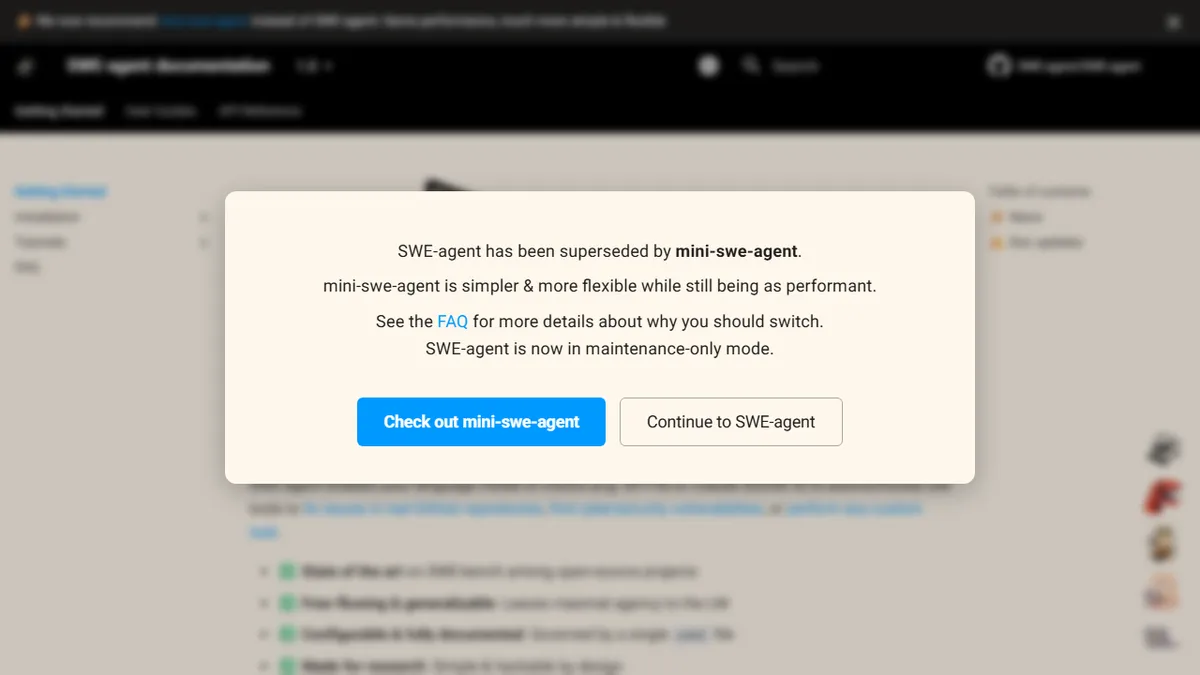
It's aimed at researchers and engineers who want a hackable agent rather than a polished SaaS. Configuration is a single YAML file, you bring your own API key (GPT-4o, Claude Sonnet, DeepSeek, or local models via LiteLLM), and you run it yourself - there's no hosted product, no pricing page, no signup. The team has explicitly moved focus to mini-swe-agent, a 100-line successor, and labels the original repo as maintenance-only, so treat SWE-agent as a stable research baseline rather than an actively-developed product.
It integrates with GitHub issues, Docker-sandboxed execution, and the SWE-bench evaluation harness, and is widely cited as a reference implementation for tool-using coding agents. Caveat: LLM API costs are on you, and on real-world tasks they add up quickly.
SWE-agent is a foundational piece of the open coding-agent canon and still worth studying, but the team has moved on to mini-swe-agent and says so on the front page. Use it as a research reference or a starting fork; for daily-driver coding, pick something actively maintained.
— The AI Tool Bible editorial team
Pros
- ✅ Open-source under MIT with a strong research pedigree (Princeton/Stanford)
- ✅ Model-agnostic via LiteLLM - swap GPT-4o, Claude, or local models freely
- ✅ Reproducible SWE-bench harness makes it a credible baseline for agent research
- ✅ EnIGMA mode extends the same loop to CTF-style security tasks
Cons
- ⚠️ Officially in maintenance mode; team now recommends mini-swe-agent
- ⚠️ No hosted product, GUI, or managed service - CLI and YAML only
- ⚠️ LLM API costs on long-horizon tasks can be significant
- ⚠️ Setup requires Docker and comfort with Python tooling
Use cases
Frequently asked
- How much does SWE-agent cost?
- SWE-agent is free and open-source. However, you must pay your own LLM API costs, which can add up quickly on real-world tasks. There is no subscription or hosted pricing.
- What LLMs does SWE-agent support?
- It supports multiple models including GPT-4o, Claude Sonnet, and DeepSeek. You can also use local models via LiteLLM. You bring your own API key and configure it via a single YAML file.
- Is SWE-agent a hosted service?
- No, there is no hosted product, pricing page, or signup. You run it yourself using Docker-sandboxed execution. It is designed as a hackable, reproducible baseline for researchers and engineers, not a plug-and-play SaaS.
- What are the main use cases?
- It is best for fixing GitHub issues, autonomous coding, SWE-bench evaluations, and CTF security challenges. It provides a custom agent-computer interface for navigating repos, editing files, and running tests.
- Should I use SWE-agent or a tool like Cursor?
- Skip SWE-agent if you want a plug-and-play hosted coding assistant; reach for Cursor, Devin, or Cline instead. Choose SWE-agent if you need a hackable, open-source baseline you can wire to any LLM for research.
Explore related
Compare with similar tools
All in Agents →LangGraph
FeaturedStateful, graph-based agent orchestration from LangChain.
CrewAI
FeaturedPython framework for multi-agent orchestration.
Ernie Bot
Baidu's Mandarin-first ChatGPT rival, powered by the ERNIE model family
Moveworks
The enterprise AI assistant that searches, answers, and takes action across your business systems
AWS Bedrock
Build and scale generative AI applications with foundation models
Claude Agent SDK
Anthropic's official SDK for building autonomous Claude agents.