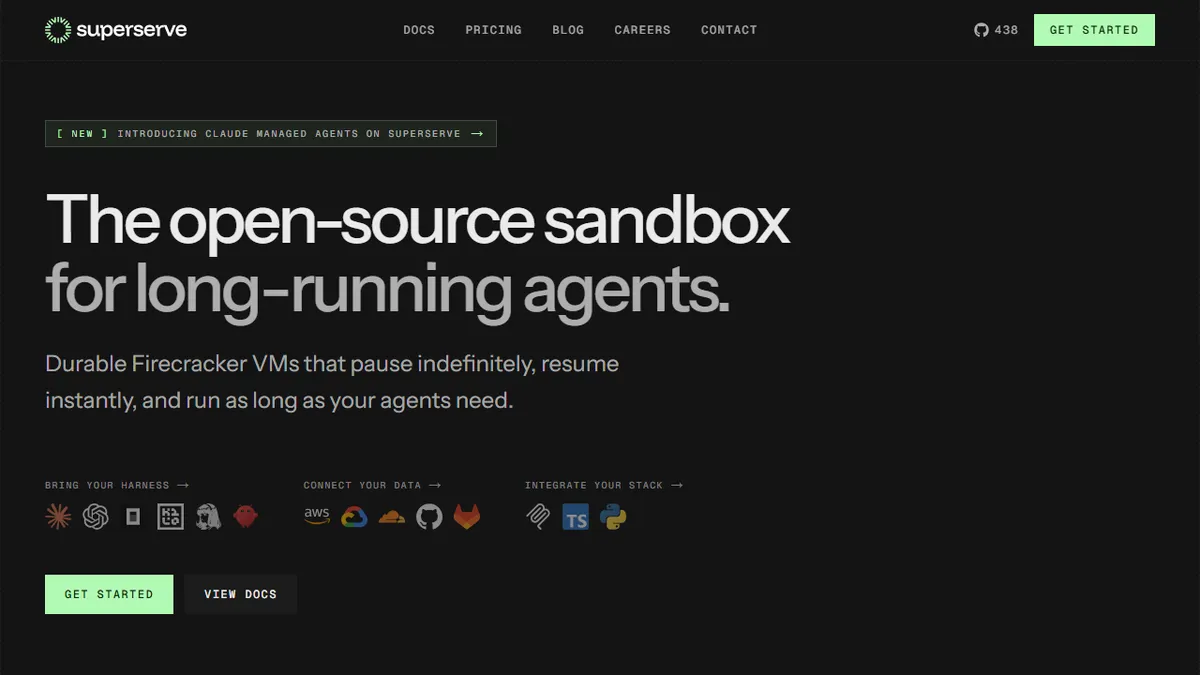
Superserve
Open-source sandbox infrastructure for long-running AI agents
Engineering teams building production AI agents that need stateful, long-running, isolated execution environments — coding agents, browser agents, evaluator swarms, and multi-hour research workflows.
End users who want a finished chatbot or no-code agent builder, or hobbyists running one-off scripts that a plain container or serverless function would already handle fine.
Superserve is an open-source sandbox platform for running AI agents inside isolated, durable virtual environments. Instead of spinning up a fresh container per tool call, Superserve gives each agent its own Firecracker microVM that can persist indefinitely, be paused to save cost, snapshotted and forked for parallel exploration, and resumed with full filesystem and process state intact. That makes it a fit for the class of agentic workloads that don't finish in one HTTP round-trip: multi-hour research, coding assistants that need to install packages and run tests, browser-controlling agents, and swarms that need to fan out and compare branches. The platform sits at the infrastructure layer rather than the model layer. It's designed to run alongside Claude, GPT-4, open models, or any framework (LangGraph, CrewAI, custom loops) via a standard SDK, and it speaks the Model Context Protocol natively so tools can be exposed to agents without bespoke glue. Security posture is a bigger deal here than in generic serverless: Firecracker isolation is closer to a VM than to a container, a credentials broker keeps API keys out of the agent's reach while still letting it make authenticated calls, and egress rules can whitelist or blacklist URLs and IPs with full request logging. Docker runs inside the sandbox, so an agent can build and execute its own images without escaping the boundary. Typical workflows include giving a coding agent a stateful workspace with a checked-out repo, running an evaluator that snapshots a sandbox, tries 20 patches in parallel forks, and merges the winner, or standing up ephemeral browsers for scraping and QA. Pricing is per-second and unbundled: you pay for the vCPU-hours, GiB-hours of RAM, and GiB-hours of storage you actually consume, and paused sandboxes drop to storage-only rates.
Superserve targets a real gap: most agent stacks either share one fragile container or spin up disposable ones that lose state between calls. Firecracker isolation plus pause/resume plus snapshot-fork is the right primitive set for serious agentic work, and open-sourcing it is a smart move against the incumbent sandbox vendors. It's infrastructure though, not a product — you need an agent to point at it before any of this matters.
— The AI Tool Bible editorial team
Pros
- ✅ Firecracker microVMs give stronger isolation than Docker containers for running untrusted agent-generated code
- ✅ Sandboxes can be paused and resumed with full state, cutting cost for long-running or idle agents
- ✅ Snapshot-and-fork enables parallel exploration branches from a common base state
- ✅ Credentials broker keeps API keys out of the agent process while still allowing authenticated outbound calls
- ✅ Per-second, unbundled pricing (compute/memory/storage separately) is transparent and predictable
- ✅ Native MCP support and framework-agnostic SDK make it easy to plug into existing agent stacks
- ✅ Open source, so teams can self-host or audit the isolation and networking layers
Cons
- ⚠️ Infrastructure product with a real learning curve; not useful without an existing agent codebase to run inside it
- ⚠️ Newer entrant competing with established sandbox providers (E2B, Modal, Daytona) and ecosystem/docs are still maturing
- ⚠️ Firecracker requires bare-metal or nested-virt hosts, so self-hosting is more involved than deploying a container
- ⚠️ Usage-based billing can be hard to forecast for workloads with unpredictable agent runtimes
- ⚠️ No built-in agent orchestration or memory layer — you bring your own framework
Use cases
Explore related
Compare with similar tools
All in Agents →LangGraph
FeaturedStateful, graph-based agent orchestration from LangChain.
CrewAI
FeaturedPython framework for multi-agent orchestration.
Ernie Bot
Baidu's Mandarin-first ChatGPT rival, powered by the ERNIE model family
Moveworks
The enterprise AI assistant that searches, answers, and takes action across your business systems
AWS Bedrock
Build and scale generative AI applications with foundation models
Claude Agent SDK
Anthropic's official SDK for building autonomous Claude agents.