Sim
✓ Editorially verifiedOpen-source visual workspace for building, deploying, and monitoring AI agents.
In short
Sim provides a unified, open-source platform for engineering teams to compose and monitor AI agents using a visual drag-and-drop builder. It connects to over 1,000 apps and supports multiple LLMs with built-in observability. It is best for teams needing a self-hostable alternative to closed agent frameworks.
Pick Sim if you want an open-source, self-hostable agent canvas that ties 1,000+ SaaS integrations to any LLM with proper tracing and cost visibility.
Skip it if you need a lightweight single-prompt chatbot or if your org bans credit-metered SaaS billing for AI workloads.
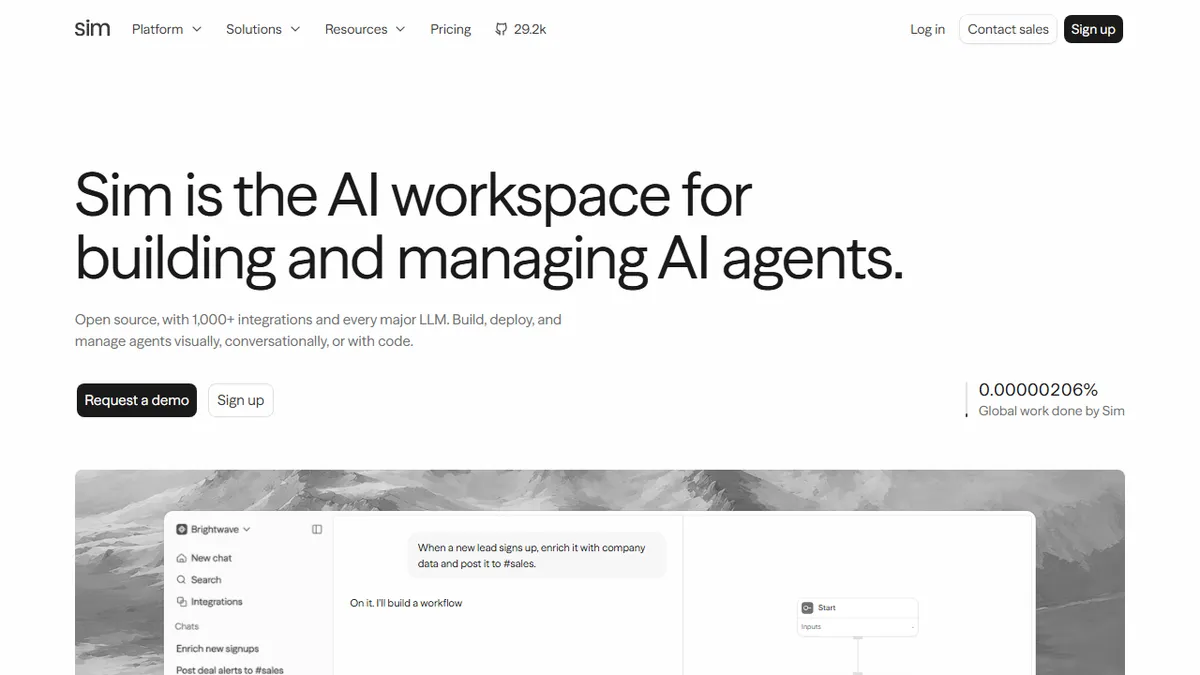
Sim (formerly Sim Studio, now at sim.ai) is an open-source agent-building platform that gives technical teams a unified workspace to compose, deploy, and monitor AI agents. The core experience is a visual drag-and-drop builder that connects to 1,000+ apps (Slack, GitHub, Jira, Salesforce, Notion), stitches in semantic knowledge bases for RAG, and pipes runs through real-time traces, logs, and cost tracking. Agents can be authored visually, conversationally, or in code, and they can call every major LLM including Claude, OpenAI, and Google models.
It targets engineering teams that want the ergonomics of a Zapier-style canvas without giving up the depth of a real agent framework. The Free tier is genuinely usable (1,000 credits/mo, 1 workspace, 5 GB storage); Pro is $25/user/mo, Max is $100/user/mo, and Enterprise unlocks SSO, SOC2 attestations, self-hosting support, and dedicated help. With ~29k GitHub stars and a permissive self-host path, it is a credible alternative to closed platforms like Relevance AI or n8n's AI workflows.
The API and MCP-friendly integration surface make it viable as either the orchestration layer for internal automations or the runtime for customer-facing agents. Caveat: like most agent canvases, non-trivial workflows quickly want code, and the credit-based pricing can bite once you hook up expensive frontier models on high-volume triggers.
Sim is one of the more credible open-source answers to closed agent builders like Relevance AI. The visual+code hybrid, real integration catalog, and observability out of the box put it ahead of n8n-style tools that bolt AI on top. Watch the credit math once you wire Claude Opus into a busy Slack trigger.
— The AI Tool Bible editorial team
Pros
- ✅ Fully open-source with self-hosting supported (~29k GitHub stars)
- ✅ 1,000+ prebuilt integrations including Slack, GitHub, Salesforce, Notion
- ✅ Visual, conversational, and code-based authoring in one canvas
- ✅ Real-time traces, logs, and per-run cost tracking built in
- ✅ Generous free tier and predictable per-seat paid plans
Cons
- ⚠️ Credit-based pricing gets expensive on high-volume frontier-model runs
- ⚠️ Complex agents still push you back into code fairly quickly
- ⚠️ SSO and SOC2 attestations gated to Enterprise
Use cases
Frequently asked
- What is the primary function of the Sim platform?
- Sim is an open-source agent-building platform that offers a unified workspace to compose, deploy, and monitor AI agents. It features a visual drag-and-drop builder that connects to over 1,000 apps and supports semantic knowledge bases for RAG.
- Which large language models are supported by Sim?
- Sim allows agents to call every major LLM, including Claude, OpenAI, and Google models. It is designed as a multi-model platform to accommodate various AI providers.
- How does Sim handle pricing and free usage?
- Sim operates on a freemium model with a free tier offering 1,000 credits per month, one workspace, and 5 GB of storage. Paid plans include Pro at $25 per user per month and Max at $100 per user per month, with custom Enterprise options available.
- Is Sim suitable for self-hosting and open-source development?
- Yes, Sim is fully open-source with a permissive self-host path and approximately 29k GitHub stars. It provides an API and MCP-friendly integration surface, making it viable for internal automations or customer-facing agents.
- What are the limitations of using Sim for complex workflows?
- Non-trivial workflows may require code authoring despite the visual builder. Additionally, credit-based pricing can become expensive when using high-volume triggers with expensive frontier models, and features like SSO and SOC2 attestations are restricted to the Enterprise tier.
Explore related
Compare with similar tools
All in Agents →LangGraph
FeaturedStateful, graph-based agent orchestration from LangChain.
CrewAI
FeaturedPython framework for multi-agent orchestration.
Ernie Bot
Baidu's Mandarin-first ChatGPT rival, powered by the ERNIE model family
Moveworks
The enterprise AI assistant that searches, answers, and takes action across your business systems
AWS Bedrock
Build and scale generative AI applications with foundation models
Claude Agent SDK
Anthropic's official SDK for building autonomous Claude agents.