Sim
Open-source AI agent workspace — build visually, conversationally, or with code
In short
Sim is an open-source platform for building and managing autonomous AI workflows using visual, conversational, or code-based methods. It is best for technical teams needing a model-agnostic, hybrid low-code/code environment with built-in RAG and extensive third-party integrations.
Technical teams that want a model-agnostic, low-code plus code hybrid platform to ship internal automations and customer-facing agents without stitching together LLM, RAG, integrations, and observability layers themselves.
Solo hobbyists who just want a chatbot, or teams already deeply invested in a code-only framework like LangGraph who don't need a visual canvas or hosted runtime.
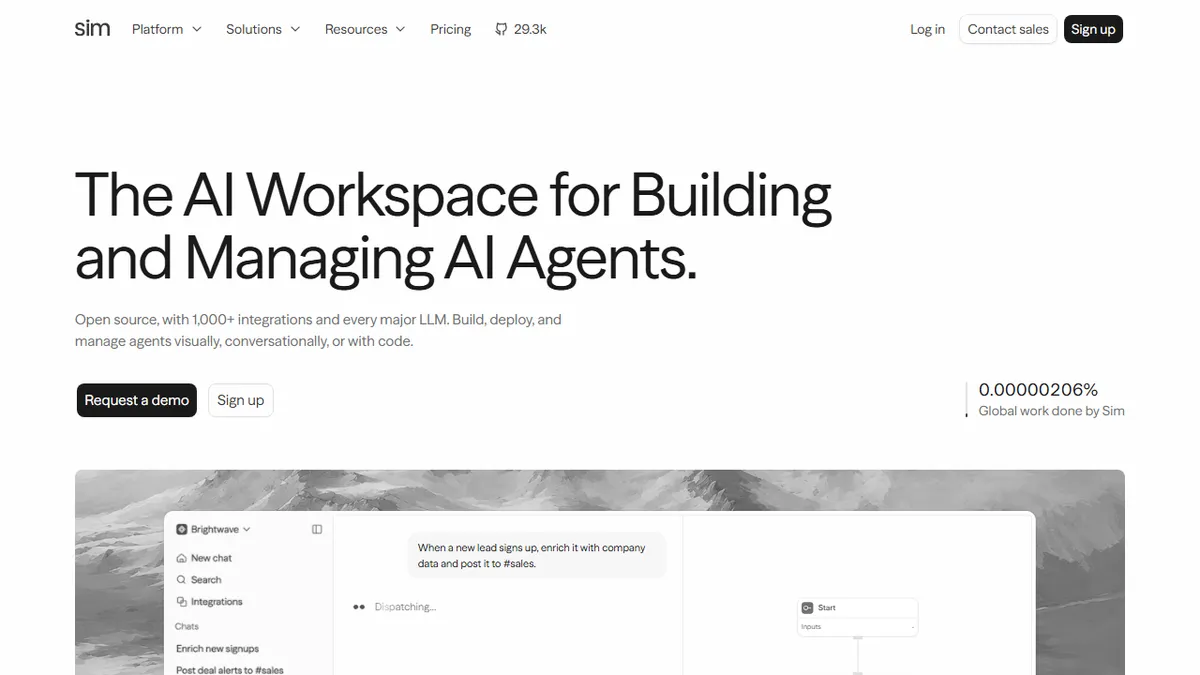
Sim is an open-source AI agent workspace for building, deploying, and managing autonomous workflows. It gives technical teams three ways to construct agents: a visual drag-and-drop workflow canvas, a plain-English conversational builder, and full code access via its SDK and API. Under the hood, Sim is model-agnostic — you can route steps to OpenAI, Anthropic, Google, DeepSeek, xAI, Cerebras, Groq, or Sakana AI models, mixing providers within a single workflow to balance cost and quality. The platform bundles the surrounding infrastructure an agent usually needs: a semantic knowledge base for RAG (files, tables, and vector search), scheduled and event-triggered runs, and native connectors to over 1,000 third-party tools including Slack, HubSpot, Salesforce, Notion, Gmail, and Linear. Real-time execution logs, per-step token accounting, and cost dashboards let operators trace what an agent actually did and what it spent. Sim is SOC2-compliant, ships as a self-hostable stack (29k+ GitHub stars), and offers a managed cloud with generous free-tier credits — making it a practical choice for teams that want the flexibility of a code-first agent framework without giving up the speed of a low-code UI. Typical deployments include sales-outreach agents, engineering automation, IT ticket triage, compliance monitoring, finance ops, and HR onboarding bots.
Sim is one of the more credible open-source challengers to n8n-plus-LangChain-style stacks: the visual builder is genuinely useful, but the escape hatch to code and the multi-provider LLM routing are what make it stick. Best pick when you want the productivity of a low-code tool but don't want to be trapped in one.
— The AI Tool Bible editorial team
Pros
- ✅ Open-source with a self-host option — 29k+ GitHub stars and no vendor lock-in
- ✅ Model-agnostic: mix OpenAI, Anthropic, Google, Groq, DeepSeek, xAI and more within one workflow
- ✅ Three build surfaces (visual canvas, natural-language chat, code SDK) suit different team skill levels
- ✅ 1,000+ prebuilt integrations covers most SaaS a business agent needs to touch
- ✅ Built-in knowledge base and semantic search means you don't need a separate vector DB
- ✅ Detailed execution traces and per-step cost tracking for debugging and budgeting
- ✅ SOC2 compliance and enterprise controls available for regulated deployments
Cons
- ⚠️ Broad surface area means a learning curve compared to single-purpose agent tools
- ⚠️ Per-user seat pricing on Pro/Max plans adds up quickly for larger teams
- ⚠️ Self-hosting the full stack (workers, DB, vector store) is more operationally involved than SaaS-only competitors
- ⚠️ Credit-metered execution model can be hard to predict for long-running or high-fan-out agents
- ⚠️ Younger ecosystem than LangChain/LangGraph, so community templates are still catching up
Use cases
Frequently asked
- What are the different ways to build agents in Sim?
- Sim provides three build surfaces: a visual drag-and-drop workflow canvas, a plain-English conversational builder, and full code access via its SDK and API.
- Which AI models does Sim support?
- Sim is model-agnostic and supports routing steps to OpenAI, Anthropic, Google, DeepSeek, xAI, Cerebras, Groq, or Sakana AI models, allowing providers to be mixed within a single workflow.
- Does Sim include built-in infrastructure for RAG and integrations?
- Yes, the platform bundles a semantic knowledge base for RAG with vector search and includes native connectors to over 1,000 third-party tools such as Slack, HubSpot, and Salesforce.
- Is Sim available for self-hosting?
- Sim is open-source and ships as a self-hostable stack, in addition to offering a managed cloud option with a free tier.
- What is the pricing structure for Sim?
- Sim uses a freemium model with a Free plan at $0, Pro at $25, Max at $100, and a custom Enterprise plan.
Explore related
Compare with similar tools
All in Agents →LangGraph
FeaturedStateful, graph-based agent orchestration from LangChain.
CrewAI
FeaturedPython framework for multi-agent orchestration.
Ernie Bot
Baidu's Mandarin-first ChatGPT rival, powered by the ERNIE model family
Moveworks
The enterprise AI assistant that searches, answers, and takes action across your business systems
AWS Bedrock
Build and scale generative AI applications with foundation models
Claude Agent SDK
Anthropic's official SDK for building autonomous Claude agents.