
Seldon
Kubernetes-native MLOps platform for deploying and orchestrating ML and generative AI models in production.
In short
Seldon provides a Kubernetes-native environment for serving, scaling, and monitoring machine learning and LLM models in production. It is best for platform teams standardizing multi-model deployment across cloud or on-prem clusters with strict governance needs.
Pick Seldon if you run a platform team that needs to serve many ML or LLM models on Kubernetes with versioning, monitoring, and governance.
Skip it if you just want a hosted inference endpoint or you do not already operate Kubernetes.
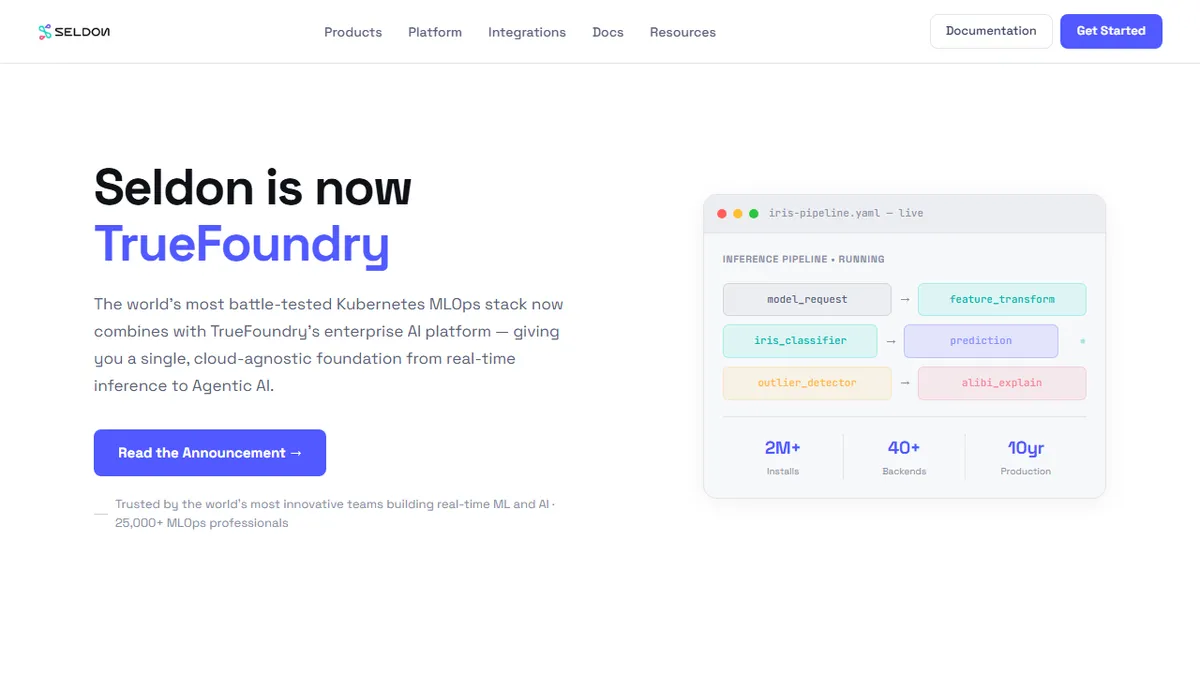
Seldon is an enterprise MLOps platform built around Kubernetes for serving, scaling, and monitoring machine learning models in production. Its flagship pieces - Seldon Core 2, MLServer, and the Alibi explainability and drift-detection libraries - let teams package models as microservices, chain them into real-time inference pipelines (with native Kafka integration), and run canary or A/B rollouts with traffic shifting between model versions. It handles both classical ML and modern LLM/generative AI workloads on the same substrate.
The target buyer is a platform team or Chief AI Officer trying to standardize how dozens or hundreds of models get deployed across EKS, AKS, GKE, or on-prem clusters. Multi-model serving with memory overcommit is a real differentiator for cost - you can pack many small models onto shared replicas instead of one-pod-per-model. The open-source core is free; the enterprise tier (now bundled under TrueFoundry following their combination) is quote-based and aimed at regulated industries that need audit trails, RBAC, and governance.
Seldon plugs into the usual MLOps stack - MLflow, Hugging Face, Prometheus/Grafana, Istio, LangSmith - and exposes both REST and gRPC inference endpoints. It is decidedly not a no-code product: expect to write Kubernetes manifests and understand service meshes to get value from it.
Seldon remains one of the few serious open-source options for production model serving, and the Alibi libraries are genuinely good. It is a platform-engineer tool, not a developer tool - if you do not have Kubernetes in your stack, the learning tax outweighs the benefits. The TrueFoundry merger is worth tracking before committing.
— The AI Tool Bible editorial team
Pros
- ✅ Mature Kubernetes-native serving with real-time pipelines
- ✅ Open-source core (Seldon Core 2, MLServer, Alibi) on GitHub
- ✅ Multi-model serving with memory overcommit cuts infra cost
- ✅ Strong observability, explainability, and drift-detection tooling
- ✅ Handles both classical ML and generative AI on one platform
Cons
- ⚠️ Steep learning curve - assumes Kubernetes fluency
- ⚠️ Enterprise pricing is opaque and quote-only
- ⚠️ Overkill for single-model or small-team deployments
- ⚠️ Recent TrueFoundry consolidation muddies the product roadmap
Use cases
Frequently asked
- What types of models can Seldon deploy?
- Seldon handles both classical machine learning and modern LLM or generative AI workloads on the same substrate. It allows teams to package models as microservices and chain them into real-time inference pipelines.
- Is Seldon suitable for teams without Kubernetes experience?
- No, Seldon is not a no-code product and assumes Kubernetes fluency. Users are expected to write Kubernetes manifests and understand service meshes to get value from the platform.
- How does Seldon handle model versioning and testing?
- The platform supports canary or A/B rollouts with traffic shifting between model versions. It also includes Alibi libraries for explainability and drift detection to monitor model performance.
- What is the pricing structure for Seldon?
- Seldon offers a freemium model with a free open-source core. Paid tiers include Basic at $10, Pro at $20, and an Enterprise tier that is quote-based and aimed at regulated industries.
Explore related
Compare with similar tools
All in Agents →LangGraph
FeaturedStateful, graph-based agent orchestration from LangChain.
CrewAI
FeaturedPython framework for multi-agent orchestration.
Ernie Bot
Baidu's Mandarin-first ChatGPT rival, powered by the ERNIE model family
Moveworks
The enterprise AI assistant that searches, answers, and takes action across your business systems
AWS Bedrock
Build and scale generative AI applications with foundation models
Claude Agent SDK
Anthropic's official SDK for building autonomous Claude agents.