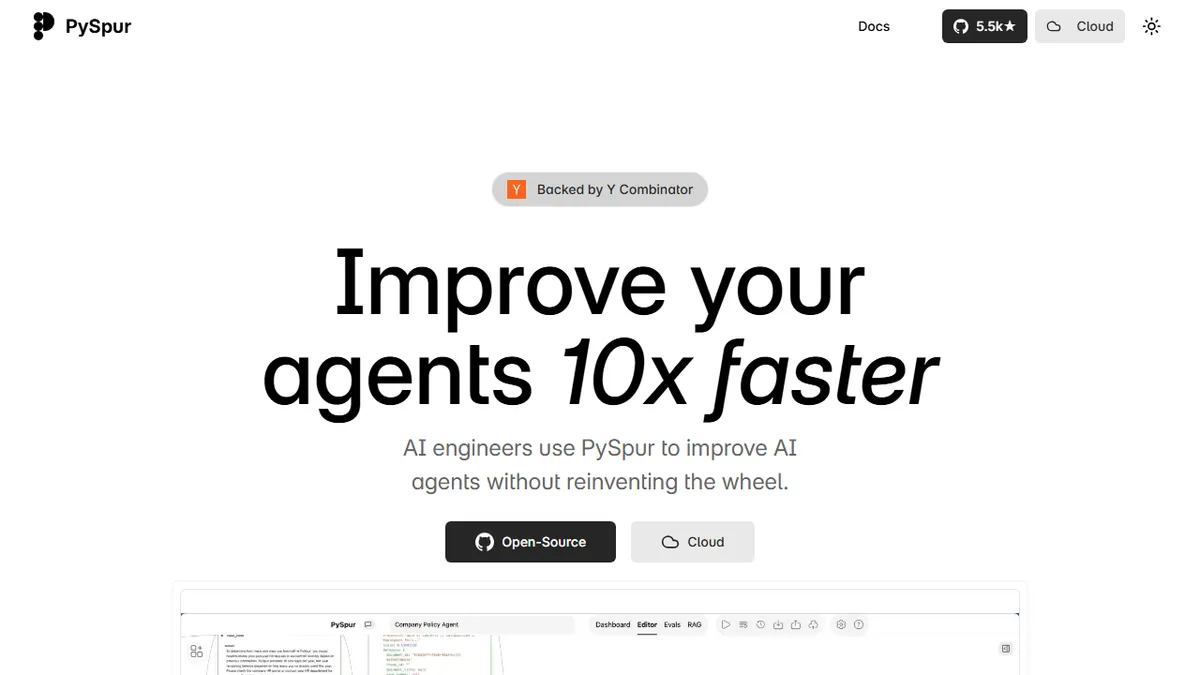

PySpur
Open-source agent builder with a drag-and-drop canvas, Python escape hatch, and a built-in test harness.
In short
PySpur is an open-source, self-hostable agent builder featuring a drag-and-drop canvas, Python support, and built-in testing for rigorous evaluation.
Pick PySpur if you want a self-hostable, git-friendly agent builder that takes evaluation as seriously as orchestration.
Skip it if you need a hosted, zero-ops SaaS today or a deep catalog of pre-built integrations.
PySpur is an open-source framework for building, testing, and deploying AI agents. It pairs a visual drag-and-drop workflow editor with first-class Python so engineers can sketch a pipeline graphically, then drop into code for custom tools, evaluators, or nodes. Agents are exported as JSON, which makes them easy to diff, code-review, and roll out via the same git flow you already use for the rest of your stack.
The differentiator is the emphasis on the iteration loop. Most agent frameworks (LangGraph, CrewAI, etc.) leave you to bolt on your own test rig; PySpur ships test-case definition, batch evaluation, and failure inspection in the core product, which is closer in spirit to LangSmith than to a pure orchestration library. It's Apache-2.0 licensed with 5,500+ GitHub stars, installs via pip, and runs equally well on a laptop, a cloud VM, or your own hardware. A managed Cloud tier and Python/TypeScript SDKs are flagged as forthcoming.
PySpur is model-agnostic: you wire up whichever LLM provider the node calls, so you can mix Claude, GPT, open-weight models, or local Ollama within one graph. It's a sensible pick for teams that want a self-hosted alternative to closed visual builders like Flowise Cloud or Relevance AI, particularly where the agent graph needs to live next to the rest of your application code.
PySpur is one of the more thoughtful open-source agent frameworks because it treats the test loop as a first-class citizen, not a tutorial appendix. The visual-plus-Python model is the right compromise, and Apache 2.0 plus JSON exports keep it from feeling like a walled garden. The trade-off is youth: docs and integrations are still catching up to the big-name competitors.
— The AI Tool Bible editorial team
Pros
- ✅ Apache-2.0 licensed and pip-installable, runs fully self-hosted
- ✅ Visual canvas plus Python escape hatch, no lock-in to a DSL
- ✅ Built-in test cases and failure inspection, not an afterthought
- ✅ Agents export as JSON so they diff cleanly in git
Cons
- ⚠️ Managed cloud and official SDKs are still on the roadmap
- ⚠️ Smaller ecosystem than LangGraph or LlamaIndex
- ⚠️ Visual builders can hide complexity that bites at scale
Use cases
Frequently asked
- How much does PySpur cost?
- PySpur operates on a freemium model. The Basic plan costs $10, the Pro plan is $20, and Enterprise pricing requires contacting sales. The core framework is open-source and Apache-2.0 licensed.
- Is PySpur suitable for self-hosting?
- Yes, PySpur is designed to be self-hostable and git-friendly. It runs on laptops, cloud VMs, or your own hardware, allowing agents to live next to your application code.
- Can I use Python with PySpur?
- Yes, PySpur pairs a visual editor with first-class Python support. Engineers can sketch pipelines graphically and drop into code for custom tools, evaluators, or nodes.
- Does PySpur support multiple AI models?
- PySpur is model-agnostic. You can wire up various LLM providers, including Claude, GPT, open-weight models, or local Ollama, within a single agent graph.
- What are the main alternatives to PySpur?
- Alternatives include LangGraph, CrewAI, Flowise Cloud, and Relevance AI. PySpur differentiates itself by including test-case definition and batch evaluation in the core product, unlike many orchestration libraries.
Explore related
Compare with similar tools
All in Agents →LangGraph
FeaturedStateful, graph-based agent orchestration from LangChain.
CrewAI
FeaturedPython framework for multi-agent orchestration.
Ernie Bot
Baidu's Mandarin-first ChatGPT rival, powered by the ERNIE model family
Moveworks
The enterprise AI assistant that searches, answers, and takes action across your business systems
AWS Bedrock
Build and scale generative AI applications with foundation models
Claude Agent SDK
Anthropic's official SDK for building autonomous Claude agents.