
PrivateGPT
Production-ready, air-gapped RAG framework for querying your documents with local LLMs.
In short
PrivateGPT enables retrieval-augmented generation on local documents using open-source LLMs, ensuring data never leaves your environment. It is best for organizations in regulated sectors requiring air-gapped AI and on-premises infrastructure control.
Pick PrivateGPT if you need a private, on-prem RAG stack for regulated data and don't want to ship documents to a hosted LLM provider.
Skip it if you just want a hosted chat-with-PDF SaaS and have no interest in self-hosting models or managing infrastructure.
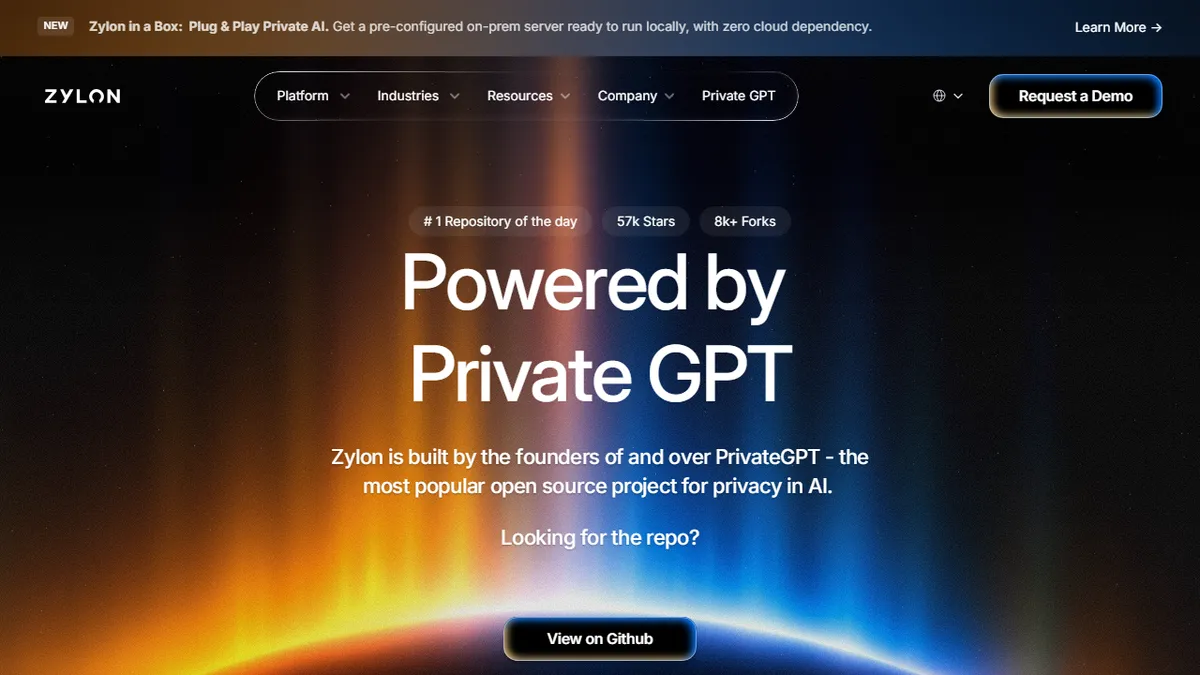
PrivateGPT is an open-source framework (57k+ GitHub stars) built by Zylon for running retrieval-augmented generation on your own documents without any data ever leaving your environment. It exposes an OpenAI-compatible API for ingestion, embedding, and chat-with-docs, and can run fully offline against local open-source LLMs, making it one of the most adopted starting points for on-premises and air-gapped GenAI deployments.
The project is paired with Zylon, the commercial platform from the same team, which layers enterprise plumbing on top: SSO/RBAC, audit logs, rate limits, multi-user workspaces, and managed deployment for regulated buyers in finance, healthcare, government, and critical infrastructure. The OSS core is free; Zylon itself is sold via enterprise contract, with no public pricing or self-serve trial. If you want a private ChatGPT-over-our-files without sending data to OpenAI or Anthropic, this is one of the few mature, batteries-included options.
Under the hood it integrates with LangChain, LlamaIndex, and Qdrant, and is model-agnostic across local backends (llama.cpp, Ollama, vLLM, etc.). Caveat: the OSS repo has slowed since Zylon shifted focus to the commercial product, and you should expect to do real DevOps work to operate it at scale.
PrivateGPT is the default reference implementation for private RAG and a sensible starting point if you're building behind a firewall. The OSS will get you to a demo quickly; the Zylon commercial layer is what you actually buy when compliance and multi-user governance enter the picture.
— The AI Tool Bible editorial team
Pros
- ✅ Fully local and air-gapped; data never leaves your infrastructure
- ✅ OpenAI-compatible API makes integration straightforward
- ✅ Massive OSS community (57k+ stars) with proven deployments
- ✅ Model-agnostic across llama.cpp, Ollama, vLLM, and Qdrant
Cons
- ⚠️ No public pricing for the enterprise Zylon platform
- ⚠️ OSS repo cadence has slowed since the commercial pivot
- ⚠️ Operating at scale still requires meaningful DevOps effort
Use cases
Frequently asked
- Does PrivateGPT send data to external cloud providers?
- No, PrivateGPT is designed to run fully offline against local open-source LLMs, ensuring that no data ever leaves your environment.
- What is the difference between the open-source version and Zylon?
- The open-source core is free, while Zylon is the commercial platform that adds enterprise features like SSO, RBAC, audit logs, and managed deployment for regulated buyers.
- Which local LLM backends does PrivateGPT support?
- It is model-agnostic and integrates with local backends such as llama.cpp, Ollama, and vLLM, along with vector stores like Qdrant.
- Is PrivateGPT suitable for teams without DevOps resources?
- It is not ideal for those wanting a hosted SaaS, as operating the OSS version at scale requires meaningful DevOps effort and self-hosting management.
Explore related
Compare with similar tools
All in RAG →Pinecone
FeaturedManaged vector database for production-scale similarity search.
LlamaIndex
FeaturedData framework for connecting LLMs to your data.
Elasticsearch Vector Search
Hybrid vector + keyword search in the enterprise-grade Elasticsearch engine
Snowflake Cortex
Generative AI and RAG built into the Snowflake data cloud
DataStax Astra DB
Serverless vector and document database for production RAG and AI agents
MongoDB Atlas Vector Search
Vector search built into the operational database you're already using.