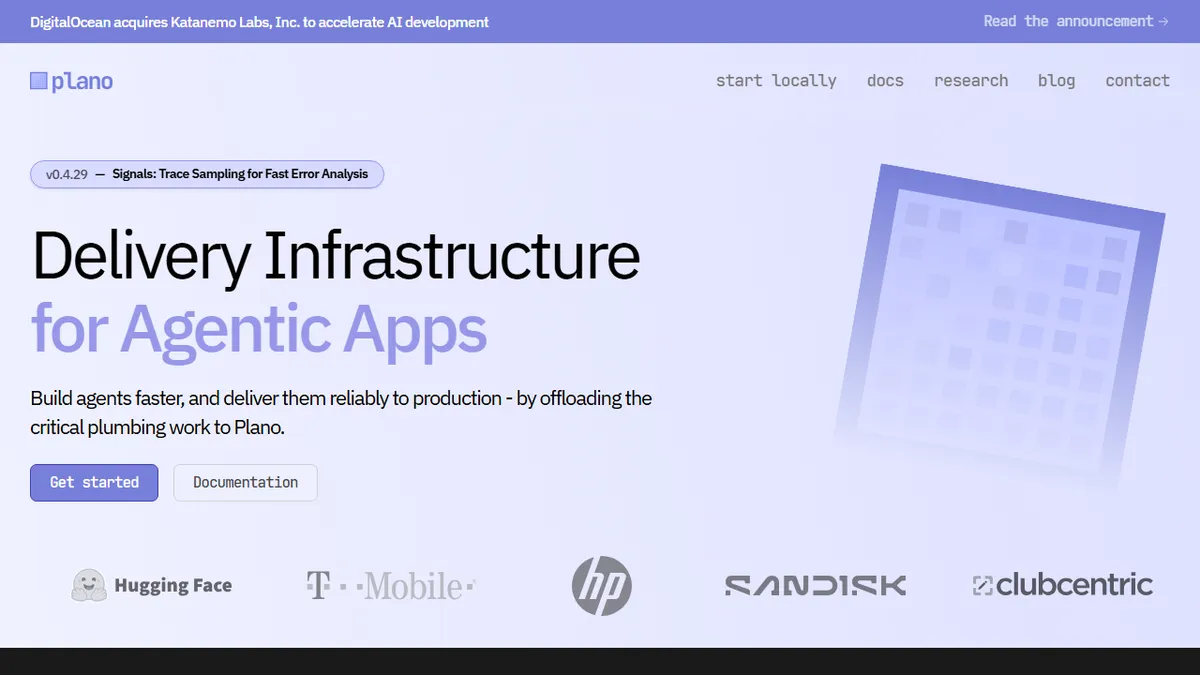

Plano
Envoy-based data plane for AI agents that handles routing, guardrails, and observability outside your app code.
In short
Plano acts as a framework-agnostic infrastructure layer between agents and LLMs, handling routing, policy enforcement, and observability. It is best for engineering teams needing production-grade traffic management and centralized guardrails without embedding logic in app code.
Pick Plano if you're running agents in production and want routing, guardrails, and observability as a dedicated data plane instead of per-framework SDKs.
Skip it if you just want a hosted agent builder or a coding assistant; this is plumbing for engineering teams, not a turnkey product.
Plano is an AI-native delivery infrastructure for agentic applications, originally built by Katanemo Labs and now acquired by DigitalOcean. It sits between your agents and the LLM/tool layer as a framework-agnostic, protocol-native fabric, handling smart model routing, multi-agent orchestration, context engineering filters, jailbreak detection, and centralized policy enforcement from a single configuration file.
What differentiates Plano is that it is built on Envoy, the same battle-tested data plane proxy used by service meshes like Istio. That gives it production-grade traffic handling out of the box and lets teams move agent infrastructure concerns (routing, guardrails, traces) out of the application code and into a dedicated control plane. It's aimed at engineering teams running agents in production who want observability and policy as cross-cutting infrastructure rather than per-framework SDK glue. Pricing is not published; the project has an open-source repo and on-prem deployment is supported, with commercial offerings presumably arriving via DigitalOcean.
It is framework-friendly (works alongside whatever agent framework you're using) and language-flexible, and emits production signals usable for reinforcement learning loops. Caveat: this is infrastructure for builders, not a turnkey agent product, so expect to invest in configuration and deployment.
Plano's Envoy lineage is the tell: this is serious infra for teams treating agents like real distributed systems, not a demo. The DigitalOcean acquisition signals it's likely to keep shipping, but you'll want to weigh the operational overhead against rolling your own gateway.
— The AI Tool Bible editorial team
Pros
- ✅ Envoy-based data plane gives production-grade traffic handling
- ✅ Framework- and language-agnostic; sits beside any agent stack
- ✅ Built-in guardrails, jailbreak detection, and centralized policies
- ✅ Open source with on-prem deployment supported
- ✅ Backed by DigitalOcean after acquisition
Cons
- ⚠️ Infrastructure layer, not a finished agent product
- ⚠️ Pricing for managed/commercial tier not disclosed
- ⚠️ Requires ops maturity to deploy and operate Envoy-based fabric
Use cases
Frequently asked
- What is the core technology behind Plano?
- Plano is built on Envoy, the same data plane proxy used by service meshes like Istio. This provides production-grade traffic handling and allows infrastructure concerns to be managed outside application code.
- Is Plano compatible with specific agent frameworks?
- Yes, Plano is framework-agnostic and language-flexible. It sits alongside whatever agent framework you are using, acting as a protocol-native fabric rather than requiring specific SDK integration.
- What security features does Plano offer?
- The platform includes built-in guardrails, jailbreak detection, and centralized policy enforcement. These features are managed from a single configuration file to ensure consistent security across agents.
- Is Plano available for free?
- Plano is open source and supports on-prem deployment. While commercial pricing is not disclosed, the project is backed by DigitalOcean following its acquisition.
- Who is Plano designed for?
- It is aimed at engineering teams running agents in production who want observability and policy as cross-cutting infrastructure. It is not a turnkey agent product or hosted builder.
Explore related
Compare with similar tools
All in Agents →LangGraph
FeaturedStateful, graph-based agent orchestration from LangChain.
CrewAI
FeaturedPython framework for multi-agent orchestration.
Ernie Bot
Baidu's Mandarin-first ChatGPT rival, powered by the ERNIE model family
Moveworks
The enterprise AI assistant that searches, answers, and takes action across your business systems
AWS Bedrock
Build and scale generative AI applications with foundation models
Claude Agent SDK
Anthropic's official SDK for building autonomous Claude agents.