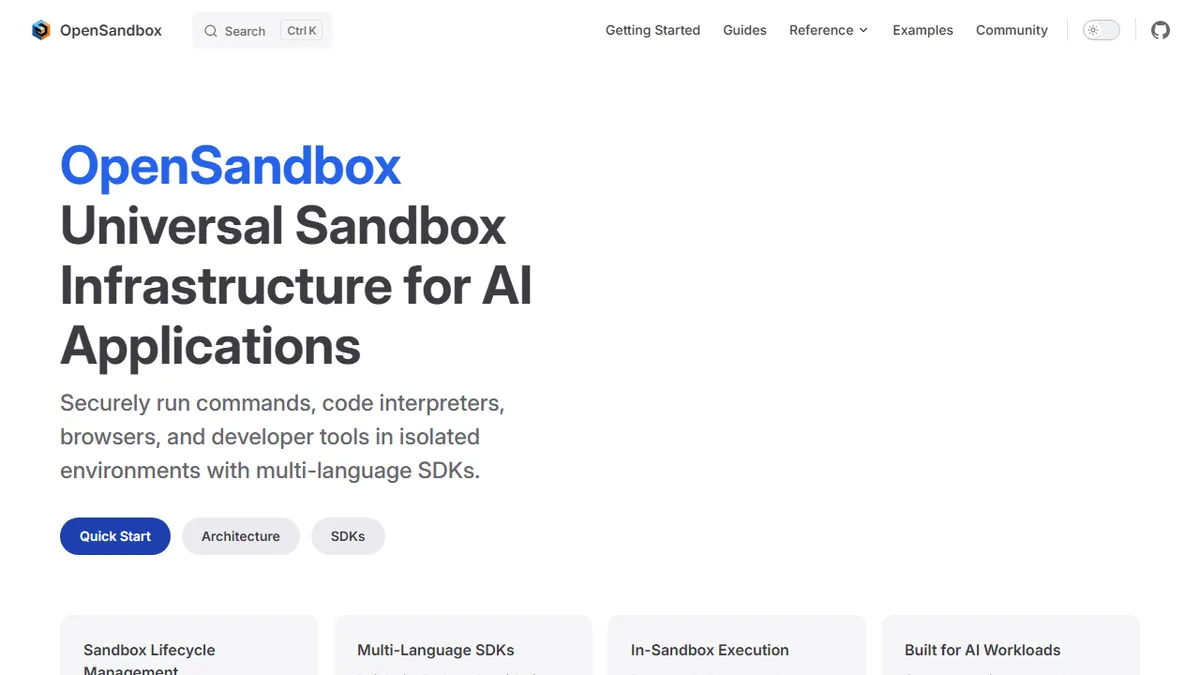
OpenSandbox
Open-source sandbox infrastructure for running AI-generated code, agents, and browsers in isolated Docker or Kubernetes environments.
In short
OpenSandbox provides a self-hostable, open-source layer for executing untrusted AI code, shell commands, and browser automation. It is best for teams building coding agents or RL pipelines who need an auditable runtime within their own VPC.
Pick OpenSandbox if you are building a coding agent or RL pipeline and need an auditable, self-hostable sandbox runtime you can drop into your own Docker or Kubernetes cluster.
Skip it if you just want a hosted REPL behind a single API call and have no appetite for running sandbox infrastructure yourself.
OpenSandbox is an Apache 2.0-licensed sandbox layer aimed at developers building agentic AI systems that need to execute untrusted code, run shell commands, drive browsers, or host coding agents like Claude Code and Gemini CLI. It handles the full sandbox lifecycle - provision, monitor, renew, pause/resume, terminate - and exposes in-sandbox primitives such as shell execution, file management, code interpreters, port forwarding, and log/metric streaming across both Docker and Kubernetes runtimes.
It slots into the same niche as E2B, Daytona, and Modal sandboxes, but leans harder on the self-hostable, framework-agnostic angle. SDKs ship for Python, JavaScript/TypeScript, Java/Kotlin, Go, and C#/.NET, which is unusually broad for this category and signals the team is courting enterprise backends, not just Python notebooks. Because the project is open source, the headline price is zero if you run it yourself; managed pricing is not advertised on the landing page.
The most likely buyers are teams shipping coding agents, RL training loops, or browser-automation agents who need a hardened execution layer they can audit and host inside their own VPC. If you only need an ephemeral REPL for an LLM and are happy with a hosted SaaS, lighter options exist.
A credible open-source alternative to the hosted sandbox vendors, with a refreshingly broad SDK matrix that hints at enterprise ambitions. The Apache 2.0 license and Kubernetes support make it a sensible default for teams that cannot send agent code to a third-party cloud. Still early - watch the GitHub activity before betting production on it.
— The AI Tool Bible editorial team
Pros
- ✅ Apache 2.0 licensed and self-hostable on Docker or Kubernetes
- ✅ First-class SDKs for Python, JS/TS, Java/Kotlin, Go, and C#/.NET
- ✅ Built for agent workloads: Claude Code, Gemini CLI, browser automation, RL
- ✅ Full lifecycle API: provision, pause/resume, renew, terminate, stream logs
Cons
- ⚠️ No public pricing or managed tier details on the landing page
- ⚠️ Younger and less battle-tested than E2B or Daytona
- ⚠️ Operational burden falls on you if you self-host on Kubernetes
Use cases
Frequently asked
- What is the licensing model for OpenSandbox?
- OpenSandbox is licensed under Apache 2.0 and is open source. The headline price is zero if you run it yourself, though managed pricing is not disclosed.
- Which programming languages are supported by OpenSandbox SDKs?
- The project ships SDKs for Python, JavaScript/TypeScript, Java/Kotlin, Go, and C#/.NET, providing a broad range of options for enterprise backends.
- What types of workloads is OpenSandbox designed to handle?
- It is built for agentic AI systems that need to execute untrusted code, run shell commands, drive browsers, or host coding agents like Claude Code and Gemini CLI.
- Can OpenSandbox be deployed on Kubernetes?
- Yes, OpenSandbox supports both Docker and Kubernetes runtimes, allowing teams to host the sandbox infrastructure inside their own VPC or cluster.
- Who should avoid using OpenSandbox?
- It is not suitable for users who only need an ephemeral REPL behind a single API call and do not have the appetite for running sandbox infrastructure themselves.
Explore related
Compare with similar tools
All in Agents →LangGraph
FeaturedStateful, graph-based agent orchestration from LangChain.
CrewAI
FeaturedPython framework for multi-agent orchestration.
Ernie Bot
Baidu's Mandarin-first ChatGPT rival, powered by the ERNIE model family
Moveworks
The enterprise AI assistant that searches, answers, and takes action across your business systems
AWS Bedrock
Build and scale generative AI applications with foundation models
Claude Agent SDK
Anthropic's official SDK for building autonomous Claude agents.