
OpenHands
✓ Editorially verifiedOpen-source autonomous coding agent that plans, edits, and ships changes across real codebases.
In short
OpenHands is an open-source AI agent platform that automates multi-step software engineering tasks like PR reviews, bug fixing, and legacy migration. It is best for teams wanting a model-agnostic solution that integrates with GitHub, GitLab, and CI/CD pipelines rather than a simple IDE assistant.
Pick OpenHands if you want an open-source, model-agnostic coding agent that can be run in your own cloud and wired into GitHub, CI, and Slack.
Skip it if you just want an IDE autocomplete or a single-file chat assistant — this is aimed at repo-level, multi-step agent work.
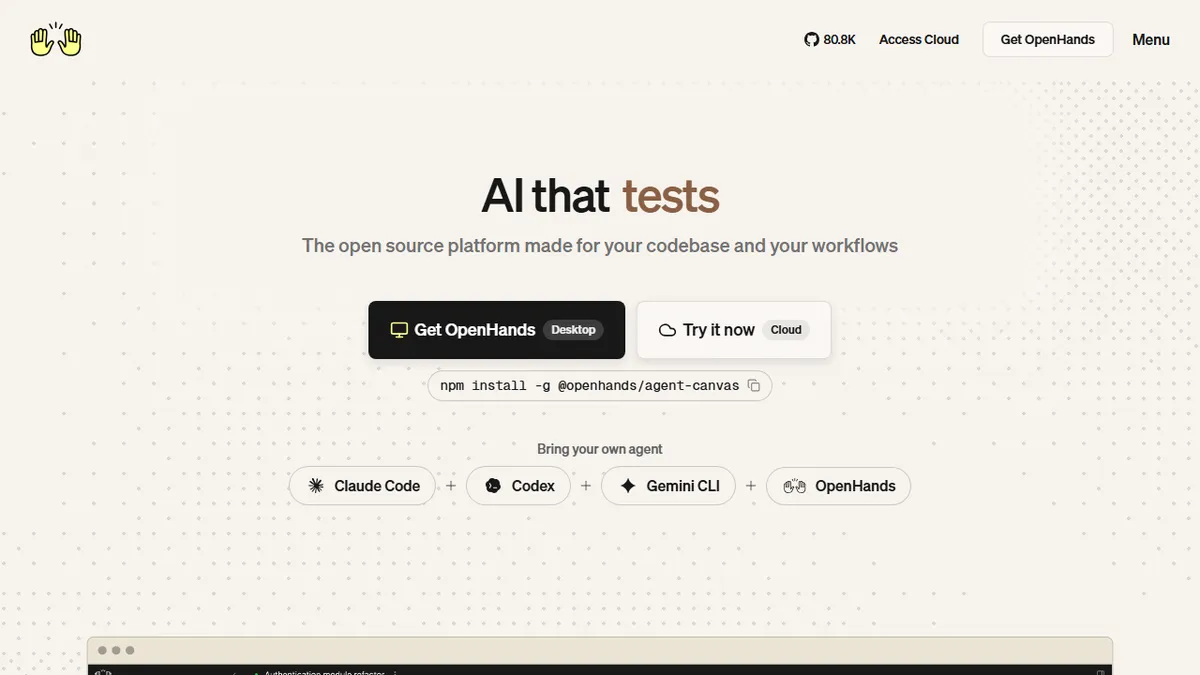
OpenHands (formerly OpenDevin, from All Hands AI) is an open-source AI agent platform for software engineering work. Instead of a chat-first copilot, it runs autonomous agents that can plan multi-step tasks, execute code in a sandbox, edit files, open pull requests, review diffs, migrate legacy code, and investigate incidents. The core project is on GitHub with 77K+ stars, and the hosted product wraps it with an Agent Canvas workspace, cloud execution, RBAC, audit logs, and cost controls.
It is model-agnostic and works with Claude, Gemini, OpenAI Codex/GPT, and others, which matters if you already have a preferred LLM contract or want to swap models per task. Pricing is a genuine freemium: the OSS version is free forever for individuals who want to self-host, a paid Team tier adds shared org features, and Enterprise is quote-based for platform teams running it against large or regulated codebases. There is also an OpenHands SDK for building custom agent integrations.
Integrations cover GitHub, GitLab, CI/CD, Slack, PagerDuty, and ticketing tools, which positions it more as an internal developer platform component than a solo IDE assistant. The main caveats are the usual autonomous-agent ones: cost can spike on long-horizon tasks, and quality still tracks whatever frontier model you point it at.
OpenHands is one of the more credible open-source answers to Devin-style coding agents, and the fact that it's model-agnostic keeps you out of a single-vendor trap. The hosted Team/Enterprise product is where most orgs will actually land, but the OSS core is genuinely usable on its own.
— The AI Tool Bible editorial team
Pros
- ✅ Fully open source with a large, active GitHub community
- ✅ Model-agnostic — swap Claude, Gemini, GPT/Codex per task
- ✅ Ships enterprise features: RBAC, audit logs, cost controls
- ✅ Real integrations with GitHub, GitLab, Slack, PagerDuty
Cons
- ⚠️ Autonomous runs can rack up token spend on big repos
- ⚠️ Output quality still bounded by the chosen underlying LLM
- ⚠️ Self-hosting the OSS version has real ops overhead
Use cases
Frequently asked
- Is OpenHands free to use?
- OpenHands offers a freemium model. The open-source core is free for individuals to self-host, while the hosted Team tier adds shared features and Enterprise pricing is custom quote-based.
- Which AI models does OpenHands support?
- The platform is model-agnostic and works with Claude, Gemini, OpenAI Codex/GPT, and others, allowing users to swap models per task or use their preferred LLM contract.
- What integrations are available?
- OpenHands integrates with GitHub, GitLab, CI/CD systems, Slack, PagerDuty, and ticketing tools, positioning it as an internal developer platform component.
Explore related
Compare with similar tools
All in Agents →LangGraph
FeaturedStateful, graph-based agent orchestration from LangChain.
CrewAI
FeaturedPython framework for multi-agent orchestration.
Ernie Bot
Baidu's Mandarin-first ChatGPT rival, powered by the ERNIE model family
Moveworks
The enterprise AI assistant that searches, answers, and takes action across your business systems
AWS Bedrock
Build and scale generative AI applications with foundation models
Claude Agent SDK
Anthropic's official SDK for building autonomous Claude agents.