
n8n
✓ Editorially verifiedSource-available workflow automation with first-class AI-agent and RAG building blocks.
In short
n8n is a source-available visual workflow platform for building AI agents and RAG pipelines. It combines 500+ integrations with code escape hatches and production-ready plumbing like cron and webhooks.
Pick n8n if you want to build AI agents and RAG pipelines on top of real production plumbing you can self-host and version-control.
Skip it if you need a strict OSI-licensed framework, a pure-code agent SDK, or a no-engineer-required tool like Zapier.
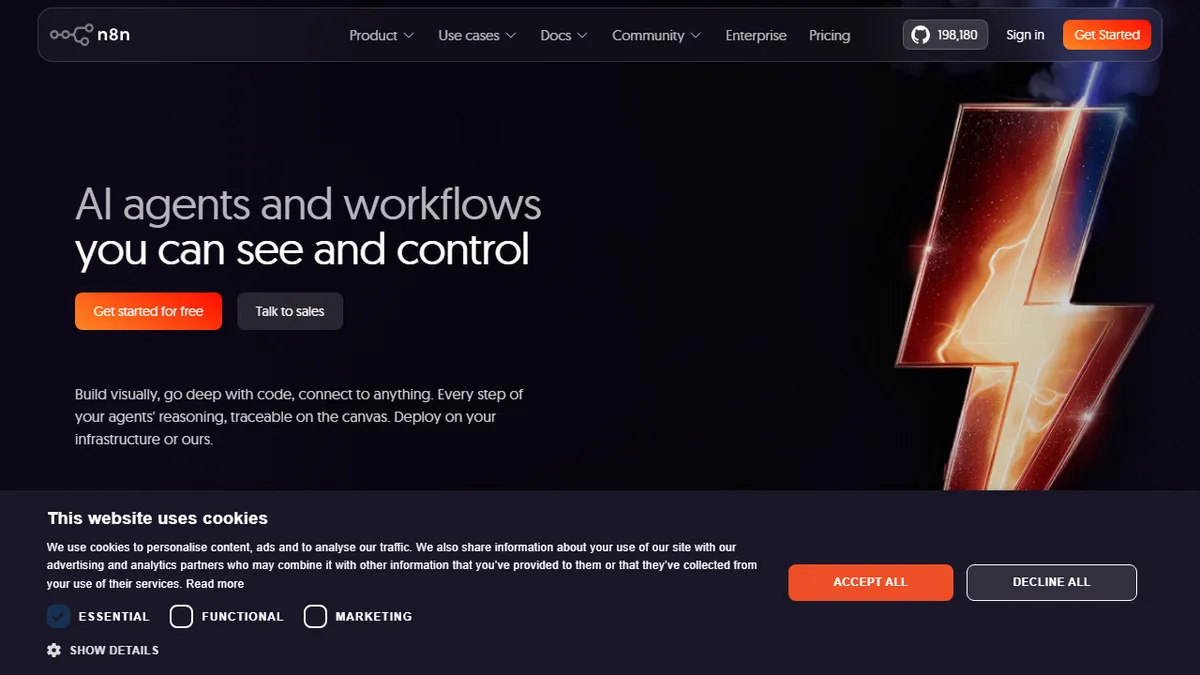
n8n is a visual workflow automation platform that has aggressively repositioned itself as an AI-agent orchestration tool. You drag nodes onto a canvas to wire 500+ integrations together, drop in JavaScript or Python where the UI runs out, and chain LLM calls into multi-step agents with branching, memory, RAG retrieval, and human-in-the-loop checkpoints. Unlike pure agent SDKs, it gives you the plumbing (cron triggers, webhooks, queues, retries, credential vault) that production automations actually need.
It's a serious alternative to Zapier or Make for engineering teams, and a more pragmatic alternative to LangChain for ops/automation work where you want a UI plus code escape hatches. The code is Fair-Code licensed (source-available, free to self-host but commercial restrictions apply), with a paid Cloud plan and an Enterprise tier that adds SSO, RBAC, audit logs, and external secret stores. The GitHub repo sits at ~194k stars, which is one of the largest communities in the automation space.
It's model-agnostic: OpenAI, Anthropic, Google, Mistral, Ollama, local models, vector stores (Pinecone, Qdrant, Weaviate, Supabase pgvector), and MCP servers are all first-class nodes. The main caveats are that the Fair-Code license isn't OSI-approved, the agent nodes still feel newer than the core automation features, and complex agent debugging can get unwieldy on large canvases.
n8n is the most credible self-hostable home for AI agents right now. It splits the difference between a Zapier-style canvas and a LangChain-style framework, and the engineering team has been shipping agent and MCP features at a pace most competitors aren't matching. The Fair-Code license is the only real asterisk.
— The AI Tool Bible editorial team
Pros
- ✅ 500+ integrations plus arbitrary JS/Python escape hatches
- ✅ Self-hostable via Docker with full feature parity
- ✅ Native nodes for LLMs, vector DBs, RAG, and MCP
- ✅ Massive community (~194k GitHub stars) and node ecosystem
- ✅ Built-in cron, queues, retries, credentials, and audit logs
Cons
- ⚠️ Fair-Code license is not OSI-approved open source
- ⚠️ Agent debugging gets messy on large multi-branch canvases
- ⚠️ Cloud pricing scales by executions, can surprise heavy users
- ⚠️ Steeper learning curve than Zapier for non-engineers
Use cases
Frequently asked
- How much does n8n cost?
- n8n uses a freemium model. Paid plans include Starter at 20€, Pro at 50€, and Business at 667€. Enterprise pricing requires contacting sales. The software is source-available and free to self-host, though commercial restrictions apply under its Fair-Code license.
- Is n8n open source?
- No, n8n is not OSI-approved open source. It uses a Fair-Code license, meaning it is source-available. You can self-host it for free, but commercial restrictions apply. It is not a pure-code agent SDK or a strictly OSI-licensed framework.
- Which AI models and vector stores does n8n support?
- n8n is model-agnostic, supporting OpenAI, Anthropic, Google, Mistral, Ollama, and local models. It also integrates with vector stores like Pinecone, Qdrant, Weaviate, and Supabase pgvector. MCP servers are also available as first-class nodes for building RAG pipelines.
- How does n8n compare to Zapier or LangChain?
- n8n is a serious alternative to Zapier or Make for engineering teams, offering more control. Compared to LangChain, it is more pragmatic for ops/automation work, providing a visual UI plus code escape hatches. It includes production plumbing like cron triggers and webhooks that pure agent SDKs often lack.
- What are the main limitations of n8n?
- The Fair-Code license is not OSI-approved. Agent nodes are newer than core automation features, and debugging complex agents on large canvases can become unwieldy. It is not suitable if you require a strict OSI-licensed framework, a pure-code SDK, or a no-engineer-required tool.
Explore related
Compare with similar tools
All in Agents →LangGraph
FeaturedStateful, graph-based agent orchestration from LangChain.
CrewAI
FeaturedPython framework for multi-agent orchestration.
Ernie Bot
Baidu's Mandarin-first ChatGPT rival, powered by the ERNIE model family
Moveworks
The enterprise AI assistant that searches, answers, and takes action across your business systems
AWS Bedrock
Build and scale generative AI applications with foundation models
Claude Agent SDK
Anthropic's official SDK for building autonomous Claude agents.