Mubert
✓ Editorially verifiedAI music generator that spits out royalty-free background tracks for video, podcast, and app use.
In short
Mubert generates royalty-free background music from human samples for creators. It offers mood-tagged tracks for video, podcasts, and apps without licensing headaches.
Pick Mubert if you crank out videos, streams, or podcasts and need an endless supply of safe, mood-tagged background music without licensing headaches.
Skip it if you want prompt-driven, song-structured AI music with vocals — Suno or Udio do that better.
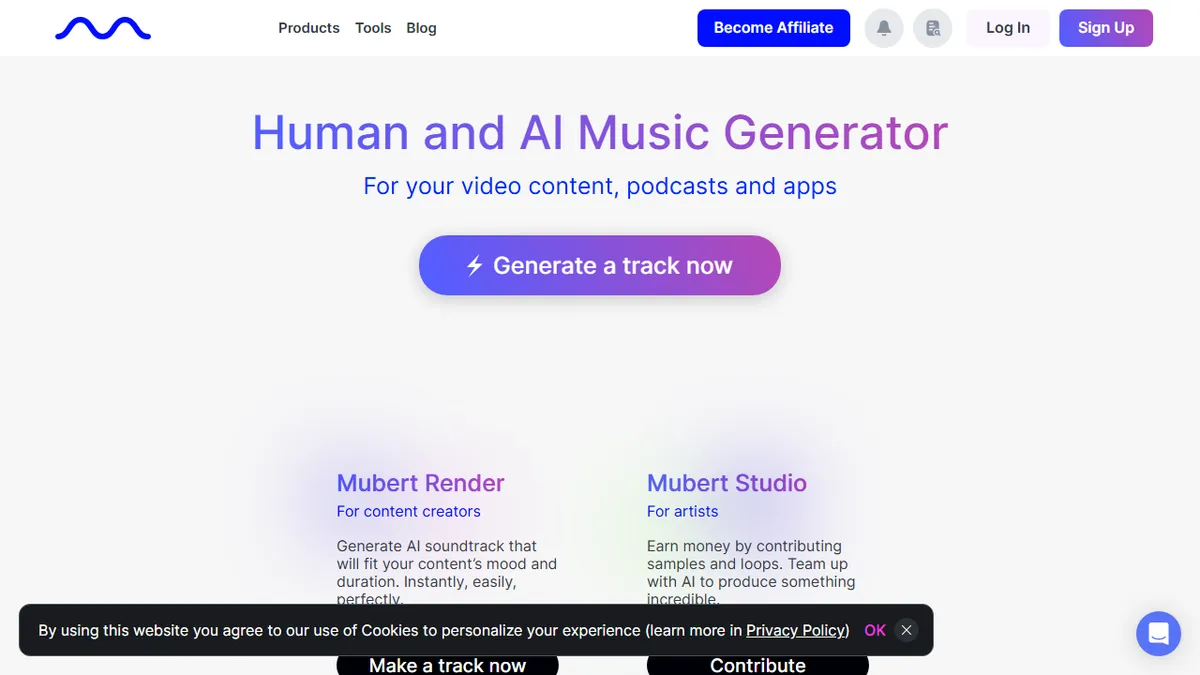
Mubert is an AI music platform that generates royalty-free soundtracks on demand from a library of human-recorded samples and loops stitched together by its generative algorithms. The product splits into four surfaces: Render (pick mood, genre, and duration to get a track for YouTube/TikTok/podcasts), Studio (a marketplace where musicians upload samples and earn when the AI uses them), Play (a mood-based listening app), and an API for developers who want to embed generative music into games, apps, or branded experiences.
The pitch is squarely at content creators who need cheap, copyright-safe background music without dealing with stock-music licensing or claim-bots on YouTube and Twitch. Pricing is freemium with paid tiers for commercial use and higher-res downloads; the API is gated behind a sales demo. Unlike pure neural-audio generators (Suno, Udio), Mubert is closer to algorithmic remixing of real human stems, which means tracks sound more like usable loop-based production music and less like AI hallucinations, at the cost of less novelty.
It's been around since well before the current text-to-music wave, so the catalog and the YouTube/Twitch/TikTok copyright-check tooling are mature. Caveat: the licensing fine print distinguishes between personal-use streams on Mubert's own domains and the royalty-free downloads you actually use in your videos, so read the tier you're paying for.
Mubert is the boring, useful pick in AI music: it predates the Suno/Udio hype cycle and still earns its place because the output is genuinely usable as background music and the copyright story is clean. Don't expect creative songwriting — expect a reliable faucet of mood-tagged loops.
— The AI Tool Bible editorial team
Pros
- ✅ Royalty-free output safe for YouTube, TikTok, Twitch, Instagram
- ✅ Mature catalog built on real human-recorded samples, not pure neural audio
- ✅ Developer API for embedding generative music in apps and games
- ✅ Revenue-share Studio program pays contributing musicians
- ✅ Free tier available for casual creators
Cons
- ⚠️ Sample-recombination approach is less novel than text-to-music rivals like Suno or Udio
- ⚠️ Licensing tiers are confusing; personal-use vs commercial-use fine print matters
- ⚠️ API access requires a sales demo, no self-serve signup
- ⚠️ Output is mood/genre-driven, not fine-grained prompt control
Use cases
Frequently asked
- How much does Mubert cost?
- Mubert uses a freemium model. The Ambassador tier is free. Paid plans include Creator at $14, Pro at $39, and Business at $199. The API requires a sales demo and is not listed with a fixed price.
- Is Mubert suitable for commercial use?
- Yes, paid tiers support commercial use and higher-res downloads. The platform generates royalty-free soundtracks designed to avoid copyright claims on platforms like YouTube and Twitch, making it safe for content creators.
- How does Mubert generate music?
- It uses a proprietary sample-based generative engine. Instead of pure neural synthesis, it stitches together human-recorded samples and loops. This creates loop-based production music that sounds less like AI hallucinations but offers less novelty.
- Can developers integrate Mubert into their apps?
- Yes, Mubert offers an API for developers to embed generative music into games, apps, or branded experiences. Access to the API is gated behind a sales demo rather than being directly available on standard pricing pages.
- What are the main limitations of Mubert?
- Mubert is not ideal for prompt-driven, song-structured music with vocals, as tools like Suno or Udio handle that better. Additionally, licensing terms distinguish between personal streams on Mubert’s domains and royalty-free downloads for your own content.
Explore related
Compare with similar tools
All in Audio →ElevenLabs
FeaturedThe gold standard for AI voice cloning and TTS.
Suno
FeaturedText-to-song AI — full vocal tracks from a prompt.
Udio
Suno's main rival for AI-generated full songs.
AssemblyAI
Speech-to-text API with diarisation, summarisation, and topic detection.
Chorus by ZoomInfo
Enterprise conversation intelligence bundled with ZoomInfo's B2B data graph
Whisper
OpenAI's open-source speech-to-text — the de-facto baseline.