
MiniMax
✓ Editorially verifiedChinese frontier-model lab shipping multimodal foundation models with a 1M-context coding/agent stack.
In short
MiniMax offers a 1M-context coding model and multimodal tools with a $20/mo plan for 12.5B tokens, ideal for cost-effective agent development.
Pick MiniMax if you need cheap, very-long-context tokens for coding agents or multimodal pipelines and you're comfortable with a Chinese provider.
Skip it if your enterprise has data-residency or export-control restrictions, or if you need a battle-tested English-first SDK and support tier.
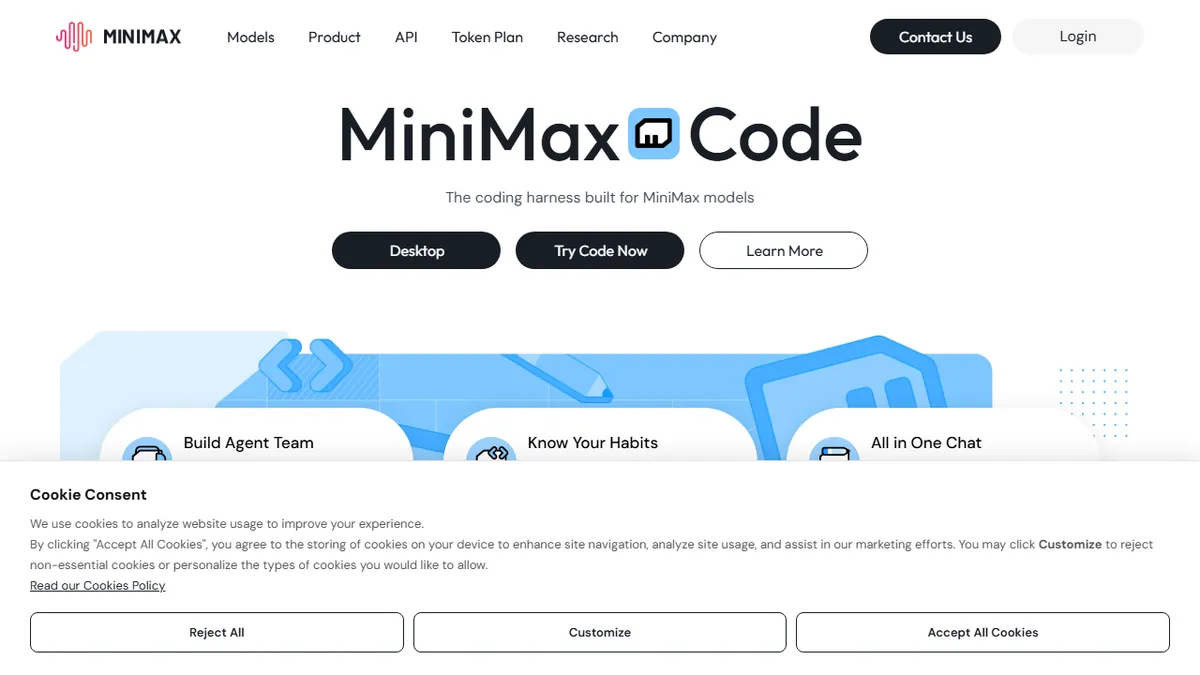
MiniMax is a Shanghai-founded AI lab (now MiniMax.io) that builds its own foundation models across text, code, speech, music, image, and video, then packages them into both a developer API and consumer-facing apps. The headline release is M3, a coding and agentic model built on a novel sparse attention architecture (MSA) with a 1M-token context window, paired with MiniMax Code (an IDE-style coding workspace) and the Mavis agent system for task automation and habit learning. Sister models include the Hailuo video generator and Speech/Music engines, so it ends up competing with Anthropic, OpenAI, ElevenLabs, and Runway from one roof.
The pitch versus Western labs is throughput-per-dollar: a $20/month token plan advertises roughly 12.5B tokens, which MiniMax frames as ~10x Claude Pro at the same price. That makes it interesting for developers running long-context retrieval, multi-step agents, or heavy code generation where US-lab token bills get painful fast. Pricing scales up from there for enterprise, and the platform is positioned more for builders than chat-only end users.
Integrations are via REST API and an OpenAI-compatible SDK surface; the broader product family (Hailuo video, T2A speech) is available through the same account. Caveats: it's a Chinese-headquartered provider, which has real implications for data residency, export-control sensitivity, and whether enterprise procurement will sign off. Documentation in English is improving but still trails the US incumbents.
MiniMax is the most credible non-US frontier lab right now, and the M3 + Hailuo + Speech bundle at ~$20/mo is genuinely disruptive on price-per-token. The catch is the obvious one: data goes to China, and most regulated buyers will stop reading at that sentence. For indie builders and agent tinkerers, it's worth a real evaluation.
— The AI Tool Bible editorial team
Pros
- ✅ 1M-token context window via novel MSA sparse attention
- ✅ Aggressive token pricing vs Claude/GPT for high-volume workloads
- ✅ One account covers text, code, video, speech, and music models
- ✅ Has its own IDE-like coding workspace and agent runtime
Cons
- ⚠️ China-headquartered provider raises data-residency and procurement friction
- ⚠️ English docs and ecosystem trail OpenAI/Anthropic maturity
- ⚠️ Model quality on hard reasoning still below frontier US labs in independent evals
Use cases
Frequently asked
- How much does MiniMax cost?
- MiniMax uses a freemium model. The token plan starts at approximately $20 per month, which includes about 12.5 billion tokens. Enterprise pricing is available upon request for larger-scale needs.
- What models are included in the MiniMax platform?
- The platform features the M3 coding model, Hailuo 2.3 for video, Speech 2.8, and Music 2.6. These models support text, code, speech, music, image, and video generation tasks.
- Is MiniMax suitable for enterprise data residency requirements?
- MiniMax is a Chinese-headquartered provider. If your enterprise has strict data-residency or export-control restrictions, you should skip it. English documentation is also still improving compared to US incumbents.
- How does MiniMax integrate with existing development tools?
- Integrations are available via REST API and an OpenAI-compatible SDK surface. The broader product family, including Hailuo video and T2A speech, is accessible through the same developer account.
- What is the main advantage of MiniMax over Western labs?
- MiniMax offers high throughput-per-dollar. The $20/month plan provides roughly 12.5B tokens, which is framed as approximately 10x the value of Claude Pro at the same price point.
Explore related
Compare with similar tools
All in Agents →LangGraph
FeaturedStateful, graph-based agent orchestration from LangChain.
CrewAI
FeaturedPython framework for multi-agent orchestration.
Ernie Bot
Baidu's Mandarin-first ChatGPT rival, powered by the ERNIE model family
Moveworks
The enterprise AI assistant that searches, answers, and takes action across your business systems
AWS Bedrock
Build and scale generative AI applications with foundation models
Claude Agent SDK
Anthropic's official SDK for building autonomous Claude agents.