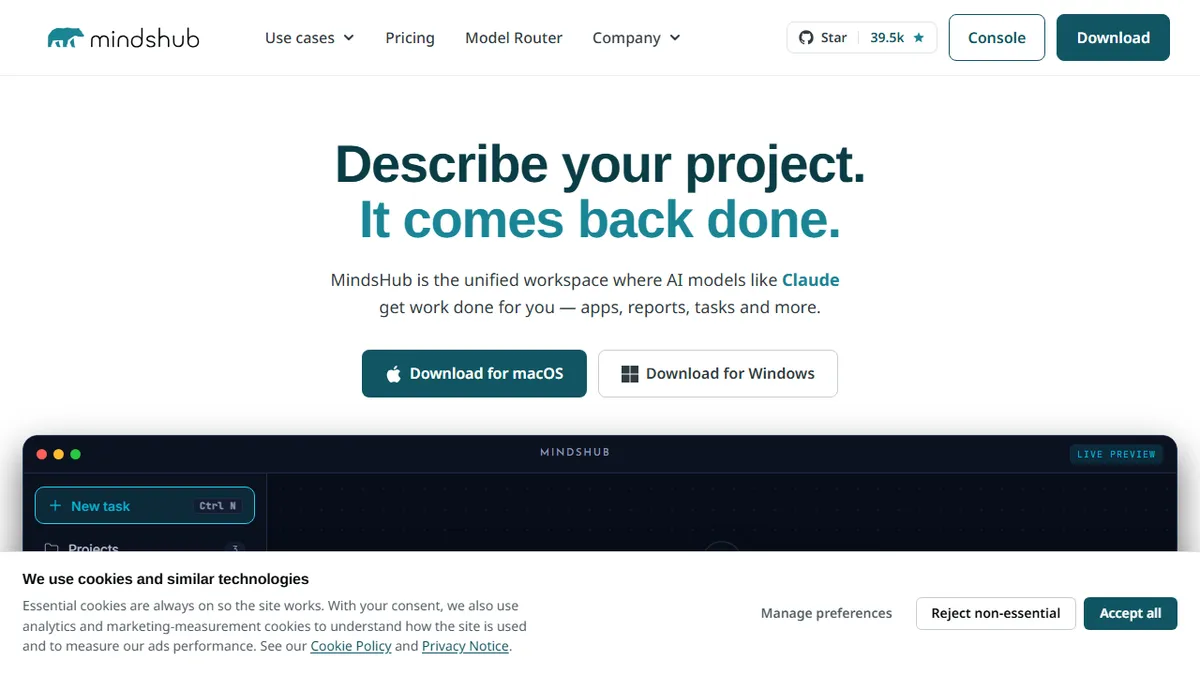
MindsHub Cowork
Unified workspace for open-source AI agents that turn tasks into shareable documents, dashboards, and apps.
In short
MindsHub Cowork routes tasks through interchangeable agent harnesses to produce concrete artifacts like reports and dashboards rather than chat transcripts. It is best for small teams seeking a low-cost, SOC 2 compliant workspace that allows swapping between frontier and open-source models without rewiring prompts.
Pick MindsHub Cowork if you want a low-cost agent workspace that turns multi-step tasks into shareable artifacts and lets you flip between frontier and open-source models.
Skip it if you need a battle-tested enterprise agent platform with deep audit, eval, and on-prem options, or if you only need a basic chatbot.
MindsHub Cowork is an agent-first workspace built around the idea that a chat transcript is rarely the deliverable you actually want. You describe a task and the platform routes it through interchangeable agent harnesses (Anton by default, Hermes as an alternative) that produce concrete artifacts — documents, dashboards, reports, lightweight apps — instead of just a wall of text. A built-in Model Router lets you swap between frontier models from Anthropic, OpenAI, and Google and open-source models like DeepSeek, Qwen, and Kimi without rewriting prompts or wiring up your own keys.
The pitch leans heavily on data access and governance: a credential vault connects BigQuery, Postgres, Gmail, Drive, HubSpot, Notion, Linear and similar systems, but keeps raw keys away from the agents themselves. Persistent memory, skill libraries, project workspaces, link-based sharing and scheduled tasks round out a feature set aimed at small teams who want something between a chatbot and a full agent platform like Lindy or Sierra. At $9.95/month it is priced more like a productivity SaaS than an enterprise agent stack, which makes it a reasonable place to experiment without committing to API budgets.
Available as a web app plus macOS and Windows desktop clients, with SOC 2 Type II compliance advertised. The open-source angle is mostly about giving you a path off frontier models when you want it, not about the platform itself being open. Expect a thinner ecosystem than incumbents and limited public detail on guardrails, eval, and long-horizon reliability.
MindsHub Cowork is one of the more sensible takes on the 'agents replace chat' pitch: artifacts over transcripts, a real model router, and a credential vault. The $9.95 price is aggressive enough to try, but the product is young and the moat is thin against larger agent stacks. Worth a pilot, not a bet-the-team commitment.
— The AI Tool Bible editorial team
Pros
- ✅ Model Router swaps frontier and open-source models without rewiring
- ✅ Outputs are artifacts (docs, dashboards, apps), not chat transcripts
- ✅ Credential vault keeps integration keys out of agent context
- ✅ Cheap entry point at under $10/month with SOC 2 Type II
Cons
- ⚠️ Young product with limited public track record vs established agent platforms
- ⚠️ No transparent usage limits or model-cost passthrough disclosed
- ⚠️ Open-source framing is about model choice, not the platform itself
- ⚠️ Enterprise controls and team admin tooling not detailed
Use cases
Frequently asked
- What types of outputs does MindsHub Cowork generate?
- The platform produces concrete artifacts such as documents, dashboards, reports, and lightweight apps instead of just text-based chat transcripts.
- How does the Model Router function within the workspace?
- It allows users to swap between frontier models from Anthropic, OpenAI, and Google, as well as open-source models like DeepSeek, Qwen, and Kimi, without rewriting prompts or managing API keys.
- What is the pricing structure for MindsHub Cowork?
- The tool offers a free tier at $0 and a Pro tier with pay-as-you-go pricing, with the entry point noted as being under $10 per month.
- Which data sources can be connected via the credential vault?
- The credential vault connects systems including BigQuery, Postgres, Gmail, Drive, HubSpot, Notion, and Linear while keeping raw keys away from the agents.
- Is MindsHub Cowork suitable for enterprise-grade agent deployments?
- It is not recommended for users needing a battle-tested enterprise platform with deep audit, eval, and on-prem options, as it is a younger product with limited public detail on guardrails.
Explore related
Compare with similar tools
All in Agents →LangGraph
FeaturedStateful, graph-based agent orchestration from LangChain.
CrewAI
FeaturedPython framework for multi-agent orchestration.
Ernie Bot
Baidu's Mandarin-first ChatGPT rival, powered by the ERNIE model family
Moveworks
The enterprise AI assistant that searches, answers, and takes action across your business systems
AWS Bedrock
Build and scale generative AI applications with foundation models
Claude Agent SDK
Anthropic's official SDK for building autonomous Claude agents.