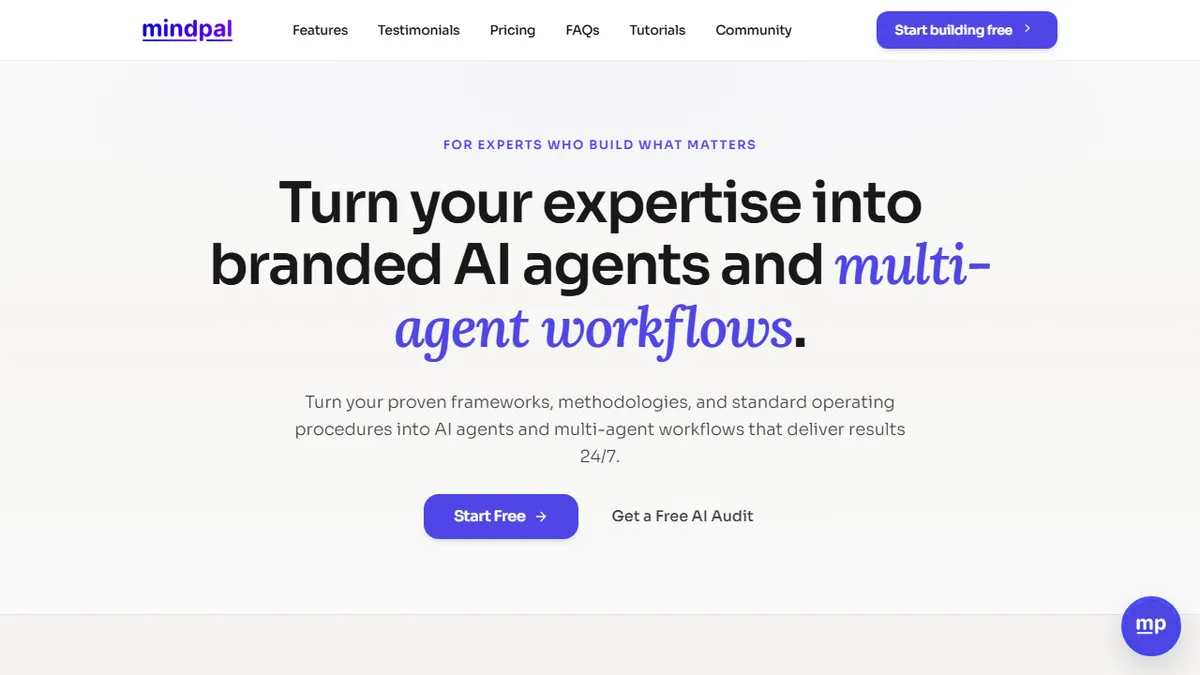
MindPal
No-code platform for building and orchestrating teams of AI agents that automate business workflows.
In short
MindPal allows users to create custom AI agents and chain them into automated workflows without writing code. It is best suited for small and mid-market teams seeking rapid automation for sales, marketing, or operations using a visual builder.
Pick MindPal if you are a non-technical operator who wants to spin up multi-agent automations for marketing, sales, or ops without touching code.
Skip it if you need fine-grained control over prompts, model routing, eval, or want to self-host an open-source agent stack.
MindPal is a no-code AI workforce platform that lets you build custom AI agents and chain them into multi-agent workflows to automate repetitive business tasks. You configure each agent with its own role, instructions, tools, and knowledge base, then wire them together so outputs from one step feed the next, similar to a Zapier-style canvas but with LLMs at every node. The marketing pitch leans heavily on "AI workforce" framing, with templates for sales, marketing, research, HR, and content operations.
The product targets small and mid-market teams that want agentic automation without writing Python or wrangling LangChain. Pricing follows a typical SaaS freemium curve with a free tier to test the builder and paid plans that unlock more agents, runs, and team seats; the site claims 50k+ businesses on board. It is a closed-source hosted SaaS, not a developer framework, so the appeal is speed-to-first-workflow rather than deep customization.
Integrations span the usual suspects (Google Workspace, Slack, Notion, web scraping, custom knowledge uploads) and the underlying intelligence is model-agnostic, drawing on the major frontier LLMs behind the scenes. The main caveats are typical of no-code agent builders: opaque token costs, ceiling on workflow complexity, and the usual reliability hit when long chains of LLM calls compound errors.
MindPal sits in the crowded no-code agent-builder lane alongside Relevance AI and Stack AI, and it competes mainly on UX and template breadth rather than novel capability. It is a reasonable starting point for ops teams, but anyone building production agents will likely outgrow it once reliability and observability matter.
— The AI Tool Bible editorial team
Pros
- ✅ Visual no-code builder for chaining multiple AI agents into one workflow
- ✅ Large library of role-based agent and workflow templates
- ✅ Knowledge base ingestion plus common SaaS integrations out of the box
- ✅ Free tier lets you prototype before committing
Cons
- ⚠️ Closed-source hosted SaaS with limited transparency on model routing and cost
- ⚠️ Long agent chains can be brittle and hard to debug
- ⚠️ Less developer control than code-first frameworks like LangGraph or CrewAI
Use cases
Frequently asked
- Do I need coding skills to use MindPal?
- No, MindPal is a no-code platform designed for non-technical operators. You configure agents with roles, instructions, and tools using a visual interface rather than writing Python or using frameworks like LangChain.
- What types of business tasks can MindPal automate?
- The platform supports multi-agent workflows for repetitive business tasks, including sales, marketing, research, HR, and content operations. It includes templates for these specific use cases.
- How does MindPal handle data and integrations?
- MindPal integrates with common tools like Google Workspace, Slack, and Notion, and supports web scraping and custom knowledge uploads. It is model-agnostic, utilizing major frontier LLMs behind the scenes.
- Is MindPal suitable for developers needing deep customization?
- It is not ideal for developers requiring fine-grained control over prompts, model routing, or self-hosting. MindPal is a closed-source hosted SaaS focused on speed-to-first-workflow rather than deep technical customization.
- What are the limitations of using MindPal for complex workflows?
- Long chains of LLM calls can be brittle and hard to debug, with a ceiling on workflow complexity. Users may also face opaque token costs and limited transparency regarding model routing compared to code-first frameworks.
Explore related
Compare with similar tools
All in Agents →LangGraph
FeaturedStateful, graph-based agent orchestration from LangChain.
CrewAI
FeaturedPython framework for multi-agent orchestration.
Ernie Bot
Baidu's Mandarin-first ChatGPT rival, powered by the ERNIE model family
Moveworks
The enterprise AI assistant that searches, answers, and takes action across your business systems
AWS Bedrock
Build and scale generative AI applications with foundation models
Claude Agent SDK
Anthropic's official SDK for building autonomous Claude agents.