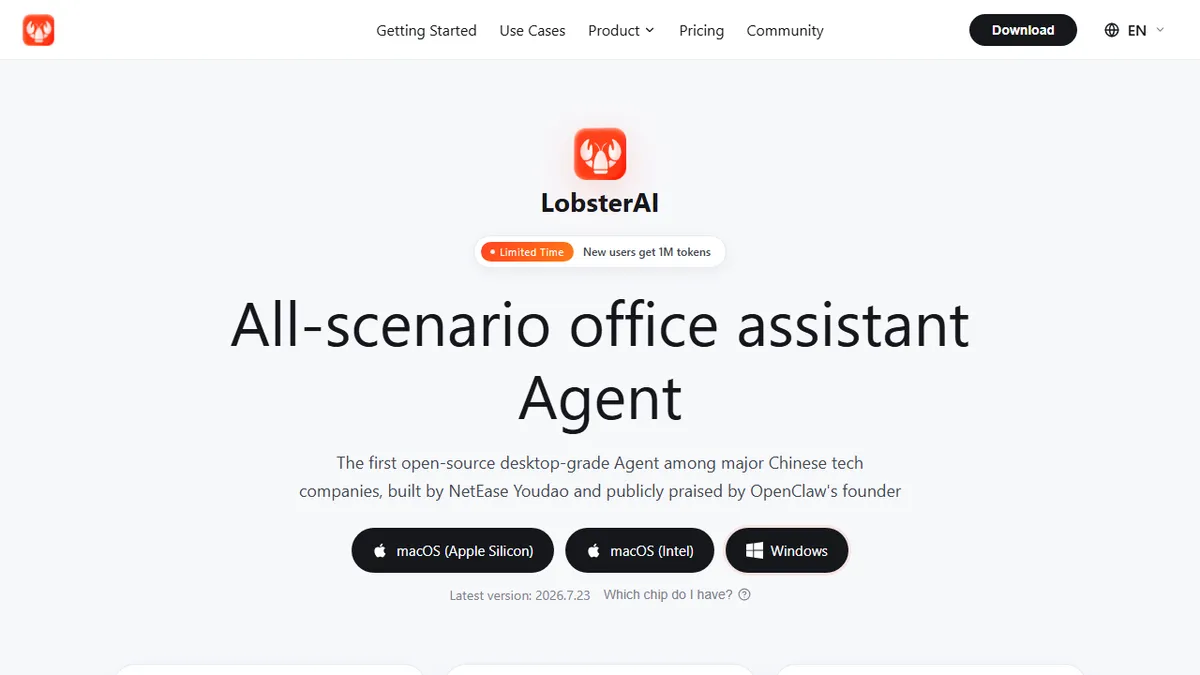

LobsterAI
Youdao's 24/7 personal agent that runs locally, plugs into multiple LLMs, and automates office workflows via dialogue and skills.
In short
LobsterAI is a desktop assistant that runs locally on your machine to automate office tasks through natural-language dialogue. It is best for China-based teams seeking a multi-model agent backed by Youdao's openclaw framework without sending data to third-party clouds.
Pick LobsterAI if you run a China-based team that wants a locally deployed, multi-model desktop agent backed by Youdao's openclaw framework.
Skip it if you need transparent pricing, English-first documentation, or a cloud agent you can spin up in minutes without enterprise procurement.
LobsterAI (有道龙虾) is NetEase Youdao's take on the always-on personal agent: a desktop assistant that sits on your machine, takes instructions via natural-language dialogue, and runs office tasks across applications on a 24/7 basis. It is built on Youdao's openclaw agent framework, ships with a dual-layer memory system for ongoing context, and exposes an extensible Skills layer so workflows can be added or remote-controlled rather than hard-coded.
What makes it interesting versus the usual cloud chat-agent is the local-deployment posture and explicit multi-model compatibility — it can be wired to major global AI models rather than locking you to a single provider, which matters for Chinese enterprises wary of pushing documents through foreign APIs. It is aimed at knowledge workers and operations teams inside Chinese-speaking organizations who want an in-house copilot for repetitive desktop work, not a public consumer chatbot. Pricing is not published on the landing page; expect a sales-led motion typical of Youdao's B2B products.
The ecosystem play is openclaw plus Youdao's existing translation, OCR and dictionary stack, so users already inside that ecosystem get a natural extension. Caveats: the marketing site is Chinese-first, model and pricing transparency is thin, and the agent space is moving fast — buyers outside the Youdao ecosystem will want a direct comparison against Manus, Dify, Coze and the major Western desktop agents before committing.
LobsterAI is Youdao's credible entry into the personal-agent race, and the local-deployment plus multi-model angle is the right read of the Chinese enterprise market. The lack of public pricing and a thin English surface make it hard to recommend outside that audience today, but the openclaw foundation is worth watching.
— The AI Tool Bible editorial team
Pros
- ✅ Local deployment keeps documents off third-party clouds
- ✅ Multi-model compatible rather than locked to one LLM
- ✅ Extensible Skills system plus remote dialogue control
- ✅ Dual-layer memory for persistent task context
- ✅ Backed by NetEase Youdao's productivity stack
Cons
- ⚠️ Marketing site is Chinese-first with limited English docs
- ⚠️ No public pricing or model disclosure on the landing page
- ⚠️ Crowded desktop-agent space with faster-moving rivals
- ⚠️ Best fit narrowly skews to China-based knowledge work
Use cases
Frequently asked
- Where does LobsterAI run and how does it handle data privacy?
- LobsterAI runs locally on your machine, which keeps documents off third-party clouds. This local-deployment posture is designed for enterprises wary of pushing sensitive data through foreign APIs.
- Is LobsterAI locked into a specific AI model provider?
- No, it is explicitly multi-model compatible and can be wired to major global AI models. This allows users to avoid locking into a single provider.
- How can users customize LobsterAI's capabilities?
- The tool exposes an extensible Skills layer that allows workflows to be added or remote-controlled rather than hard-coded. It also features a dual-layer memory system for ongoing context.
- Is LobsterAI suitable for international teams or English-first users?
- It is primarily aimed at knowledge workers in Chinese-speaking organizations. The marketing site is Chinese-first with limited English documentation, making it less ideal for those needing English-first support.
- How is LobsterAI priced?
- Pricing is not publicly listed on the landing page. It follows a sales-led motion typical of Youdao's B2B products, requiring direct contact for details.
Explore related
Compare with similar tools
All in Agents →LangGraph
FeaturedStateful, graph-based agent orchestration from LangChain.
CrewAI
FeaturedPython framework for multi-agent orchestration.
Ernie Bot
Baidu's Mandarin-first ChatGPT rival, powered by the ERNIE model family
Moveworks
The enterprise AI assistant that searches, answers, and takes action across your business systems
AWS Bedrock
Build and scale generative AI applications with foundation models
Claude Agent SDK
Anthropic's official SDK for building autonomous Claude agents.