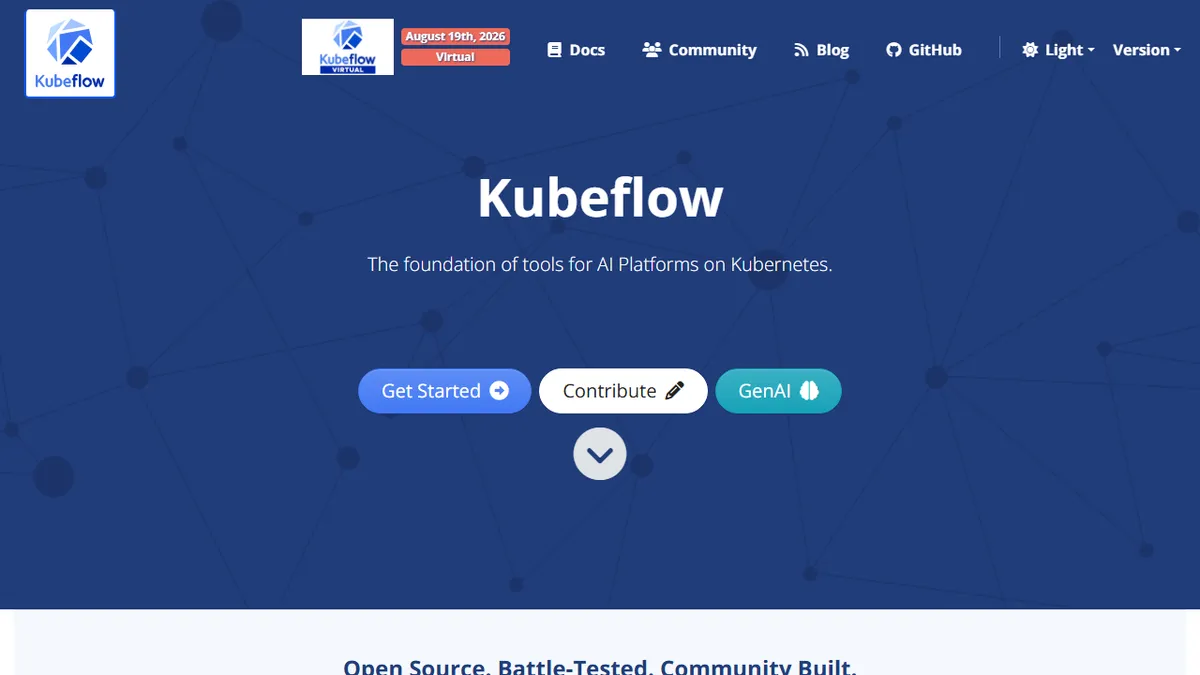

Kubeflow
Open-source toolkit for running the full ML lifecycle on Kubernetes.
In short
Kubeflow packages production ML components like training, pipelines, and serving into Kubernetes-native tools. It is best for platform teams building vendor-neutral, multi-tenant ML infrastructure on existing clusters.
Pick Kubeflow if you're a platform team building an internal, multi-tenant ML platform on Kubernetes and want CNCF-grade, vendor-neutral building blocks.
Skip it if you're a solo practitioner or small team without Kubernetes ops capacity, a managed service like Vertex AI or SageMaker will save you months.
Kubeflow is a CNCF-graduated, open-source platform that packages the messy parts of production ML, training, hyperparameter tuning, pipelines, notebooks, model registry, and serving, into a composable set of Kubernetes-native components. It's not a single app but a federation of projects (Trainer, Katib, Pipelines, Notebooks, Spark Operator, Hub, Central Dashboard) you mix and match to build an internal AI platform on top of whatever cluster you already run.
The target user is a platform or MLOps team standing up infrastructure for data scientists who want PyTorch/JAX/XGBoost jobs, distributed LLM fine-tuning, and reproducible pipelines without inventing all the plumbing themselves. Pricing is the Kubernetes-style 'free software, you pay in ops effort', there's no SaaS tier; the spend is your cluster, your engineers, and optionally a vendor distribution (Google Vertex AI Pipelines, AWS, Azure, Arrikto, Charmed Kubeflow) that wraps it for you.
It integrates with the broader cloud-native stack (Istio, Argo, Prometheus, KServe for serving) and most major training frameworks. The honest caveat: Kubeflow is powerful but heavy, installing and operating it well requires real Kubernetes maturity, and individual subprojects evolve at different speeds, so teams without a dedicated platform group often get more value from a managed alternative.
Kubeflow is the default answer when 'we need MLOps on our own cluster' is non-negotiable, and the Trainer and Pipelines components are genuinely excellent. Just budget for a platform engineer who lives and breathes Kubernetes, because the install-day-two story is still where most teams stumble.
— The AI Tool Bible editorial team
Pros
- ✅ CNCF-graduated, vendor-neutral, no lock-in to a single cloud
- ✅ Covers the full lifecycle: notebooks, pipelines, training, tuning, registry, serving
- ✅ Distributed LLM fine-tuning across PyTorch, JAX, XGBoost out of the box
- ✅ Huge ecosystem: 33K+ GitHub stars, 3K contributors, mature operator pattern
- ✅ Composable, adopt only the subprojects you actually need
Cons
- ⚠️ Steep operational learning curve, you need real Kubernetes expertise
- ⚠️ Subprojects ship on different cadences, version-matrix headaches are common
- ⚠️ No hosted SaaS, install and upgrade pain falls on your platform team
- ⚠️ Overkill for solo researchers or small teams without a cluster
Use cases
Frequently asked
- Is Kubeflow free to use?
- Yes, Kubeflow is free and open source. While the software itself has no cost, users must pay for their own cluster infrastructure and engineering effort to operate it.
- Who is Kubeflow designed for?
- It is intended for platform or MLOps teams standing up infrastructure for data scientists. It is not recommended for solo practitioners or small teams without dedicated Kubernetes operations capacity.
- What machine learning frameworks does Kubeflow support?
- Kubeflow supports multiple frameworks including PyTorch, JAX, XGBoost, and TensorFlow. It also enables distributed LLM fine-tuning and hyperparameter tuning.
- Does Kubeflow require Kubernetes expertise?
- Yes, operating Kubeflow well requires real Kubernetes maturity. The platform is composable but heavy, and installation and upgrades require significant operational effort from a platform team.
Explore related
Compare with similar tools
All in Agents →LangGraph
FeaturedStateful, graph-based agent orchestration from LangChain.
CrewAI
FeaturedPython framework for multi-agent orchestration.
Ernie Bot
Baidu's Mandarin-first ChatGPT rival, powered by the ERNIE model family
Moveworks
The enterprise AI assistant that searches, answers, and takes action across your business systems
AWS Bedrock
Build and scale generative AI applications with foundation models
Claude Agent SDK
Anthropic's official SDK for building autonomous Claude agents.