
Jina Serve
Open-source Python framework for serving multimodal AI models as scalable gRPC/HTTP microservices.
In short
Jina Serve wraps ML models in Python classes to create production-grade gRPC and HTTP services. It is best for building multimodal or retrieval pipelines with multiple stages using dynamic batching and Kubernetes orchestration.
Pick Jina Serve if you're building a multimodal or retrieval pipeline with multiple ML stages and want production-ready gRPC microservices without writing the plumbing.
Skip it if you just need a single Python model behind a REST endpoint — FastAPI or LitServe will be far less ceremony.
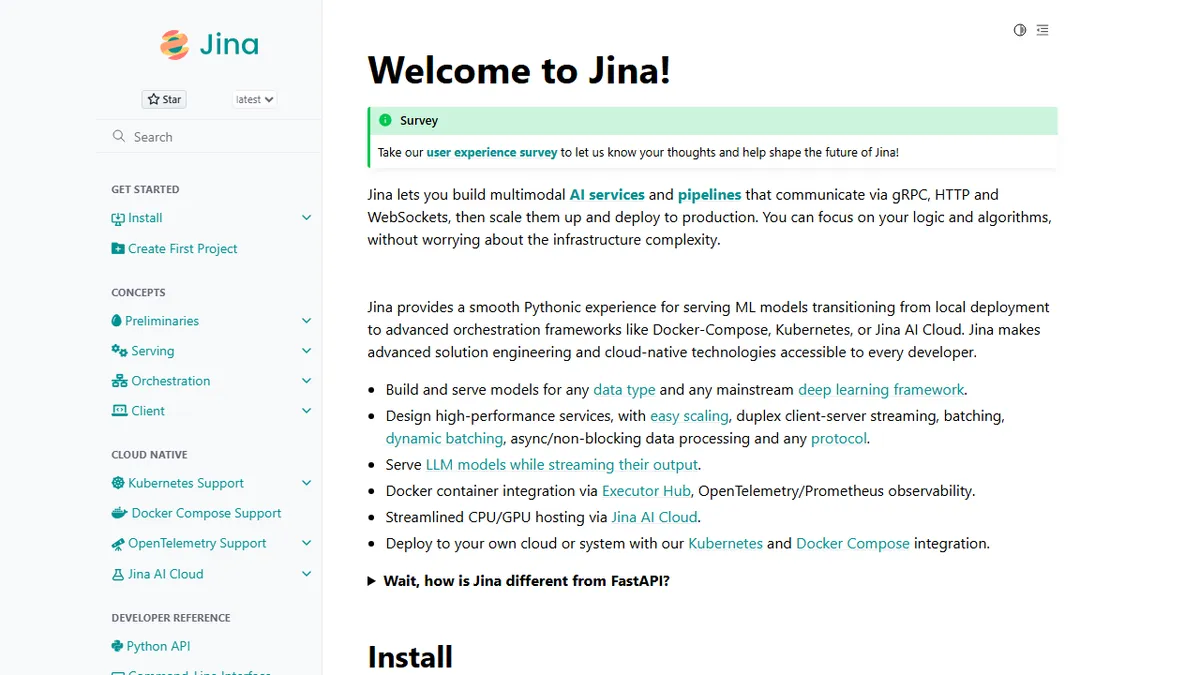
Jina Serve (formerly just "Jina") is an Apache-2.0 framework from Jina AI for wrapping ML models in Python "Executor" classes and exposing them as production-grade services over gRPC, HTTP, and WebSockets. A single Executor can be deployed standalone, or many can be chained into a Flow — a directed acyclic graph pipeline that handles dynamic batching, async processing, and inter-service communication. It is built around DocArray for multimodal payloads, so passing images, embeddings, and text between stages is a first-class concern rather than an afterthought.
The pitch is essentially "FastAPI for ML pipelines": you get protocol flexibility, containerization, and Kubernetes/Docker Compose orchestration out of the box, which matters when you outgrow a single-process inference server. It's aimed at ML engineers shipping retrieval, embedding, or multimodal pipelines who don't want to reinvent the serving layer. The framework itself is free via pip/conda; the optional Jina AI Cloud offers managed hosting for teams that don't want to run their own Kubernetes.
Note that Jina AI has shifted emphasis over time toward their hosted embeddings, reranker, and reader APIs, so Serve sees less marketing oxygen than it once did. The repo is still active and the abstractions remain solid, but you should expect a learning curve around Executors, Flows, and DocArray conventions.
Jina Serve is one of the more mature open-source ML serving frameworks, especially if your workload is multimodal or pipeline-shaped. The trade-off is conceptual overhead: you're buying into Executors, Flows, and DocArray. For RAG and embedding infrastructure teams it's a reasonable backbone; for a quick inference API it's overkill.
— The AI Tool Bible editorial team
Pros
- ✅ Apache-2.0 open source with no vendor lock-in
- ✅ Native gRPC, HTTP, and WebSocket support in one framework
- ✅ Built-in dynamic batching, async, and Kubernetes orchestration
- ✅ DocArray makes multimodal payloads (text, image, embeddings) first-class
Cons
- ⚠️ Steeper learning curve than FastAPI for simple endpoints
- ⚠️ Less marketing focus now that Jina pushes hosted APIs
- ⚠️ Executor/Flow abstractions can feel heavy for small projects
Use cases
Frequently asked
- What is Jina Serve used for?
- It is used for serving multimodal AI models as scalable microservices over gRPC, HTTP, and WebSockets. It supports chaining models into pipelines for retrieval, embedding, or RAG infrastructure.
- Is Jina Serve open source?
- Yes, Jina Serve is an Apache-2.0 open-source framework from Jina AI. It is available for free via pip or conda, with optional managed hosting through Jina AI Cloud.
- What protocols does Jina Serve support?
- The framework supports gRPC, HTTP, and WebSockets. It also includes built-in features for dynamic batching, async processing, and Kubernetes or Docker Compose orchestration.
- Who should use Jina Serve?
- It is best for ML engineers building multimodal or retrieval pipelines with multiple stages who need production-ready microservices. It is not recommended for simple single-model REST endpoints where lighter frameworks suffice.
Explore related
Compare with similar tools
All in Agents →LangGraph
FeaturedStateful, graph-based agent orchestration from LangChain.
CrewAI
FeaturedPython framework for multi-agent orchestration.
Ernie Bot
Baidu's Mandarin-first ChatGPT rival, powered by the ERNIE model family
Moveworks
The enterprise AI assistant that searches, answers, and takes action across your business systems
AWS Bedrock
Build and scale generative AI applications with foundation models
Claude Agent SDK
Anthropic's official SDK for building autonomous Claude agents.