
Izlo
Prompt management platform with version control, collaboration, and an API for production deployment.
In short
Izlo is a model-agnostic prompt management platform offering version control, collaboration, and an API for production deployment. It helps teams move prompts from code and docs to a shared, testable store.
Pick Izlo if your team is tired of prompts living in code and Google Docs and you want a shared, versioned, API-addressable prompt store.
Skip it if you are a solo hacker happy with prompts in a repo, or if you need deep tracing/eval observability across LLM calls.
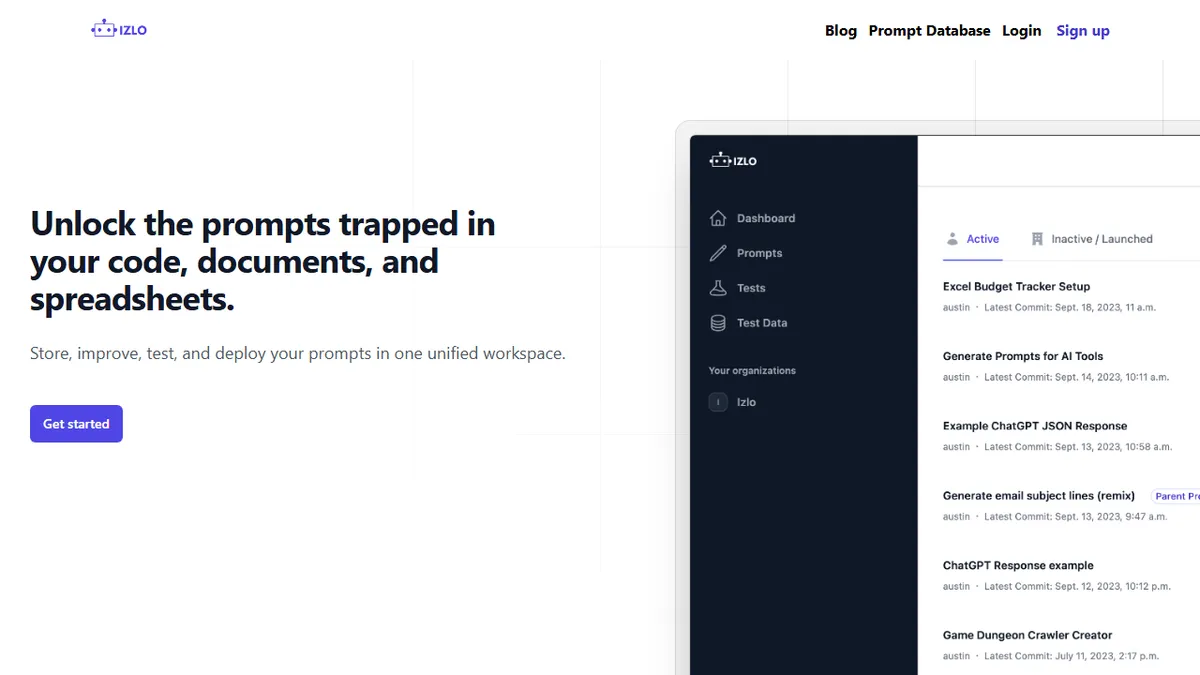
Izlo is a team-oriented prompt management platform that treats LLM prompts like first-class engineering artifacts. It offers shared version history, a 'Remix' sandbox for iterating without touching production, automated test pipelines with variables, and an activity log so a team can see who changed what. A REST API lets engineers pull the latest production prompt at runtime, decoupling prompt iteration from app deploys.
It is aimed at small-to-mid product teams who have outgrown the 'prompts buried in Notion docs and Python string literals' phase and want a single source of truth that PMs, writers, and engineers can co-edit. Pricing starts at $20/mo Solo, $25/user/mo Pro (up to 10 users), and $39/user/mo Enterprise; each seat comes with a small monthly token allowance for in-app testing. There is no advertised free tier.
Izlo is model-agnostic infrastructure rather than a generation tool itself, so its value depends on how much prompt churn your team actually has. Competitors in this space include PromptLayer, Langfuse, and Helicone — Izlo's pitch leans more toward collaborative editing than observability.
Izlo is a focused take on the 'prompts as a managed artifact' problem, and the Remix-plus-API pattern is genuinely useful for shipping prompt changes without redeploys. The absence of a free tier and a thin token allowance make it a harder sell against Langfuse and PromptLayer, but for collaboration-first teams it earns the look.
— The AI Tool Bible editorial team
Pros
- ✅ Git-style version history and activity log for every prompt change
- ✅ Remix sandbox isolates experiments from production prompts
- ✅ REST API lets you swap prompts without redeploying the app
- ✅ Built for multi-user team editing, not just solo developers
Cons
- ⚠️ No free tier; cheapest plan is $20/mo
- ⚠️ Stingy token allowance (5K/seat) for in-app testing
- ⚠️ Lighter on observability/analytics than Langfuse or Helicone
- ⚠️ Supported model providers not clearly listed on the site
Use cases
Frequently asked
- How much does Izlo cost?
- Izlo offers paid plans starting at $20/month for Solo, $25 per user/month for Pro (up to 10 users), and $39 per user/month for Enterprise. Each seat includes a small monthly token allowance for in-app testing. There is no advertised free tier.
- What are the main alternatives to Izlo?
- Competitors in this space include PromptLayer, Langfuse, and Helicone. Izlo differentiates itself by leaning more toward collaborative editing and prompt management rather than deep tracing or observability across LLM calls.
- Does Izlo work with specific AI models?
- Izlo is model-agnostic infrastructure. It does not generate content itself but serves as a prompt management layer. Its value depends on how much prompt churn your team has, regardless of the underlying LLM provider.
- How does Izlo handle prompt versioning and testing?
- It offers shared version history, a 'Remix' sandbox for iterating without touching production, and automated test pipelines with variables. An activity log tracks who changed what, ensuring a single source of truth for the team.
- Can I deploy prompts to production via API?
- Yes, Izlo provides a REST API that allows engineers to pull the latest production prompt at runtime. This decouples prompt iteration from application deploys, enabling updates without redeploying the entire app.
Explore related
Compare with similar tools
All in Agents →LangGraph
FeaturedStateful, graph-based agent orchestration from LangChain.
CrewAI
FeaturedPython framework for multi-agent orchestration.
Ernie Bot
Baidu's Mandarin-first ChatGPT rival, powered by the ERNIE model family
Moveworks
The enterprise AI assistant that searches, answers, and takes action across your business systems
AWS Bedrock
Build and scale generative AI applications with foundation models
Claude Agent SDK
Anthropic's official SDK for building autonomous Claude agents.