iii
Self-hosted distributed runtime for multi-language workers and AI agents under one protocol.
In short
iii is a free, self-hosted distributed runtime that unifies multi-language workers and AI agents under one protocol, eliminating the need to glue together separate SaaS services.
Pick iii if you're an engineering team that wants one self-hosted runtime for multi-language workers and AI agents without gluing five SaaS services together.
Skip it if you want a managed, no-ops agent platform or a polished prebuilt agent UI rather than a low-level distributed runtime.
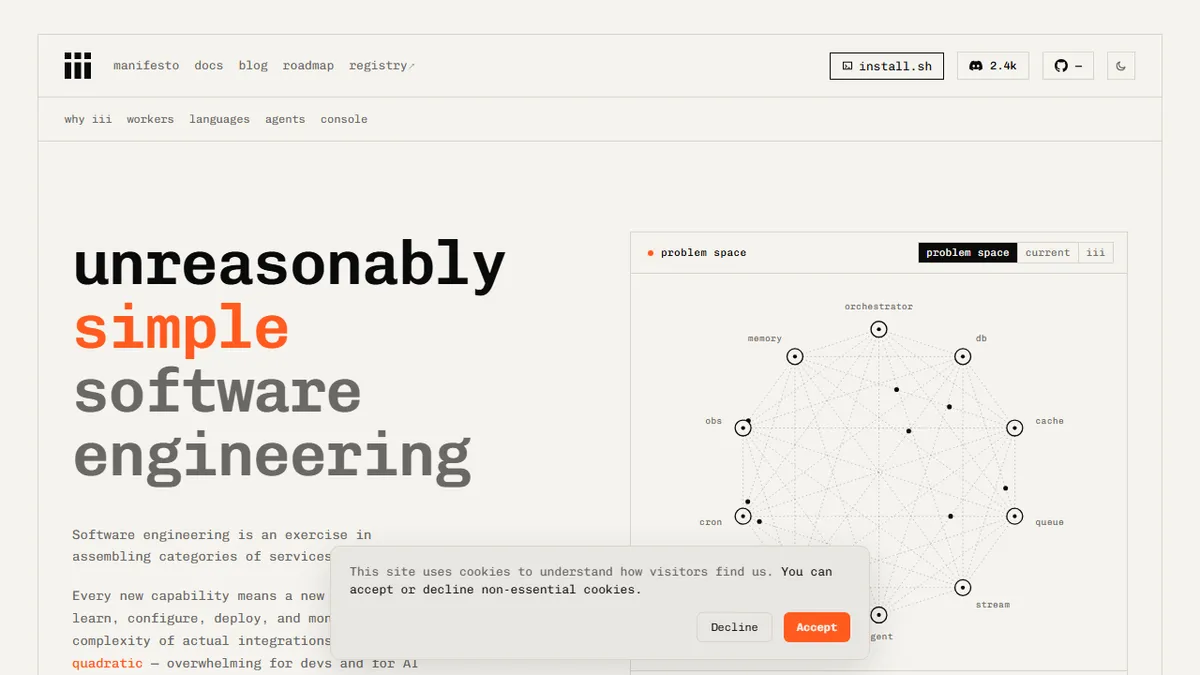
iii (pronounced "three eye") is an open-source distributed software platform that unifies workers, functions, and AI agents across Python, Rust, Node.js, and Go behind a single protocol. Instead of stitching together separate queues, state stores, vector indexes, and observability tooling, iii ships them as built-in primitives, with a unified console that surfaces workers, functions, triggers, streams, queues, traces, and logs in real time. AI agents are treated as ordinary workers, so planning, tool-running, and synthesis steps run on the same engine as the rest of the backend.
The platform is aimed at engineering teams building distributed systems or agentic applications who are tired of the quadratic integration cost of gluing together five SaaS dependencies. It bundles durable orchestration, OpenTelemetry tracing, WebSocket streaming, HTTP endpoints, event triggers, cron scheduling, queuing with backpressure, and vector storage. Install is a single curl-piped shell script and it runs locally (127.0.0.1) by default, so it sits closer to a self-hosted Temporal/Inngest hybrid than a managed agent cloud.
The project lives on GitHub (iii-hq/iii) with an active Discord. Pricing isn't published — the GitHub-first, self-hosted posture suggests the open-source core is free with a paid commercial tier likely to follow. Model integrations aren't dictated by the platform; you bring your own LLM in whichever language your worker is written in.
iii is an ambitious attempt to collapse the agent stack and the distributed-systems stack into one engine, and the multi-language worker protocol is the genuinely interesting bit. It's early — docs and pricing are thin — but worth a look for teams already self-hosting Temporal, Inngest, or a homegrown worker mesh.
— The AI Tool Bible editorial team
Pros
- ✅ One protocol for Python, Rust, Node.js, and Go workers
- ✅ Bundles queues, state, vectors, and OpenTelemetry tracing out of the box
- ✅ Treats AI agents as ordinary workers — no separate agent runtime
- ✅ Open source with single-command install
Cons
- ⚠️ Pricing and managed-cloud story not yet published
- ⚠️ Early-stage project with thin public documentation
- ⚠️ Self-host operational burden vs hosted competitors
Use cases
Frequently asked
- How much does iii cost?
- iii is open-source and free. Commercial pricing is not published, but the self-hosted posture suggests a free core with a potential paid commercial tier to follow.
- Which programming languages does iii support?
- iii supports Python, Rust, Node.js, and Go. It unifies workers, functions, and AI agents across these languages behind a single protocol.
- Do I need to bring my own AI model?
- Yes, iii uses a bring-your-own model approach. The platform does not dictate model integrations; you bring your own LLM in whichever language your worker is written in.
- Is iii a managed service or self-hosted?
- iii is a self-hosted distributed runtime. It runs locally by default and is not a managed, no-ops agent platform. It sits closer to a self-hosted Temporal/Inngest hybrid.
- What features are built into iii?
- iii includes durable orchestration, OpenTelemetry tracing, WebSocket streaming, HTTP endpoints, event triggers, cron scheduling, queuing with backpressure, and vector storage as built-in primitives.
- Who is iii best suited for?
- iii is best for engineering teams building distributed systems or agentic applications who want one self-hosted runtime without gluing together five SaaS dependencies.
Explore related
Compare with similar tools
All in Agents →LangGraph
FeaturedStateful, graph-based agent orchestration from LangChain.
CrewAI
FeaturedPython framework for multi-agent orchestration.
Ernie Bot
Baidu's Mandarin-first ChatGPT rival, powered by the ERNIE model family
Moveworks
The enterprise AI assistant that searches, answers, and takes action across your business systems
AWS Bedrock
Build and scale generative AI applications with foundation models
Claude Agent SDK
Anthropic's official SDK for building autonomous Claude agents.