
Hyperbrowser
Cloud browser infrastructure built for AI agents that need to scrape, click, and navigate the live web.
In short
Hyperbrowser provides managed cloud browsers for AI agents, handling proxies, stealth, and CAPTCHAs so developers can focus on logic without operating Chrome fleets.
Pick Hyperbrowser if you're shipping an AI agent that has to drive real browsers and you don't want to operate proxies, stealth patches, and Chrome fleets yourself.
Skip it if a simple HTTP scraper or your own headless Chrome container already covers the job, or if you need an on-prem/self-hosted browser stack.
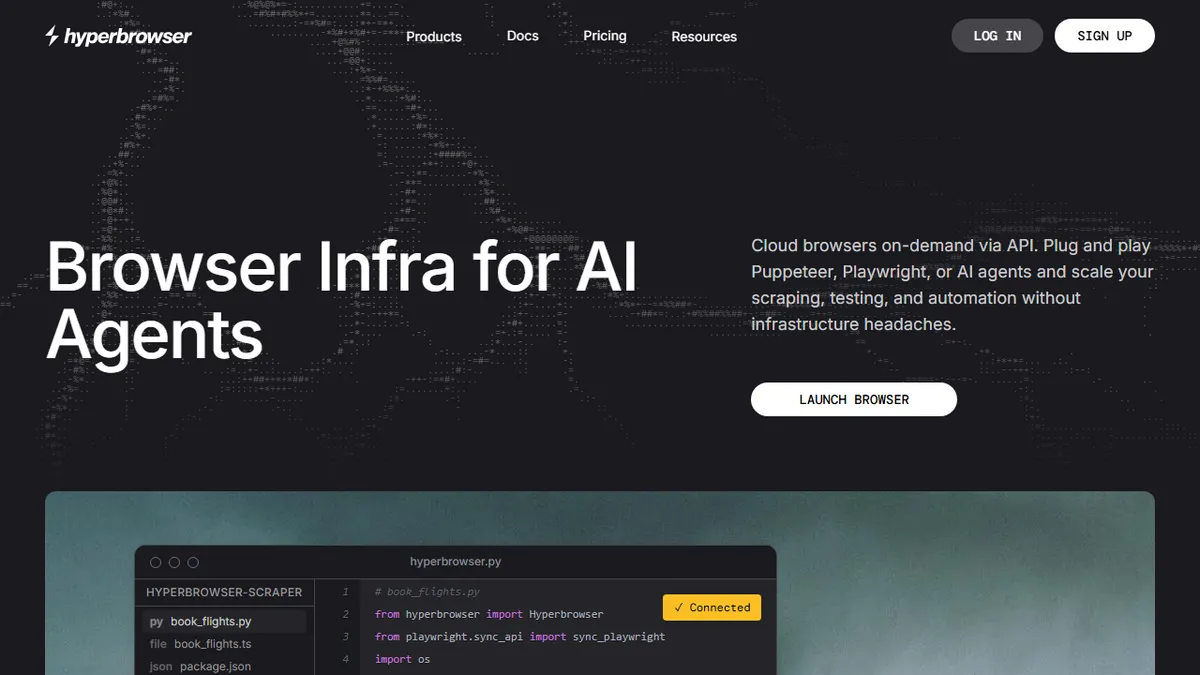
Hyperbrowser is a managed cloud-browser platform aimed squarely at developers building AI agents that have to interact with real websites. It spins up headless Chromium sessions on demand, exposes them via Playwright/Puppeteer/CDP, and bundles the unglamorous plumbing agent teams keep reinventing: rotating residential proxies, stealth/anti-detection patches, CAPTCHA solving, persistent session profiles, and a scrape/crawl/extract Web API for one-shot data jobs.
It slots into the same category as Browserbase and Browserless but leans harder into agent-framework support. There are first-class integrations for Browser Use, Stagehand, LangChain, and the OpenAI/Anthropic computer-use tooling, plus official Python and Node SDKs. The pitch is mostly for engineers shipping autonomous web workflows, RPA replacements, or large-scale scraping pipelines who don't want to run a fleet of browsers themselves. Pricing is usage-based with a free developer tier; serious workloads land in paid plans.
It's a closed-source commercial service, not a self-hostable library, so you're trading control for not having to babysit Chrome containers and IP pools. If your agent ever needs to touch the open web from production, it's one of the obvious candidates to evaluate.
Hyperbrowser is part of the new wave of agent-browser providers that exist because raw Playwright in a Docker container falls apart the moment Cloudflare shows up. The framework integrations are the real selling point — if you're already using Browser Use or Stagehand, it's the path of least resistance. Worth pricing against Browserbase before committing.
— The AI Tool Bible editorial team
Pros
- ✅ Purpose-built for agent frameworks like Browser Use and Stagehand
- ✅ Stealth mode, residential proxies, and CAPTCHA solving included
- ✅ Drop-in Playwright/Puppeteer connect strings, plus Python and Node SDKs
- ✅ Scrape/crawl/extract Web API for quick one-shot jobs without writing scripts
- ✅ Free tier lets you prototype before committing
Cons
- ⚠️ Closed source and SaaS-only; no self-hosting option
- ⚠️ Usage-based pricing can climb fast on large crawls
- ⚠️ Younger and less battle-tested than Browserbase at enterprise scale
Use cases
Frequently asked
- How much does Hyperbrowser cost?
- Hyperbrowser uses a freemium model with a free developer tier. Paid plans are usage-based, meaning you pay according to your actual workload volume rather than a fixed monthly subscription fee.
- Which AI frameworks does Hyperbrowser integrate with?
- It offers first-class integrations for Browser Use, Stagehand, LangChain, and OpenAI/Anthropic computer-use tooling. It also provides official Python and Node SDKs for direct integration into your existing agent workflows.
- Can I self-host Hyperbrowser on my own infrastructure?
- No, Hyperbrowser is a closed-source commercial service. It is not a self-hostable library, so you cannot run it on-premises. You trade control for the convenience of not managing Chrome containers and IP pools yourself.
- What technical features are included in the platform?
- The platform bundles rotating residential proxies, stealth/anti-detection patches, CAPTCHA solving, and persistent session profiles. It exposes headless Chromium sessions via Playwright, Puppeteer, or CDP, and includes a Web API for one-shot data jobs.
- Is Hyperbrowser suitable for simple HTTP scraping tasks?
- If a simple HTTP scraper or your own headless Chrome container already covers your job, you should skip Hyperbrowser. It is best for complex agent workflows requiring real browser interaction, stealth, and proxy management.
Explore related
Compare with similar tools
All in Agents →LangGraph
FeaturedStateful, graph-based agent orchestration from LangChain.
CrewAI
FeaturedPython framework for multi-agent orchestration.
Ernie Bot
Baidu's Mandarin-first ChatGPT rival, powered by the ERNIE model family
Moveworks
The enterprise AI assistant that searches, answers, and takes action across your business systems
AWS Bedrock
Build and scale generative AI applications with foundation models
Claude Agent SDK
Anthropic's official SDK for building autonomous Claude agents.