Headroom
Open-source context compression layer that strips 70-95% of boilerplate before it hits your LLM.
In short
Headroom is a model-agnostic proxy that compresses boilerplate data like JSON and logs before sending them to LLMs. It is best for teams needing to reduce token costs in agent loops or RAG pipelines without rewriting prompts.
Pick Headroom if your agent or RAG pipeline is burning tokens on repetitive JSON, logs, or tool outputs and you want a model-agnostic fix without rewriting prompts.
Skip it if your prompts are already lean prose, you can't tolerate an extra proxy hop, or you need a vendor-supported, SOC2-attested commercial product.
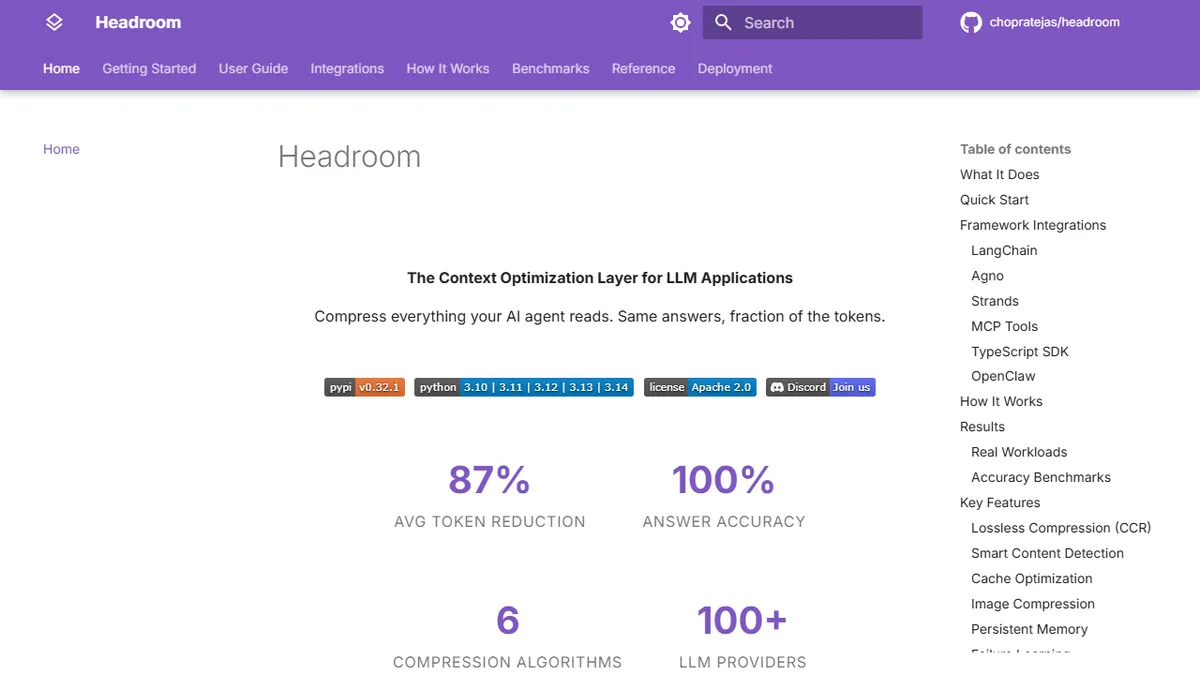
Headroom is a context optimization proxy for LLM applications. It sits between your app and the model provider (Anthropic, OpenAI, Vertex, Bedrock, Azure, or any of 100+ providers via LiteLLM) and compresses the heavy stuff agents tend to drag into context: JSON blobs, logs, code, diffs, HTML, API responses, and database dumps. The published benchmarks claim 87% average token reduction with 100% answer accuracy on retrieval tasks, plus a separate image-compression path that knocks 40-90% off vision-model token counts.
Under the hood it runs a two-stage pipeline: CacheAligner shapes prompts to maximize provider KV-cache hits, and ContentRouter auto-detects content type and dispatches one of six specialized compression algorithms. You can drop it in as a transparent localhost proxy (zero code changes), a Python SDK call, or via native integrations for LangChain, Agno, Strands, and MCP. It's Apache 2.0, free for commercial use, and ships through PyPI and npm. The target user is anyone whose agent loops, RAG pipelines, or log-summarization jobs are bleeding tokens on repeated boilerplate.
Caveats: it's a relatively young project from a small lab, so production hardening, observability, and edge-case behavior across exotic content types are still proving out. The 100%-accuracy benchmark numbers are self-reported and worth re-running on your own corpus before you trust them in a critical path.
A genuinely interesting niche: token-side middleware rather than yet another orchestration framework. The architecture (cache-aligner + content-router) is the right shape, and Apache 2.0 means you can audit the compression yourself. We'd run our own accuracy benchmarks before putting it in front of a paying user, but it's worth a look for any team whose context windows keep blowing up.
— The AI Tool Bible editorial team
Pros
- ✅ Drop-in localhost proxy means zero code changes to integrate
- ✅ Claims 87% token reduction with lossless retrieval
- ✅ Apache 2.0, free for commercial use, on PyPI and npm
- ✅ Native integrations for LangChain, Agno, Strands, and MCP
- ✅ Provider-agnostic via LiteLLM, including Bedrock and Vertex
Cons
- ⚠️ Young project; production track record is thin
- ⚠️ Benchmark numbers are self-reported and need independent validation
- ⚠️ Adds a proxy hop and another moving part to your inference path
- ⚠️ Documentation depth varies across the six compression algorithms
Use cases
Frequently asked
- How does Headroom integrate with existing LLM applications?
- It can be deployed as a transparent localhost proxy requiring zero code changes, used via a Python SDK, or integrated natively with LangChain, Agno, Strands, and MCP.
- Which model providers are supported by Headroom?
- Headroom is model-agnostic and supports Anthropic, OpenAI, Vertex, Bedrock, Azure, and over 100 other providers via LiteLLM.
- What are the claimed performance benefits of using Headroom?
- The tool claims an average 87% token reduction with 100% answer accuracy on retrieval tasks, and a separate image-compression path that reduces vision-model token counts by 40-90%.
- Is Headroom free to use for commercial projects?
- Yes, Headroom is open-source under the Apache 2.0 license and is free for commercial use, available via PyPI and npm.
- What are the main limitations of Headroom?
- It is a young project with a thin production track record, and its self-reported benchmark numbers should be independently validated on your own corpus before critical deployment.
Explore related
Compare with similar tools
All in Agents →LangGraph
FeaturedStateful, graph-based agent orchestration from LangChain.
CrewAI
FeaturedPython framework for multi-agent orchestration.
Ernie Bot
Baidu's Mandarin-first ChatGPT rival, powered by the ERNIE model family
Moveworks
The enterprise AI assistant that searches, answers, and takes action across your business systems
AWS Bedrock
Build and scale generative AI applications with foundation models
Claude Agent SDK
Anthropic's official SDK for building autonomous Claude agents.