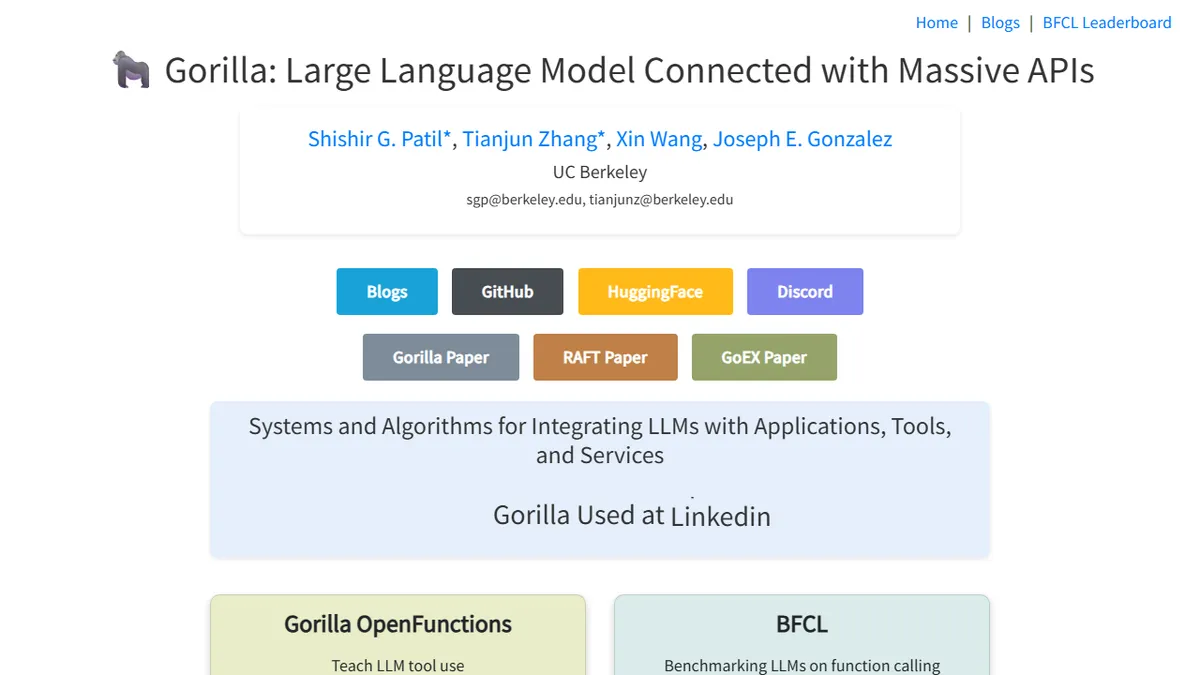
Gorilla
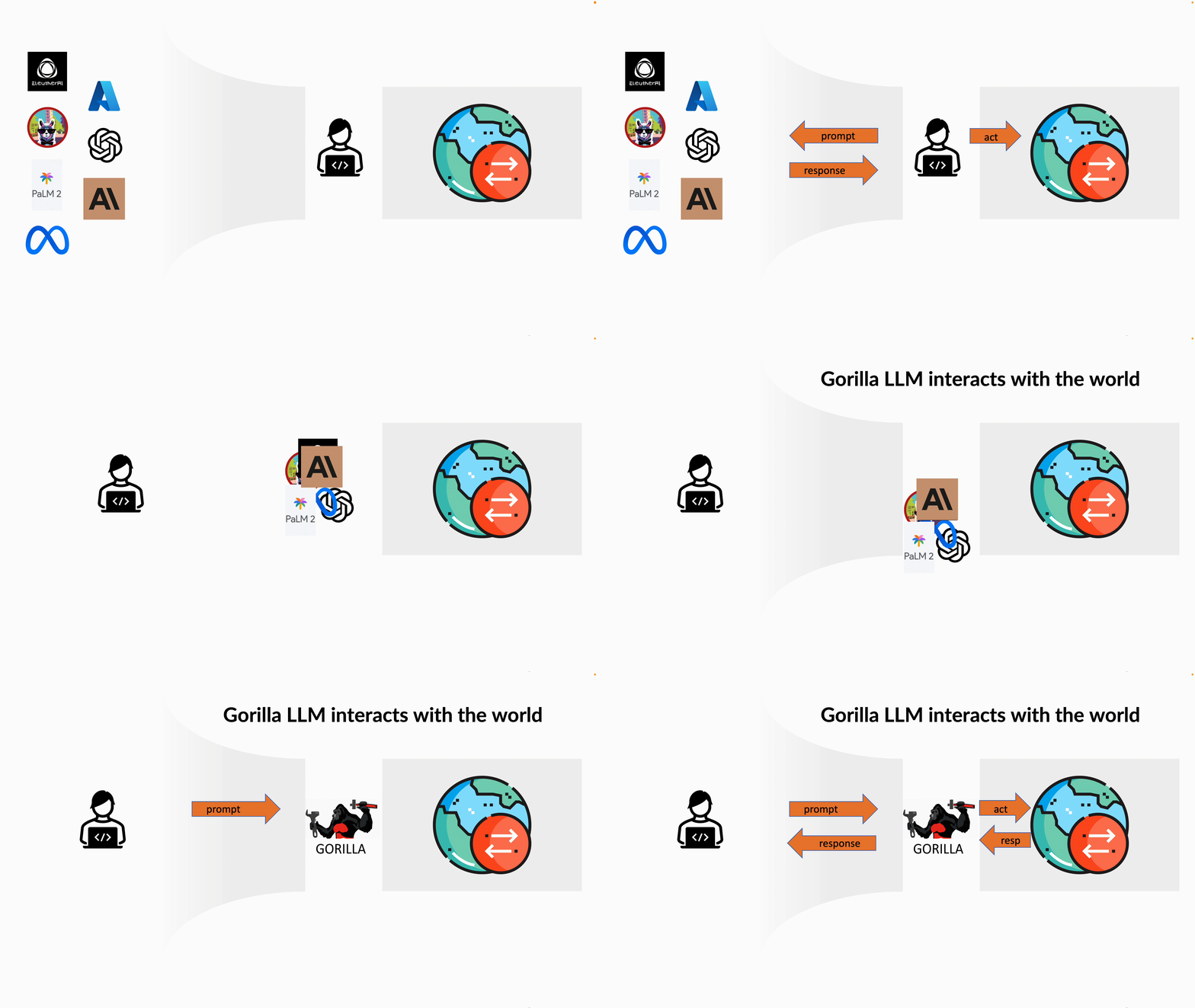
Open-source LLM purpose-built for function calling and API invocation across thousands of tools.
In short
Gorilla is a free, open-source 6.91B LLM from UC Berkeley designed for accurate function calling and API invocation. It offers self-hosted flexibility with Apache 2.0 licensing.
Pick Gorilla if you need an open, self-hostable model that does function calling and tool use as a first-class skill.
Skip it if you want a turnkey hosted agent API with SLAs and a polished dashboard.
Gorilla is a UC Berkeley research project that ships an open-source LLM (gorilla-openfunctions-v2, ~6.91B params) trained specifically to translate natural-language intents into accurate API calls. Beyond the base model, the project includes GoEX (a runtime that executes LLM-generated actions with undo and damage-confinement safety primitives), RAFT (a fine-tuning recipe for retrieval-augmented generation), and the Berkeley Function-Calling Leaderboard (BFCL) which benchmarks function-calling quality across 2,000+ test cases in Python, Java, and REST.
It's aimed at developers and ML teams who want an open, self-hostable alternative to closed function-calling APIs from OpenAI or Anthropic. Everything is Apache 2.0, with weights on HuggingFace and a hosted demo plus Colab notebook for kicking the tires. Because it's research-led, the polish is uneven compared to commercial offerings, but the BFCL leaderboard and ongoing publications give it real credibility as a reference implementation for tool-using agents.
Integrations cover Python, Java, and REST out of the box, and the project pairs naturally with agent frameworks that need a local function-calling backbone. The caveat is that 'product' here means GitHub code plus model weights, not a managed SaaS, so you handle hosting, eval, and ops yourself.
Gorilla is one of the few credible open alternatives to closed function-calling APIs, and the BFCL leaderboard alone makes the site worth bookmarking. Treat it as a research-grade building block rather than a finished product, and pair it with your own serving stack.
— The AI Tool Bible editorial team
Pros
- ✅ Fully open-source (Apache 2.0) with weights on HuggingFace
- ✅ Purpose-trained for function calling, not a generic chat model retrofitted
- ✅ Includes BFCL leaderboard as a public eval harness
- ✅ GoEX runtime adds undo and damage-confinement for executed actions
- ✅ Active Berkeley research backing with regular updates
Cons
- ⚠️ Research project polish; not a managed SaaS
- ⚠️ Smaller param count than frontier closed models
- ⚠️ Self-hosting and ops are on you
- ⚠️ Documentation skews toward papers and notebooks
Use cases
Frequently asked
- How much does Gorilla cost to use?
- Gorilla is completely free and licensed under Apache 2.0. You can self-host the model, with weights available on HuggingFace. There are no subscription fees, but you must handle your own hosting, evaluation, and operations infrastructure.
- What programming languages and protocols does Gorilla support?
- Gorilla supports Python, Java, and REST out of the box. The Berkeley Function-Calling Leaderboard benchmarks these integrations across over 2,000 test cases. It is designed to translate natural language into accurate API calls for these specific environments.
- Is Gorilla suitable for production environments?
- Gorilla is a research-led project, so polish is uneven compared to commercial SaaS offerings. It is not a managed service with SLAs or a polished dashboard. You are responsible for hosting, evaluation, and operations, making it best for developers comfortable with self-hosting.
- What additional tools are included in the Gorilla project?
- Beyond the base model, Gorilla includes GoEX, a runtime for executing actions with safety primitives, and RAFT, a fine-tuning recipe for retrieval-augmented generation. It also features the Berkeley Function-Calling Leaderboard to benchmark function-calling quality across various test cases.
- How does Gorilla compare to closed APIs like OpenAI?
- Gorilla offers an open, self-hostable alternative to closed function-calling APIs from providers like OpenAI or Anthropic. While it lacks the turnkey convenience of hosted agent APIs with SLAs, it provides full control and transparency with its Apache 2.0 licensed weights and code.
Explore related
Compare with similar tools
All in Agents →LangGraph
FeaturedStateful, graph-based agent orchestration from LangChain.
CrewAI
FeaturedPython framework for multi-agent orchestration.
Ernie Bot
Baidu's Mandarin-first ChatGPT rival, powered by the ERNIE model family
Moveworks
The enterprise AI assistant that searches, answers, and takes action across your business systems
AWS Bedrock
Build and scale generative AI applications with foundation models
Claude Agent SDK
Anthropic's official SDK for building autonomous Claude agents.