
Fireworks AI
✓ Editorially verifiedProduction inference and fine-tuning platform for open-source LLMs, tuned for speed and enterprise economics.
In short
Fireworks AI provides a managed platform for running open-weight LLMs with serverless inference and full-parameter or LoRA fine-tuning. It is best for teams needing OpenAI-compatible endpoints and multi-LoRA serving without managing their own GPU infrastructure.
Pick Fireworks AI if you want a managed, OpenAI-compatible endpoint for open-weight LLMs plus a real fine-tuning and multi-LoRA pipeline.
Skip it if you already operate your own vLLM/SGLang GPU fleet or you only need a closed-model API from OpenAI/Anthropic directly.
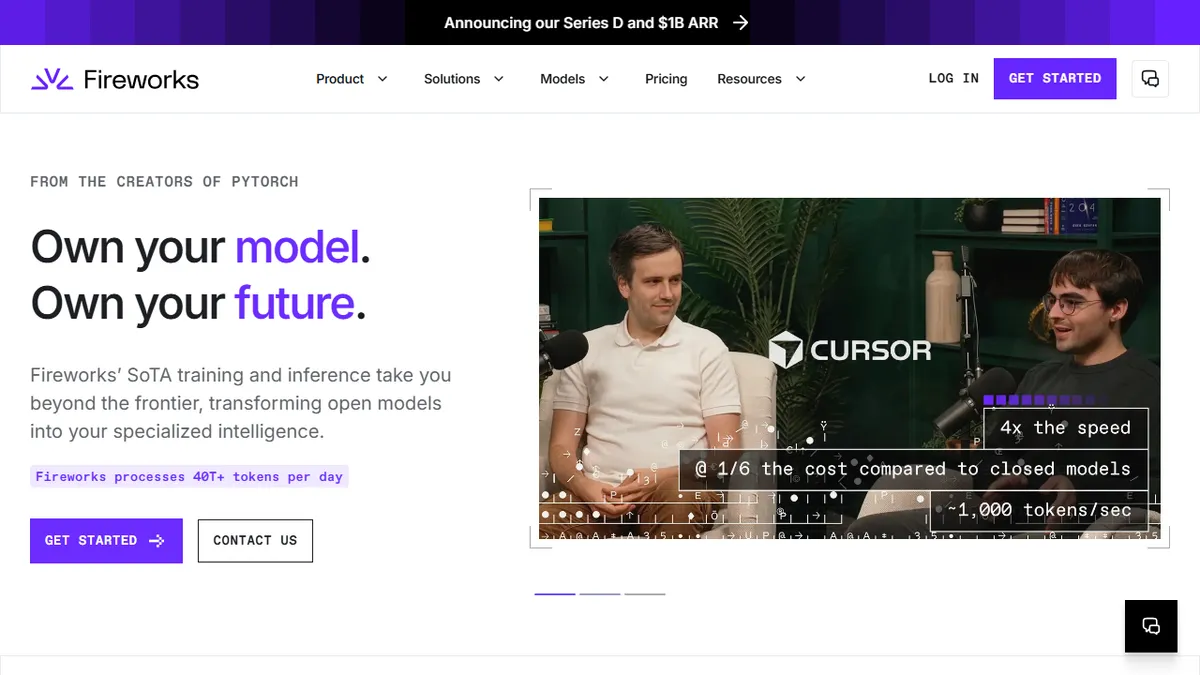
Fireworks AI is a generative-AI inference and fine-tuning platform built by former PyTorch engineers, aimed at teams that want to run open-weight models (DeepSeek, Qwen, GLM, Kimi, Gemma, Minimax and more) in production without standing up their own GPU stack. It offers serverless per-token inference, on-demand dedicated deployments, reserved capacity, and full-parameter or LoRA fine-tuning through a REST API that speaks both OpenAI and Anthropic wire formats.
Where Fireworks earns its keep is the fine-tuning and multi-LoRA story: you can train a custom variant, host dozens of adapters against a shared base model, and route traffic to them with the same latency budget as the base. Pricing is per million tokens (e.g. DeepSeek-V4-Flash around $0.14 in / $0.28 out; GLM 5.2 at $1.4 / $4.4), with enterprise reserved-capacity deals for teams with steady load. Customer logos include Cursor, Sourcegraph, Vercel, Notion and UiPath, which is a reasonable proxy for how battle-tested the serving stack is.
Caveats: the platform itself is proprietary (only the models it hosts are open), and if you already run your own vLLM or SGLang cluster the economics get closer. But for teams that want a managed, OpenAI-compatible endpoint against open weights plus a real fine-tuning pipeline, it is one of the strongest options in the category.
Fireworks is the option we reach for when a client wants open-weight economics without babysitting Kubernetes and CUDA. The fine-tuning + multi-LoRA story is genuinely differentiated versus Together, Replicate and DIY vLLM. Watch the pricing sheet though; the catalog moves quickly.
— The AI Tool Bible editorial team
Pros
- ✅ OpenAI- and Anthropic-compatible APIs against open-weight models
- ✅ Strong fine-tuning + multi-LoRA hosting on a shared base
- ✅ Serverless, on-demand, and reserved-capacity tiers cover most load shapes
- ✅ Used in production by Cursor, Sourcegraph, Vercel, Notion
Cons
- ⚠️ Platform itself is proprietary despite hosting open models
- ⚠️ Per-token pricing can beat DIY GPUs at low volume but not at very high steady load
- ⚠️ Model catalog churns fast; today's best price/perf may not be tomorrow's
Use cases
Frequently asked
- Which models does Fireworks AI support?
- The platform hosts open-weight models including DeepSeek, Qwen, GLM, Kimi, Gemma, and Minimax. It allows users to run these models in production without standing up their own GPU stack.
- How does Fireworks AI handle fine-tuning and multi-LoRA serving?
- It offers full-parameter or LoRA fine-tuning through a REST API. Users can host dozens of adapters against a shared base model and route traffic to them with the same latency budget as the base model.
- Is the Fireworks AI API compatible with existing tools?
- Yes, the platform provides a REST API that speaks both OpenAI and Anthropic wire formats, allowing for easy integration with existing development workflows.
- What are the pricing options for Fireworks AI?
- Pricing is freemium with free signup credits and pay-per-token rates starting from approximately $0.14 per million input tokens. Enterprise reserved capacity is available on request for teams with steady load.
- Who are the current customers of Fireworks AI?
- Customer logos include Cursor, Sourcegraph, Vercel, Notion, and UiPath, indicating the platform is used in production by various technology companies.
Explore related
Compare with similar tools
All in Fine-tuning →Together AI
FeaturedFine-tune & serve open-weight models (Llama, Mistral, DeepSeek).
Modal
Serverless GPUs and infra for training & serving ML.
Replicate
One-API platform for running and fine-tuning open-source models.
OpenAI Fine-tuning
Fine-tune GPT-4o-mini and friends on your own data.
Llama
Meta's open-weight LLM family covering 1B mobile models up to 405B frontier and natively multimodal 10M-context Llama 4 variants.
RunPod
On-demand GPU cloud and serverless inference platform built specifically for AI workloads.