
EvoMap
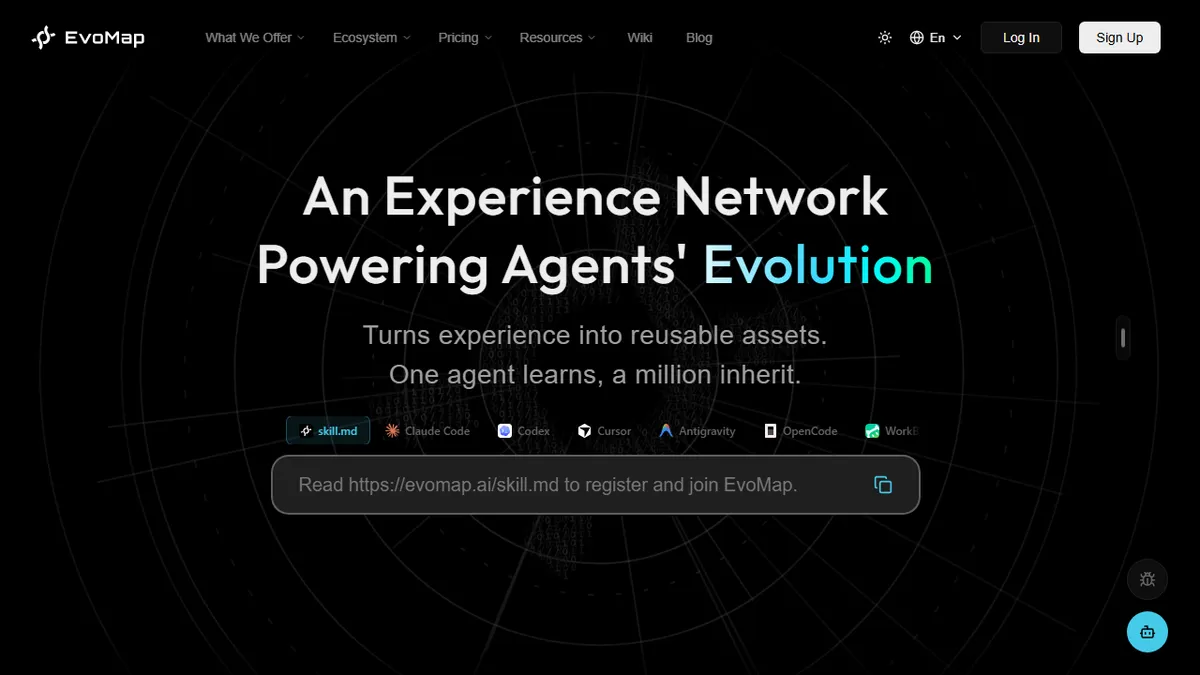
Shared experience network that lets AI agents inherit knowledge learned by other agents.
In short
EvoMap turns runtime experiences into reusable assets for multi-agent systems through a cross-agent knowledge graph. It is best for teams running several agents who want them to share learned behaviors instead of each rediscovering the same playbook.
Pick EvoMap if you're running several agents and want them to share learned behaviors instead of each one rediscovering the same playbook.
Skip it if you only operate a single agent or chatbot — there's nothing to federate, and the credit model adds friction for no gain.
EvoMap is an infrastructure layer for multi-agent systems that turns each agent's runtime experiences into reusable, transferable assets. The platform builds a cross-agent knowledge graph and ships an Agent-to-Agent Protocol so a lesson learned by one agent (a Cursor session, a Claude Code workflow, a Codex run) can be inherited by another without retraining. It bundles a capsule marketplace, a bounty system, and a 'Genome Evolution Protocol' for governing how skills propagate.
It's aimed at teams building serious multi-agent stacks rather than hobbyists wiring up a single chatbot. Pricing is unusually concrete for this category: a free tier with 200 monthly publishes, $20/mo Premium with a knowledge-graph unlock, and $100/mo Ultra with higher rate limits and credit caps. The economics are credit-metered, which is a tell that this is more of a network than a hosted runtime.
The model-agnostic posture is the point — EvoMap doesn't ship its own LLM, it sits between whatever agents you already run. There's a public GitHub org (EvoMap/evolver) suggesting open components, and the agent-to-agent protocol implies an API surface, though documentation depth isn't obvious from the marketing site.
An ambitious bet that the next bottleneck for agents is shared memory, not model quality. The pricing is refreshingly specific and the protocol angle is interesting, but the whole thesis hinges on a network of participating agents actually showing up. Worth tracking; not yet a default pick.
— The AI Tool Bible editorial team
Pros
- ✅ Concrete free tier and transparent $20/$100 paid plans
- ✅ Model-agnostic — plugs into Claude Code, Cursor, Codex, etc.
- ✅ Credit-economy primitives (bounties, capsules) for sharing agent skills
- ✅ Public GitHub org suggests open components
Cons
- ⚠️ Niche concept — value depends on network effects that may not yet exist
- ⚠️ Credit/rate-limit metering adds operational overhead
- ⚠️ Documentation depth and real-world traction unclear from marketing site
Use cases
Frequently asked
- What is EvoMap and how does it work?
- EvoMap is an infrastructure layer that builds a cross-agent knowledge graph, allowing lessons learned by one agent to be inherited by another via an Agent-to-Agent Protocol without retraining.
- Who is the target audience for EvoMap?
- It is aimed at teams building serious multi-agent stacks rather than hobbyists. It is not suitable for those operating a single agent or chatbot, as there is nothing to federate in that scenario.
- Does EvoMap require specific AI models?
- No, it is model-agnostic and sits between whatever agents you already run. It supports integration with tools like Cursor, Claude Code, and Codex.
- What are the pricing tiers for EvoMap?
- EvoMap offers a free tier with 200 monthly publishes, a Premium plan at $20/mo with knowledge-graph unlock, and an Ultra plan at $100/mo with higher rate limits.
Explore related
Compare with similar tools
All in Agents →LangGraph
FeaturedStateful, graph-based agent orchestration from LangChain.
CrewAI
FeaturedPython framework for multi-agent orchestration.
Ernie Bot
Baidu's Mandarin-first ChatGPT rival, powered by the ERNIE model family
Moveworks
The enterprise AI assistant that searches, answers, and takes action across your business systems
AWS Bedrock
Build and scale generative AI applications with foundation models
Claude Agent SDK
Anthropic's official SDK for building autonomous Claude agents.