DeerFlow
Open-source multi-agent framework from ByteDance for long-running research, coding, and content tasks.
In short
DeerFlow is ByteDance's free, MIT-licensed multi-agent framework for self-hosted long-running research and coding tasks with full sandbox control.
Pick DeerFlow if you want a self-hosted, MIT-licensed multi-agent harness for long-running research or coding tasks with full sandbox control.
Skip it if you need a hosted, point-and-click agent product or you're not comfortable running Docker and managing your own LLM API keys.
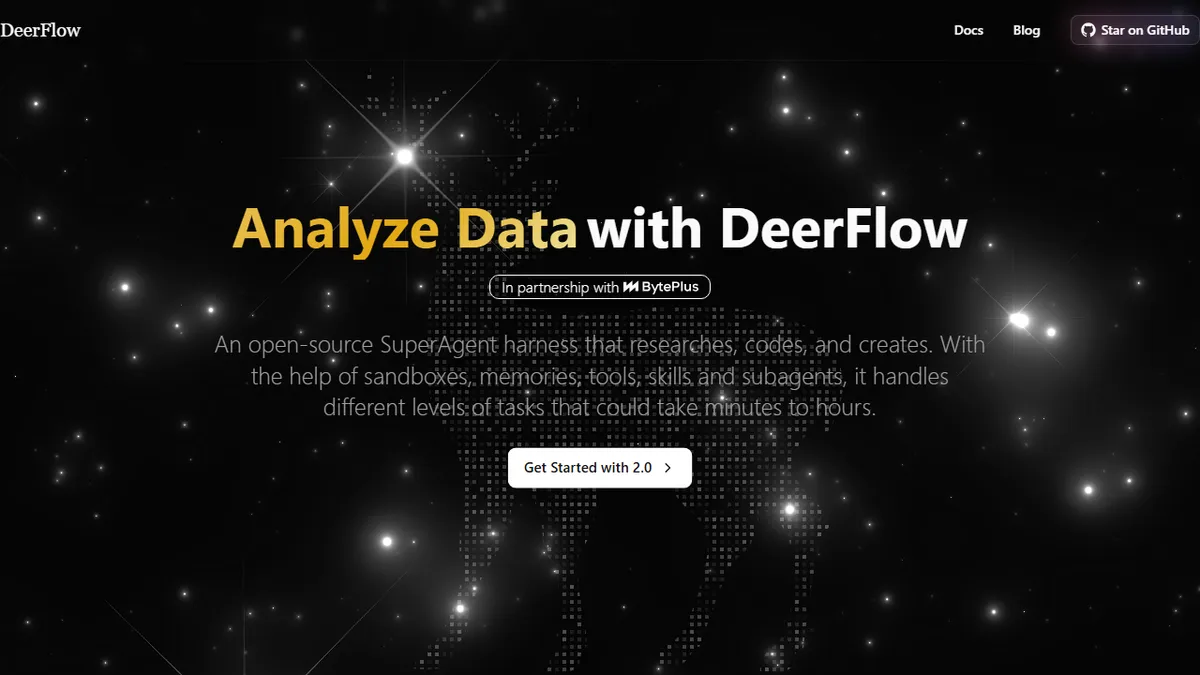
DeerFlow is ByteDance's open-source 'SuperAgent harness' that orchestrates LLM-powered agents through long-horizon tasks — deep research, code generation, multimedia creation — that can run for minutes or hours. The framework ships with a persistent Docker sandbox (file system, shell, VSCode integration), long- and short-term memory, sub-agent spawning, progressive skill loading, and a planner capable of decomposing complex problems into sequential or parallel sub-tasks.
It's pitched at developers and researchers who want an autonomous agent stack they can self-host and fully control rather than a closed SaaS like Manus or Devin. DeerFlow is MIT-licensed (the repo lives at bytedance/deer-flow) and brings its own model-agnostic routing: out of the box it speaks to Doubao, DeepSeek, OpenAI, and Gemini, so you can mix a cheap planner with a stronger executor. Because it's OSS and self-hosted, there's no per-seat or per-task pricing — your only cost is the LLM tokens and the host you run the sandbox on.
The trade-off is the usual one for agent frameworks at this layer: you need Docker, an LLM key, and the patience to wire up your own tools and prompts. There's no managed SaaS, no hosted web app for non-technical users, and the docs/community are still maturing compared with LangGraph or CrewAI.
A serious open-source entrant from ByteDance that sits between LangGraph's plumbing and Manus's closed UX — you get the persistent sandbox and sub-agent loop without giving up control of your stack. Worth a look if you're building agentic research workflows and have rejected SaaS lock-in, but expect to do real engineering.
— The AI Tool Bible editorial team
Pros
- ✅ Fully MIT-licensed and self-hostable — no vendor lock-in
- ✅ Persistent Docker sandbox with shell + VSCode integration
- ✅ Model-agnostic: routes to Doubao, DeepSeek, OpenAI, or Gemini
- ✅ Built-in long/short-term memory and sub-agent spawning
- ✅ Backed by ByteDance, so active upstream development
Cons
- ⚠️ No managed/hosted SaaS — Docker and LLM keys required
- ⚠️ Smaller community than LangGraph or CrewAI
- ⚠️ Public API surface for embedding is under-documented
Use cases
Frequently asked
- How much does DeerFlow cost?
- DeerFlow is free and MIT-licensed. As a self-hosted tool, you pay only for LLM tokens and the hosting infrastructure required to run the Docker sandbox.
- Which AI models does DeerFlow support?
- It supports multi-model routing, speaking out of the box to Doubao, DeepSeek, OpenAI, and Gemini. This allows you to mix cheaper planners with stronger executors.
- Is DeerFlow suitable for non-technical users?
- No. It requires Docker, LLM API keys, and the ability to manage your own tools and prompts. It is not a hosted, point-and-click product for non-technical users.
- What are the main use cases for DeerFlow?
- It is best for deep research, autonomous coding, multi-agent orchestration, content generation, and data analysis. It handles long-horizon tasks that can run for minutes or hours.
- How does DeerFlow compare to hosted agents?
- Unlike closed SaaS products like Manus or Devin, DeerFlow is open-source and self-hosted. You gain full control over the sandbox and memory, but must manage the infrastructure yourself.
Explore related
Compare with similar tools
All in Agents →LangGraph
FeaturedStateful, graph-based agent orchestration from LangChain.
CrewAI
FeaturedPython framework for multi-agent orchestration.
Ernie Bot
Baidu's Mandarin-first ChatGPT rival, powered by the ERNIE model family
Moveworks
The enterprise AI assistant that searches, answers, and takes action across your business systems
AWS Bedrock
Build and scale generative AI applications with foundation models
Claude Agent SDK
Anthropic's official SDK for building autonomous Claude agents.