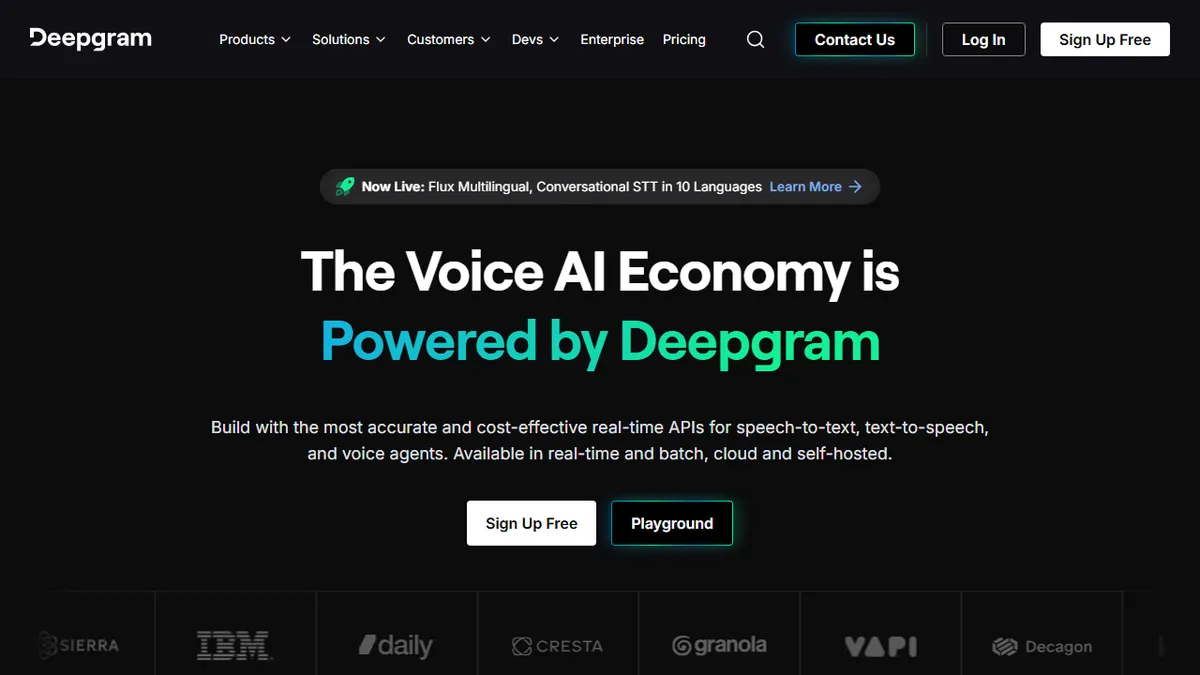

Deepgram
✓ Editorially verifiedProduction-grade speech-to-text, text-to-speech, and voice-agent APIs for real-time and batch audio.
In short
Deepgram is a voice AI platform providing low-latency speech-to-text, text-to-speech, and unified voice-agent APIs. It is best for developers building real-time voice products like call centers or meeting bots who need streaming performance and self-hosting capabilities.
Pick Deepgram if you're building a real-time voice product — agents, call analytics, live captions — and need streaming latency plus a self-hosting escape hatch.
Skip it if you only need occasional batch transcription and would prefer a fully open-source stack like Whisper or a cheaper pay-per-minute API.
Deepgram is a voice AI platform built around a family of proprietary speech models: Nova for transcription, Flux for multilingual conversational STT across 10 languages, and Speak for text-to-speech. It exposes everything as low-latency APIs with both cloud and self-hosted deployment, plus a Voice Agent API that bundles STT, TTS, and LLM orchestration into a single conversational pipeline.
The target user is a developer or platform team building voice into a product — contact centers, meeting bots, medical scribes, podcast transcription, IVR replacements. Deepgram's differentiator against the OpenAI/Google/AssemblyAI pack has historically been latency and cost per hour at scale, plus the option to run models on-prem for compliance-heavy workloads. Pricing isn't posted on the marketing page, but the console offers self-serve signup with free credits, and metered usage scales into enterprise contracts.
It is not open source, and while docs are thorough, choosing between Nova, Flux, and the Agent API can be confusing at first. For teams that just want a hosted transcription call and don't need real-time streaming, cheaper batch-only alternatives exist. But if latency, streaming, or self-hosting matter, Deepgram is one of the most credible options.
Deepgram is one of the few voice AI vendors that consistently ships models competitive with the hyperscalers on latency and price. The Voice Agent API is a smart bet as the interaction pattern shifts from transcription to full conversations. Just budget time for a proper bake-off — Nova vs Whisper vs AssemblyAI is a real decision.
— The AI Tool Bible editorial team
Pros
- ✅ Very low latency streaming STT suitable for real-time voice agents
- ✅ Self-hosted deployment option for regulated industries
- ✅ Unified Voice Agent API bundles STT + TTS + LLM orchestration
- ✅ Multilingual conversational STT via Flux across 10 languages
Cons
- ⚠️ Pricing not transparent on the marketing site
- ⚠️ Not open source; vendor lock-in on proprietary models
- ⚠️ Product lineup (Nova vs Flux vs Agent) can confuse first-time evaluators
Use cases
Frequently asked
- What specific models does Deepgram offer?
- Deepgram provides a family of proprietary models including Nova for transcription, Flux for multilingual conversational speech-to-text across 10 languages, and Speak for text-to-speech.
- Can Deepgram be deployed on-premises?
- Yes, Deepgram supports both cloud and self-hosted deployment, which is useful for compliance-heavy workloads in regulated industries.
- How is Deepgram priced?
- Deepgram uses a freemium model with free credits on signup and usage-based pricing. Enterprise contracts are available, though specific pricing is not posted on the marketing page.
- What is the Voice Agent API?
- The Voice Agent API bundles speech-to-text, text-to-speech, and LLM orchestration into a single conversational pipeline for building voice agents.
- Is Deepgram suitable for batch-only transcription?
- While it supports batch audio, it is not the best fit if you only need occasional batch transcription, as cheaper batch-only alternatives or open-source stacks like Whisper may be more appropriate.
Explore related
Compare with similar tools
All in Audio →ElevenLabs
FeaturedThe gold standard for AI voice cloning and TTS.
Suno
FeaturedText-to-song AI — full vocal tracks from a prompt.
Udio
Suno's main rival for AI-generated full songs.
AssemblyAI
Speech-to-text API with diarisation, summarisation, and topic detection.
Chorus by ZoomInfo
Enterprise conversation intelligence bundled with ZoomInfo's B2B data graph
Whisper
OpenAI's open-source speech-to-text — the de-facto baseline.