
Daytona
✓ Editorially verifiedSecure, isolated sandboxes for running AI-generated code with sub-90ms cold starts.
In short
Daytona provides secure, isolated sandboxes for AI agents with sub-90ms cold starts. It supports stateful execution across Linux, Windows, and macOS for coding and computer-use tasks.
Pick Daytona if you're shipping a coding or computer-use agent and want managed, audited sandboxes that boot fast and persist state.
Skip it if you only need a single long-lived dev VM or your workload is steady-state compute better served by a regular VPS.
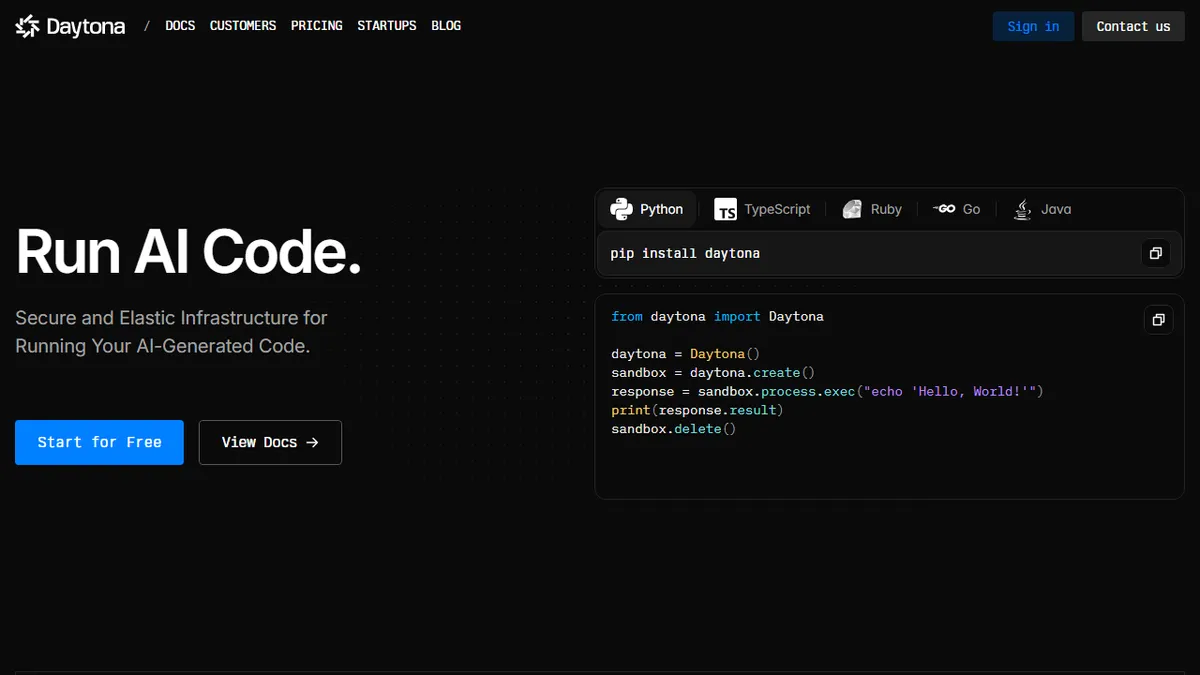
Daytona is a managed sandbox infrastructure built specifically for AI agents that need to execute untrusted, model-generated code. It spins up ephemeral Linux, Windows, or macOS environments in under 90 milliseconds, exposes programmatic APIs for process execution, file system access, Git, and LSP, and lets sandboxes stay stateful so long-running agent workflows can pick up where they left off. Snapshots, shared volumes, and multi-region deployment round out the runtime story.
The target user is anyone building coding agents, code interpreters, eval harnesses, data-analysis tools, RL training loops, or computer-use agents who would otherwise hand-roll Firecracker or gVisor. Pricing is pay-per-second compute starting around $0.000014/sec with $200 in free credit, plus surcharges for GPUs (H100, RTX PRO 6000) and Windows. SOC 2, HIPAA, and GDPR are covered, and you can bring your own cloud for customer-managed compute.
The core is open-source so you can audit the isolation model, and there's a REST API plus SDKs in Python and TypeScript. It sits in the same competitive lane as E2B, Modal sandboxes, and CodeSandbox SDK, with the differentiator being explicit support for computer-use agents (virtual desktops with SSH and browser VS Code) alongside headless code execution.
Daytona is one of the more credible answers to 'where does my agent's code actually run.' The sub-90ms boot and open-source core are the real selling points; the computer-use story is a useful bonus that E2B doesn't match cleanly. Worth a serious look against E2B and Modal for any agent shipping to production.
— The AI Tool Bible editorial team
Pros
- ✅ Sub-90ms sandbox cold start beats most agent-sandbox competitors
- ✅ Open-source core lets you audit isolation and self-host
- ✅ Stateful sandboxes with snapshots and shared volumes
- ✅ Supports Linux, Windows, and macOS virtual desktops for computer-use agents
- ✅ SOC 2, HIPAA, GDPR plus bring-your-own-cloud option
Cons
- ⚠️ Per-second pricing gets expensive for always-on workloads versus a VPS
- ⚠️ Newer than E2B and Modal, so smaller community and fewer examples
- ⚠️ GPU and Windows tiers carry meaningful surcharges
Use cases
Frequently asked
- How much does Daytona cost?
- Daytona uses a freemium model with pay-per-second compute starting at $0.000014/sec. New users receive $200 in free credit. Additional surcharges apply for GPU usage (H100, RTX PRO 6000) and Windows environments.
- What are the main alternatives to Daytona?
- Daytona competes with E2B, Modal sandboxes, and CodeSandbox SDK. Its key differentiator is explicit support for computer-use agents, offering virtual desktops with SSH and browser VS Code alongside standard headless code execution capabilities.
- Which operating systems does Daytona support?
- Daytona spins up ephemeral environments for Linux, Windows, and macOS. It supports both headless code execution and computer-use agents with virtual desktops, allowing for diverse agent workflows and development environments.
- Is Daytona suitable for long-running agent workflows?
- Yes, sandboxes can remain stateful so long-running workflows can resume where they left off. Features like snapshots and shared volumes help maintain context, making it suitable for complex, multi-step agent tasks.
- Does Daytona offer security and compliance features?
- Daytona covers SOC 2, HIPAA, and GDPR compliance. The core isolation model is open-source for auditing, and you can bring your own cloud for customer-managed compute to meet specific security requirements.
Explore related
Compare with similar tools
All in Agents →LangGraph
FeaturedStateful, graph-based agent orchestration from LangChain.
CrewAI
FeaturedPython framework for multi-agent orchestration.
Ernie Bot
Baidu's Mandarin-first ChatGPT rival, powered by the ERNIE model family
Moveworks
The enterprise AI assistant that searches, answers, and takes action across your business systems
AWS Bedrock
Build and scale generative AI applications with foundation models
Claude Agent SDK
Anthropic's official SDK for building autonomous Claude agents.