Composio
✓ Editorially verifiedAuth, tools, and sandboxed execution for AI agents across 1,000+ apps
In short
Composio is a tool-calling layer that offers 1,000+ pre-built integrations with managed OAuth and sandboxed execution. It is best for engineering teams shipping multi-tool AI agents who need to avoid building complex authentication and API client logic from scratch.
Engineering teams shipping multi-tool AI agents in production who want managed auth, a broad integration catalogue, and sandboxed execution without building the plumbing themselves.
Solo hackers whose agent only needs one or two APIs, or teams with strict data-residency rules that forbid delegating OAuth tokens to a third-party managed platform.
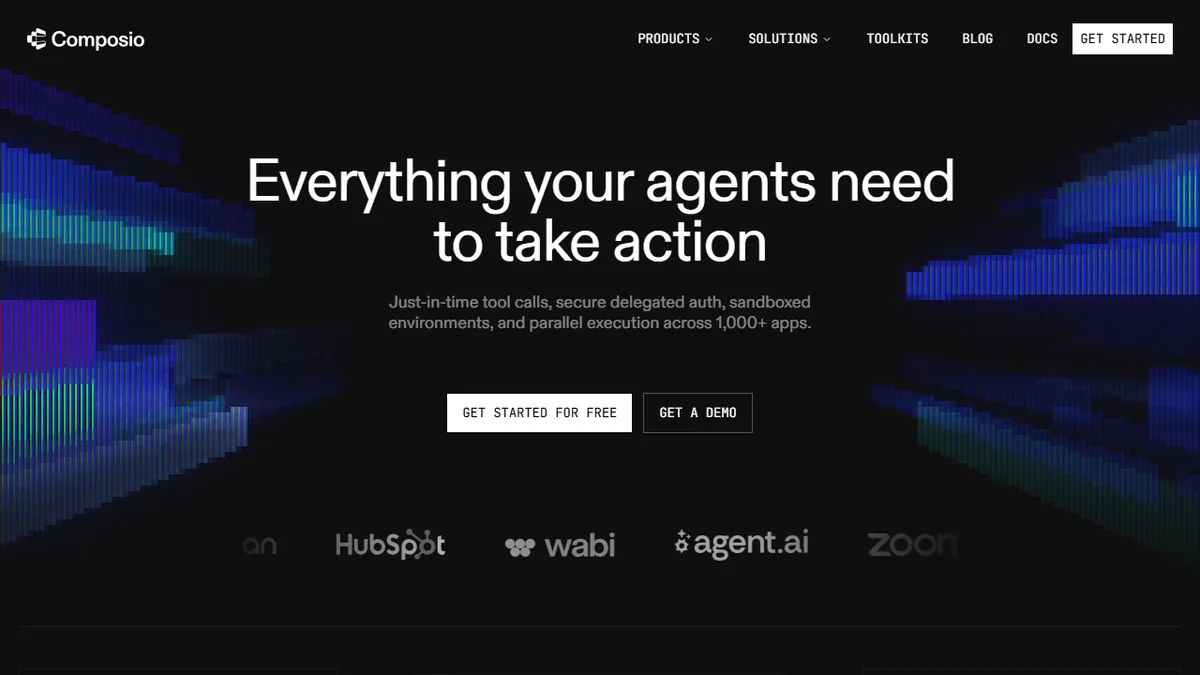
Composio is a tool-calling and integration layer for AI agents that solves the plumbing problem most builders hit the moment their agent needs to actually do something in the real world. Instead of hand-rolling OAuth flows, API clients, retry logic, and sandboxed execution for every SaaS your agent touches, Composio ships a managed catalogue of 1,000+ pre-built integrations — Gmail, Slack, GitHub, Linear, Notion, Sentry, Stripe, Vercel, Supabase, Google Docs, Google Calendar and the long tail — each exposed as a callable tool with delegated auth, token refresh, and structured schemas already handled. It is framework- and model-agnostic: you wire it into LangChain, LlamaIndex, CrewAI, OpenAI's SDK, Anthropic's SDK, Vercel AI SDK, or an MCP client, and the same tool definitions work across Claude, GPT, Gemini, and open-weights models. Beyond the integration catalogue, Composio adds intent-based tool discovery (the agent asks 'send an email' and the right tool surfaces rather than shoving 1,000 schemas into context), sandboxed remote execution environments with navigable filesystems for code-writing agents, bidirectional triggers so external app events wake your agent up, and per-end-user auth state so a multi-tenant agent can act on behalf of each of its users without leaking credentials. Common workflows include building customer-support agents that read Gmail and file Linear tickets, sales agents that update CRMs and post to Slack, coding agents that open GitHub PRs and read Sentry issues, and internal ops bots that automate Notion, Docs, and Calendar. It is aimed squarely at engineering teams shipping production agents who would rather buy the auth-and-integration substrate than build it.
Composio is the most credible attempt yet to be the Twilio of agent tool-calling — auth, integrations, and sandboxes as a service so you can spend time on the agent, not the plumbing. The pricing scales with tool calls, which is honest but bites at volume, and delegating OAuth to any third party is a real trust decision. For teams past the demo stage building agents that actually touch SaaS, it earns its keep.
— The AI Tool Bible editorial team
Pros
- ✅ 1,000+ pre-built app integrations with managed OAuth, token refresh, and per-end-user auth state out of the box
- ✅ Framework- and model-agnostic — works with LangChain, LlamaIndex, CrewAI, OpenAI, Anthropic, Vercel AI SDK, and MCP clients
- ✅ Intent-based tool discovery avoids blowing up context windows with hundreds of tool schemas
- ✅ Sandboxed remote execution environments for code-running agents, with filesystem access
- ✅ Bidirectional triggers let agents react to external app events, not just poll
- ✅ Generous free tier (20K tool calls/mo) makes it cheap to prototype
- ✅ Enterprise path with SOC-2, VPC, and on-prem deployment for regulated buyers
Cons
- ⚠️ Usage-based pricing on tool calls can escalate fast for chatty agents at scale
- ⚠️ You are trusting a third party with delegated OAuth tokens for sensitive apps — a supply-chain and blast-radius concern
- ⚠️ Managed catalogue means you inherit whatever quirks and rate-limit handling Composio ships per integration
- ⚠️ Abstraction can leak when you need low-level control over a specific API's edge cases
- ⚠️ Newer platform — docs, SDK stability, and community depth still trail LangChain-era tooling
- ⚠️ Overkill if your agent only needs one or two integrations you already have SDKs for
Use cases
Frequently asked
- What does Composio provide for AI agent development?
- It offers a managed catalogue of over 1,000 pre-built integrations, including Gmail, Slack, and GitHub, with delegated auth, token refresh, and structured schemas. It also provides sandboxed remote execution environments and bidirectional triggers for external app events.
- Which frameworks and models are compatible with Composio?
- Composio is framework- and model-agnostic, working with LangChain, LlamaIndex, CrewAI, OpenAI, Anthropic, and Vercel AI SDK. It supports frontier and open-weights models such as Claude, GPT-4o, Gemini, and Llama.
- How does Composio handle authentication for multi-tenant agents?
- It manages per-end-user auth state, allowing a multi-tenant agent to act on behalf of each user without leaking credentials. This includes handling delegated auth and token refresh for the connected applications.
- What are the pricing options for Composio?
- Composio uses a freemium model with a free tier, a $29 plan, and a $229 plan. Usage-based pricing applies to tool calls, which can escalate for high-volume agents.
- Who is Composio not suitable for?
- It is not ideal for solo hackers needing only one or two APIs or teams with strict data-residency rules that forbid delegating OAuth tokens to a third-party managed platform.
Explore related
Compare with similar tools
All in Agents →LangGraph
FeaturedStateful, graph-based agent orchestration from LangChain.
CrewAI
FeaturedPython framework for multi-agent orchestration.
Ernie Bot
Baidu's Mandarin-first ChatGPT rival, powered by the ERNIE model family
Moveworks
The enterprise AI assistant that searches, answers, and takes action across your business systems
AWS Bedrock
Build and scale generative AI applications with foundation models
Claude Agent SDK
Anthropic's official SDK for building autonomous Claude agents.