
Chainlit
Open-source Python framework for building production-grade conversational AI interfaces in minutes.
In short
Chainlit allows Python developers to create polished chat interfaces for LLMs and agents using simple decorators. It is best for teams needing a quick, production-ready internal chatbot or agent demo without building a custom frontend.
Pick Chainlit if you need a credible chat UI in front of a Python LLM or agent pipeline without building a frontend team.
Skip it if you need a fully custom-branded consumer chat product or your stack is Node/Go/Rust on the backend.
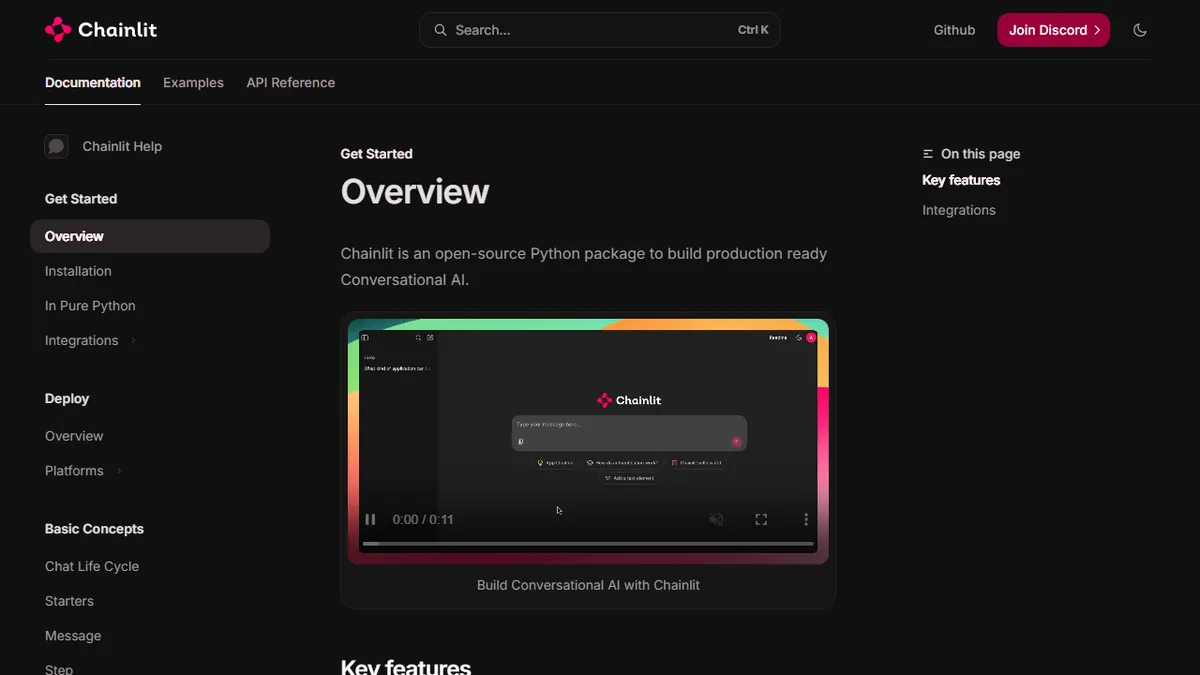
Chainlit is an open-source Python package that lets developers wrap any LLM, agent, or RAG pipeline in a polished chat UI without writing a line of frontend code. Decorate a Python function with @cl.on_message, return a response, and you get a streaming chat interface with multi-step reasoning visualization, file uploads, message history, and feedback collection out of the box.
It sits in the same niche as Gradio and Streamlit, but is purpose-built for conversational and agentic workloads rather than generic ML demos. Chainlit integrates natively with LangChain, LlamaIndex, OpenAI, Mistral, Haystack, and Semantic Kernel, and ships first-class support for enterprise auth (OAuth, header-based, password), data persistence layers, and human-in-the-loop feedback. It's the de-facto choice for teams who want a working internal chatbot demo on day one and a path to production by week two.
The framework itself is free and Apache-licensed; the optional Literal AI observability/analytics platform from the same team is the commercial upsell. Caveats: the UI is opinionated (you get the Chainlit look, with limited theming), and deep customization usually means dropping down to a custom React frontend talking to the Chainlit backend over websockets.
Chainlit is the shortest path from a working LangChain or LlamaIndex script to a chat app you can show stakeholders. It won't replace a bespoke React frontend for a consumer product, but for internal copilots and agent demos it's hard to beat. Pair it with Literal AI only if you actually need the observability.
— The AI Tool Bible editorial team
Pros
- ✅ Production-ready chat UI from a few lines of Python
- ✅ Native integrations with LangChain, LlamaIndex, OpenAI, Mistral
- ✅ Built-in multi-step reasoning visualization and feedback capture
- ✅ Enterprise auth and data persistence supported out of the box
- ✅ Apache-licensed and fully self-hostable
Cons
- ⚠️ UI is opinionated; deep theming requires a custom React frontend
- ⚠️ Python-only on the backend
- ⚠️ Smaller community than Streamlit/Gradio
Use cases
Frequently asked
- How does Chainlit simplify building chat interfaces?
- It lets developers wrap any LLM, agent, or RAG pipeline in a chat UI by decorating a Python function with @cl.on_message. This provides streaming, file uploads, and message history without writing frontend code.
- Which frameworks and models does Chainlit integrate with?
- Chainlit integrates natively with LangChain, LlamaIndex, OpenAI, Mistral, Haystack, and Semantic Kernel. It supports multi-model architectures and is designed for conversational and agentic workloads.
- Is Chainlit free to use?
- Yes, the framework is open-source under the Apache 2.0 license. There is an optional paid Literal AI observability tier, but the core framework is free and self-hostable.
- What are the limitations of using Chainlit?
- The UI is opinionated with limited theming options, and deep customization requires a custom React frontend. It is also Python-only on the backend, making it unsuitable for Node, Go, or Rust stacks.
Explore related
Compare with similar tools
All in Agents →LangGraph
FeaturedStateful, graph-based agent orchestration from LangChain.
CrewAI
FeaturedPython framework for multi-agent orchestration.
Ernie Bot
Baidu's Mandarin-first ChatGPT rival, powered by the ERNIE model family
Moveworks
The enterprise AI assistant that searches, answers, and takes action across your business systems
AWS Bedrock
Build and scale generative AI applications with foundation models
Claude Agent SDK
Anthropic's official SDK for building autonomous Claude agents.